Athanasius (196-373 AD) lived a long and varied life subject to philosophical, political, and theological controversies, violence, exile, and contentious relations with the most powerful rulers of his time, the Roman Emperors. Athanasius is well known for the Creed named for him formulated by his disciples after his death. Athanasius’s significance lies in his valiant defense of the Trinity at a time when this fundamental basis of Christian theology was under attack.
Athanasius was born in Alexandria, which was a center of violence, persecution, and civil conflict as well as one of the great cities of antiquity, a cosmopolitan center of learning and a growing center of Christian thought. Athanasius was of a well-to-do family; he benefitted from an excellent classical and Christian education. When Athanasius was growing up, the Roman Empire came under the control of an autocrat, Diocletian, succeeded by the first Christian emperor, Constantine, who used Christianity as a way to solidify his power. Even though Constantine’s Christianity was underdeveloped, as head of the state religion he mediated conflicts among Christians over doctrine. At the Council of Nicaea in 325, he heard the arguments of the Arians, that Christ was not co-eternal, not the same substance as God the Father, and the Nicaeans, who believed that the first chapter of John’s Gospel proved that Christ, the Logos, was co-eternal, and of the same substance (homoousios), as the Father and the Holy Spirit. Constantine supported the Nicaeans and repressed the Arians. According to the fifth-century historian Socrates Scholasticus, Athanasius was present at the Council of Nicaea as an aid and secretary to Bishop Alexander of Alexandria. Athanasius forcefully presented the arguments for the Trinity. Constantine supported those who believed in the concept of homoousios and he banished the Arians, but only briefly; thereafter, the emperor agreed to end the exile of Arius and his supporters. By this time Athanasius was Bishop of Alexandria and he refused to accept the Arians, arguing that once they had disowned Christ the Logos they could not be forgiven. This earned him the ire of the Arians, led by Eusebius, Bishop of Nicomedia, as well as the emperor, who forced Athanasius into exile.
When Arius died a horrible death in 336, according to Socrates Scholasticus, Constantine was reaffirmed in his Nicaean views. After Constantine died, the empire was left to his three sons: Constantine II, Constans, and Constantius II, who controlled the East, including Alexandria. Constantine and Constans supported their father’s Nicaean creed. Constantius supported the moderate Arian belief that Christ is like (Homoean) but not the same or equal to God.
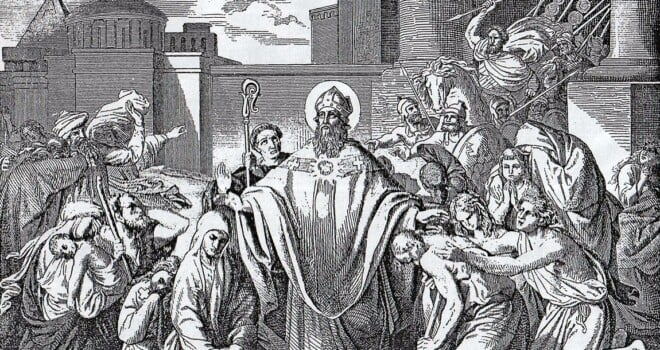
In the ensuing years, there was a fierce debate between Constantine II and Constans and the bishops of the West against Constantius II and the bishops of the East. In 338, Constantine II tried to re-invest Athanasius in Alexandria, but Constantius in turn deposed him—but only temporarily. Upon Athanasius’s return, his enemies renewed their attack. In the Council of Antioch of 341, dominated by Arians, Gregory of Cappadocia was appointed to the See at Alexandria. Five thousand soldiers accompanied the new Bishop Gregory to Alexandria, forcing Athanasius to flee. He journeyed to Rome and made his case to Pope Julius, who agreed that Athanasius had been wronged. Nevertheless, Athanasius was forced to spend many years in exile away from Alexandria. According to Sozomen, the fifth century author of Historia Ecclesiasticus, Constans supported Athanasius’s attempts to return to Alexandria, even threatening war, forcing Constantius to agree: Athanasius became Bishop of Alexandria again. Constantine II had already been defeated and killed by Constans; when Constans died in 350, Constantius II, as sole emperor of the Roman Empire, became more oppressive to the Nicaeans and their leader Athanasius.
During these years the Council of Arles in 353 and the Council of Milan in 355 renewed the condemnation against Athanasius, again forcing him into exile. But upon the death of Constantius II in 361, the Apostate Emperor Julian came to power. Julian’s rule was brief, followed by the Christian Jovian, similarly brief. Athanasius was in and out of exile during these years. As the recognized leader of the Nicaeans he bore the brunt of the Arian anger. He revealed during these many years resilience, faith in the midst of danger and scandal, and hope in the triumph of the will of God.
Today, we venerate this Doctor of the Church and most forceful proponent of Christ’s divinity and of the eternal Logos, who provides us with an example to fight for our beliefs in the face of ridicule, hatred, and violence. As the 21st century progresses, Christians will find, as in previous centuries, that we will have to rely on prayer, and the intercession of such saints as Athanasius, to support us in patience, perseverance, and suffering in the face of an increasingly atheistic world.
(This article first appeared in a modified form in the online journal, Catholic Exchange: https://catholicexchange.com/an-early-christian-saint-for-our-time-st-athanasius/

 The American Plutarch