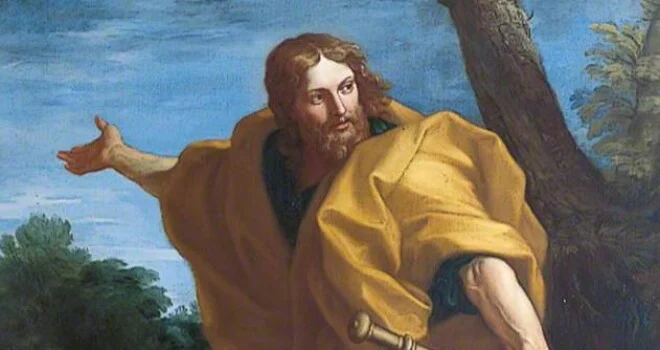
James the son of Zebedee and brother of John the Apostle was one of the first disciples of Jesus, was a fiery personality completely committed to the Great Commission, and was the first martyr of Jesus’ disciples.
The Gospels tell the story of an occasion of no clear time or place, perhaps at Capernaum on the Sea of Galilee, when and where Jesus was preaching to listeners from this town and others about the Kingdom of God. It was early in his ministry. Capernaum was a place of fishers, those who went out every day, or night, fishing the great freshwater lake. Among the listeners were two young men, James and John, the sons of a fisher named Zebedee. Jesus preached from a fishing boat owned by Simon Peter, who with his brother Andrew were engaged in the fishing business either alongside or as partners with the Zebedees. After Jesus spoke, he asked Peter to take the boat further out into the lake. Peter had spent some time with Jesus, even had had him at his house, and though the fishers had fished the previous night without success, Peter complied with Jesus’ request to take to the lake again to fish. The fishers lowered the nets and to their astonishment there was such a catch that it threatened the sturdiness of the nets, even threatening the stability of the boat. The Zebedee brothers witnessed the miracle and brought their boat alongside and lowered their nets, which filled with fish. Peter, afraid now, asked the Lord to depart. The Gospels do not record the reaction of the Zebedee brothers.
We can gather from their subsequent relationship with Jesus what might have been their response. One of the brothers, John, was closer to Jesus than his older brother James, and besides John outlived James by a good fifty years; he came to regard Jesus early on as the Christ, but more, the Wisdom of God, the Word, the Logos who was with God in the beginning. We might assume that his brother James had somewhat the same intuitive understanding.
Not only had James witnessed the miracle of the fish, but he was with Peter and John on the mount when Jesus was transfigured. He was with Jesus the many times that Jesus healed the physically and mentally ill. On one occasion at a synagogue a man possessed demanded what Jesus wanted from him, crying out that he knew Jesus was the “holy one of God.” James listened to the parables and sermons, hearing words so forcefully put, so astonishingly truthful, that he knew this person was the Christ.
James, along with his brother John, had learned that Jesus, a craftsman from Nazareth, knew people, each person, knew them entire, their past and future, their suspicions and problems. What is more, the miracle of the fish informed James that this man not only knew each human, but each creature as well: how else would he know where schools of fish were in the lake unless he knew each fish as an individual, as he knew each human as an individual? Thus did James and John discover that Jesus was not only the long-anticipated Messiah but the eternal spoken and written truth, the Logos, long talked about by Greek philosophers. Jesus was (is) God become flesh.
About the particulars of James’ life little is known. He is rarely mentioned in the Gospels, though his presence is implied in the major actions of Jesus’ ministry. His mother, according to Matthew (27: 56), was present at the crucifixion, as was his brother John, hence so too was James. Mark (15,40) says that James’ mother was Salome, wife of Zebedee. John (19, 25) implies that Salome was Mary’s sister, which if true, would mean that Jesus and James were cousins. Salome, if Jesus’ aunt, was sufficiently audacious to request of Jesus that her sons James and John be granted the privilege of sitting next to him in Heaven. Jesus responded that only if they could drink from his cup of suffering. That they were so willing explains Jesus’ nickname for the two brothers, the “Sons of Thunder.” That James was so fervent an apostle explains his early martyrdom.
James was executed in 44, Anno Domini, by Herod’s grandson Herod Antipas, who the Roman emperors Caligula and Claudius allowed to rule a huge amount of territory, including Judaea and Samaria. Antipas was obsequious to the Romans as well as the Jews, hence he was a persecutor of Christians, and for an unknown reason had James beheaded, as recorded in the Book of Acts (12,2).
Anecdotal evidence suggests that at some point between the Crucifixion and his own death James was an Apostle in Spain, and that his remains are at the Cathedral of Santiago de Compostela in northwestern Spain.
This article originally appeared in slightly modified form in Catholic Exchange: https://catholicexchange.com/st-james-son-of-thunder/

 The American Plutarch