
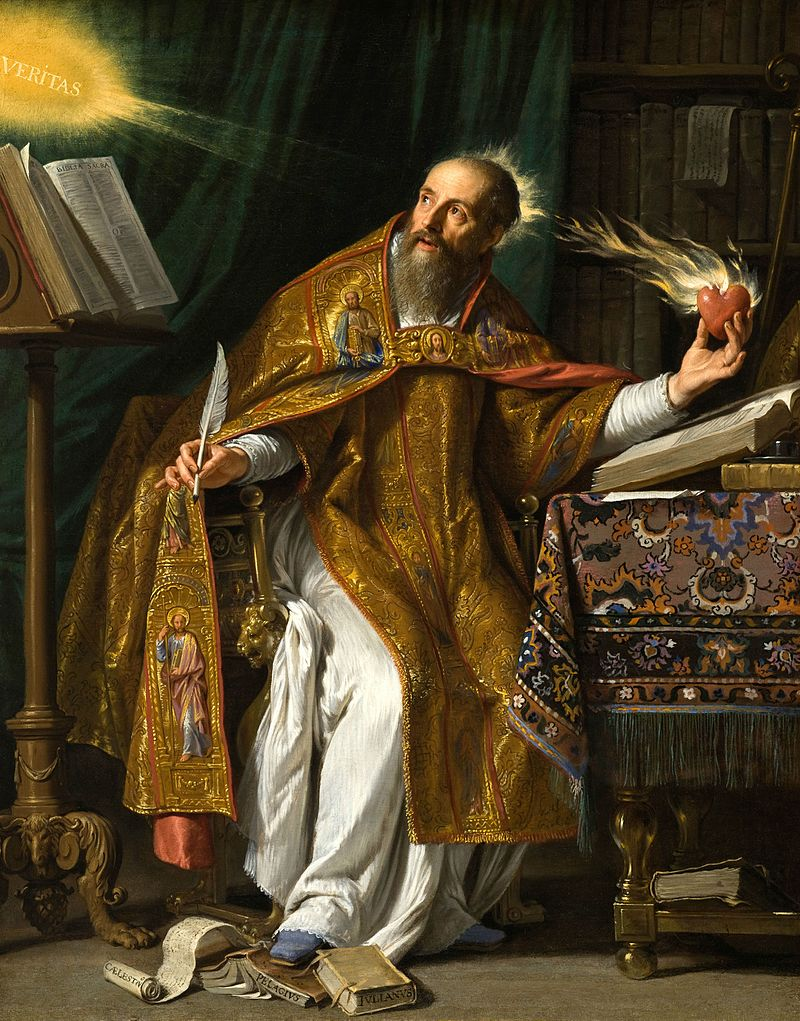
Providence, the will and presence of God in each moment, is never felt by some people, is felt in moments of joy or consternation by others, is sensed in the minutiae of nature by some, is a product of intense contemplation, a sudden epiphany, in others, is experienced in a dream by some, is sensed by intuitive awareness by others, is seen by some, and is heard by others. Aurelius Augustine, who became Bishop of Hippo, and after death a Saint and a Doctor of the Church, heard the voice of Providence during one intense moment in his life; what he heard during four seconds changed his life.
Aurelius Augustine (354-430 AD) used the story of life to discover what was universally true. Following upon John the Apostle, Augustine conceived of knowledge as a universal transcendent phenomenon understood at particular times and places by the individual knower. Augustine knew this relationship between himself the knower and Knowledge, God, because of “a voice” “within me” that “cries out” to “truth itself.” This personal, temporal realization of Knowledge is what John meant by the word (Logos). Augustine’s more complete portrait of the individual’s experience of the word, that is, Providence, is his Confessions.
Augustine was raised in North Africa near Carthage by a pagan father and Christian mother named Monica. Her son was an intelligent, precocious boy, a genius at rhetoric, but a sensualist as well. He often got into trouble growing up, at one point engaging in the wanton theft and destruction of an apple orchard. Monica meant him to be a Christian, but her son was not attracted to the stories of the Bible, which he found boring and ludicrous; instead, the great humanistic works of the Greeks and Romans interested him.
Augustine lived at a time during which Christianity was a little over three centuries old; it had not been that many years since Christians were mercilessly hunted and tortured by the Emperor Diocletian. Since Constantine’s conversion in 312, the Church had become more secure. Nevertheless paganism, the beliefs in the old Roman and Greeks gods, preoccupied the population more than the new religion, which was however making inroads. Near Eastern religions such as Mithraism and Manicheism were strong competitors with Christianity for the beliefs and loyalties of Romans. Greco-Roman philosophies, too, attracted the attention of the educated, such as the Agnostic Aurelius Augustine.
Augustine was as he grew up the typical Roman of his time. He was a sensualist, drinking and whoring, at the same time as he read deeply in the works of Latin writers such as Cicero, Virgil, and Horace. Cicero in particular attracted Augustine because of his eloquence, mastery of written and spoken Latin, Stoic philosophy, Republican politics, and sophisticated tastes. The extreme diversity of Roman culture, however, confused Augustine, as it did many others, and he engaged in a search by the time he was beginning to teach rhetoric at age twenty-one—the search to know what is true. There were so many different philosophies, mystery religions, and expressions of Christianity in the far-flung empire that encompassed western and southern Europe, north Africa, and the Near East, that Augustine was not alone in feeling confused, and confusion resulted in anxiety. For example, Augustine over the course of a decade or so studied Stoicism, the philosophy of Cicero and Seneca, Manicheism, an eastern philosophy developed by the mystic Mani, and Neoplatonism, a derivative of Plato’s thought developed by the philosopher Plotinus. Stoicism focused on the path to contentment by thought and controlling emotions; Manicheism focused on the path to spiritual enlightenment by controlling the bodily senses and dietary restrictions; and Neoplatonism focused on the path to uncovering the ultimate reality, the One, by a strict focus on the mind. As Augustine studied and taught rhetoric first in North Africa then in Milan, Italy, as he grew famous as a teacher and wealthy so that he could afford to indulge his senses in a variety of ways, he grew increasingly unhappy—and he did not know why he was so unhappy. Why did not success, fame, wealth, a great mind, a great career, lead to happiness? What was the source of happiness?
Living in Milan, Augustine’s mother Monica came to join him, as she was concerned about his anxiety and unhappiness, and she knew that the answer was Christianity. She encouraged Augustine to go to the cathedral to listen to the sermons of Bishop Ambrose. In doing so, Augustine developed a new appreciation for the Bible, especially the writings of St. Paul. He found in Paul’s Epistles a mind like his own, searching for truth even while experiencing anxiety and doubt. But Paul found the truth, the discovery of which eluded Augustine. He grew more restive as his unhappiness grew, and his attempts to alleviate it by drink, sex, philosophy, and work, failed. At a point of crisis, visiting a friend, while in the garden of the friend’s house, Augustine suffered a breakdown. He began to cry uncontrollably that he did not know what is the correct path, how to achieve contentment. Then he heard a voice. “Take if and read . . . Take it and read.” He stopped, listening. Were there children nearby? No. Whose voice did he hear? Was it the wind, his imagination, his nerves speaking? No, it was real, it was an auditory event. But who spoke to him? Augustine had been reading Paul’s Epistles, and a copy of the book was nearby. He thought that he was being beckoned to take the book and read from it. He did: “Not in reveling and drunkenness, not in debauchery and licentiousness, not in quarreling and jealousy. But put on the Lord Jesus Christ, and make no provision for the flesh, to gratify its desires.”
The words were directed toward him and his emotional quandary. He knew. A child’s voice had told him to read the solution that he was searching for so vehemently. Put on the Lord Jesus Christ. Who could have spoken to him but the Lord? It was a child’s voice, yes, a voice of innocence, but a voice of command. Do this, and ye shall be saved, the voice said to him in so many words. In the space of four seconds on a given afternoon in the year 386, God intervened in time to speak His will to Aurelius Augustine. Four seconds of the experience of Providence had saved a disturbed and sorrowful man.
It was a new birth. Shortly thereafter, he was baptized; he joined the Church and put as much energy into his work as he had before in ruminating, doubting, searching, and hungering. He became a priest and then a bishop, all the while thinking of what happened to him, the four seconds that changed him. Knowing the miracle that occurred to an unrepentant sinner, he decided to put into words what had happened to him. The result was The Confessions, completed in 398. What fascinated him the most was how Providence could act in just a moment of time to affect the whole of time. In that four seconds God spoke to his previous thirty-two years of anguish and searching, bringing to an end the moment by moment despair, after which providential moment the future was secured for him. This must be the nature of God, he thought. God is wisdom, intellect, spoken and written truth, creator of all, including time, hence outside of time yet interacting in time. God sees all simultaneously, knows past, present, future, and intervenes at will. He intervened in Augustine’s life at a point when Augustine was ready, when Augustine would hear and respond, realize God’s love and return love to God and His creation.
A life in search of contentment found it. As he wrote in Confessions, “Surely happiness is what everyone wants, so much so that there can be none who do not want it.” Augustine believed that all people know what happiness is because they at one point or another have experienced it. At each moment one yearns for happiness because one has a memory of its experience. What, then, is this experience of happiness? Augustine argued that this experience of God, however fleeting, is the experience of happiness. “True happiness is to rejoice in the truth, for to rejoice in the truth is to rejoice in you, O God.” But how can humans, ignorant because they live in time, know what is timeless, the truth? One’s mind must “be seized and held steady,” Augustine wrote, “for that short moment” so to “glimpse the splendour of eternity which is for ever still.” Time on the other hand “is never still.” God alone is still.
(Quotes from Augustine, Confessions, trans. R. S. Pine-Coffin (Penguin Books, 1961) and Wippel and Wolter, Medieval Philosophy (New York: Free Press, 1969).)
A version of this essay appeared in Catholic Exchange

 The American Plutarch