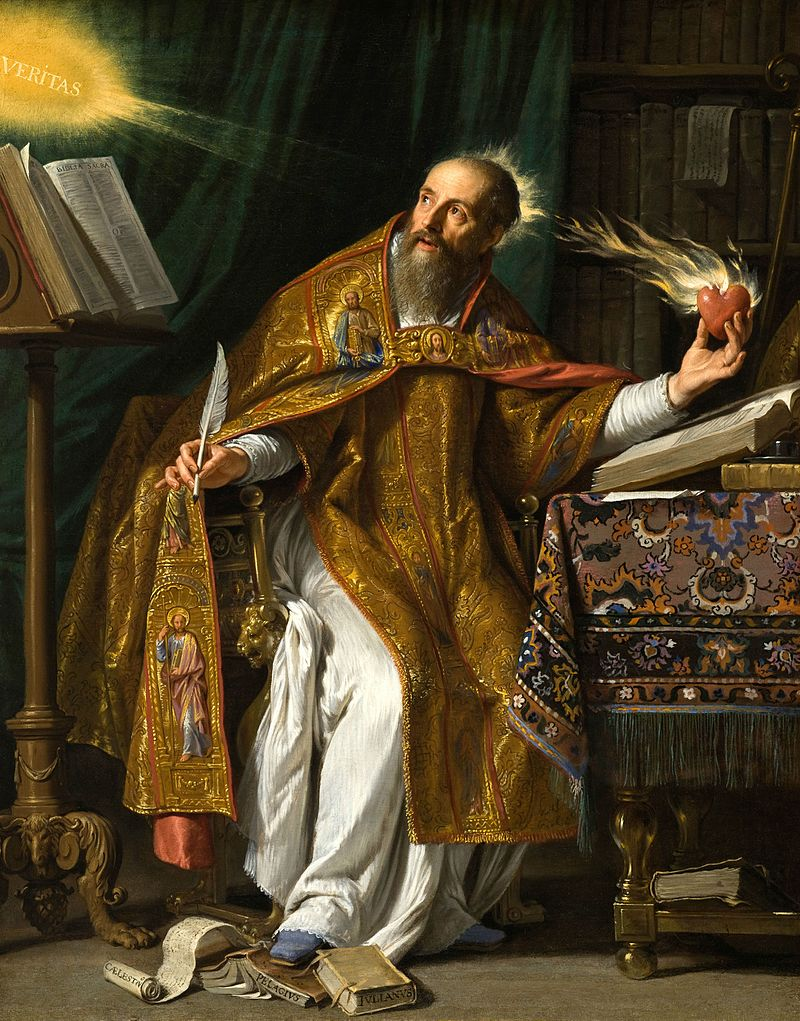
Augustine, a convert to Christianity who had experienced four seconds of providence in 386 AD, who had become Bishop of Hippo in Africa in 397, who had written an account of his life, Confessions, in 392, who heard as all Romans had of the disaster of the Eternal City falling to Alaric the Goth in 410, who watched as Germanic tribes were overrunning the western empire and the Vandals after 409 were sweeping through Spain into North Africa and approaching Augustine’s diocese of Hippo, who grew old and was facing death in the 420s, was at peace. Knowing that the will of God is behind all things brought him peace.
But who has peace today? Our world is in love with disasters. The news, social media, blockbuster movies feed on the fear people have in the twenty-first century that a disaster–an F-5 tornado, category 5 hurricane, tsunami, terrorist attack, random shooting, nuclear war—will lead to destruction, chaos, death. The end of time. Few of us actually experience such disasters. But the people of the Roman Empire during Augustine’s time did. For the Romans, Rome was civilization. What would succeed civilization but barbarism, evil, and death? But why was this happening? Romans asked, why have the gods forsaken us? And some answered: it is the Christians, who have denied Jupiter, Juno, Apollo, and the rest, and focused on only one god. The gods—Neptune, Venus, Athena—are punishing us, and Rome is doomed. Augustine knew differently. “God’s providence constantly uses war to correct and chasten the corrupt morals of mankind,” he wrote in 426 in his masterpiece, The City of God.
God is behind all earthly events. Providence is eternally active in the affairs of humans, animals, the universe, nature, all things. Such is the thesis of The City of God. Rome falls not because of the anger of the gods but because the one true God wills it. Humans die not because of something they have done but because the one true God wills it. All things, all corporeal life, come to an end. The works of humans, notwithstanding the wonders of architecture, the power of modern technology, will be destroyed in time. But we ask, as did the Romans, why? Why must bad things such as suffering and death happen to the good, the innocent?
The City of God is a deep and complex book, but there is a reason why people have for fourteen hundred years, and still do, read it. In its depth is a simple primer of providence. Pope John Paul II during his papacy wrote extensively on suffering and its validity for Christians; in his works he was echoing the theme of The City of God. Augustine wrote succinctly, God “has willed that these temporal goods and temporal evils should befall good and bad alike, so that the good things should not be too eagerly coveted, when it is seen that the wicked also enjoy them, and that the evils should not be discreditably shunned, when it is apparent that the good are often afflicted with them.” Remember, he declared, that humans are conceived in sin; the good and bad are both punished not because they are equal but because both love temporal existence and must be chastened. Who can argue against this when Christ Himself taught the same lessons? Moths might destroy our finest dresses, our designer suits, but they cannot touch our souls. Augustine throughout his book condemns pagans for doing every kind of hedonistic vice there is, and such hedonism is what led to the destruction of Rome. Hence such hedonism, it is implied, necessitated the coming of Christ the redeemer.
In theory this makes sense, but then we see what the powerful can do, see the privileges of wealth, see the fame that money and power bring, while most of us live our anonymous lives in obscurity. Just think if I was an Instagram influencer or had my own Youtube Channel! Providence is the great equalizer. The great, the rich, the famous, begin to lose hair, develop arthritis in their joints, suffer incontinence and develop cataracts, then the slow painful march towards the end occurs demanding such patience, such faith! God “gives earthly dominion both to good men and to evil . . . in accordance with the order of events in history, an order completely hidden from us, but perfectly known to God himself.” This is why Augustine was at peace. He knew that God was in control, that God is good, that evil is but a departure from ultimate good, thus suffering and death are ultimately, Good.
The skeptic then asks, with good reason: “So are we therefore mere puppets on a string?” Philosophers for millennia have debated the issue of fate and will. One of Augustine’s favorite writers, Cicero, believed that the gods cannot have ultimate control over the future because this would limit free will—and no good Roman would want to admit that he or she was not in charge of their own thoughts and behavior. It is the issue of foreknowledge, which Martin Luther wrote extensively about in the sixteenth century. If God know all things, all events, even those in the future, then by knowing God is willing. No, not right, responded Augustine. God knows “all things before they happen and . . . leaves nothing unordered. From him come all powers, but not all wills.” What does this mean? “We are not afraid that what we do by an act of will may not be a voluntary act, because God, with his infallible prescience, knew that we should do it.”
God does not conform to the either/or: Either God is in control or we are in control. God is in control and we are in control of our own actions–but God knows our actions even before we do them. This was David’s message in Psalm 139. God in His great love will not abandon us to our own ways. Augustine, in the Confessions as well as The City of God, examines the intricacies of Providence per the nature of time. Following St. John, God is the creator of time, and as the creator is not bound by time—He is time. God creates beginning and end simultaneously. God sees past, present, future simultaneously. The son, the Logos, is with God in the beginning, appears in His creation, time, at the Incarnation, leaves His creation, time, at the ascension, and interacts with time as the Holy Spirit until the end. God sees all simultaneously, hence knows all simultaneously. But such is His great love for His creation, His creatures, that He allows them to live in time making their own decisions, sometimes succeeding, sometimes failing, sometimes living, sometimes dying. But they live and die in the presence of Love, as John so eloquently expressed. God showers Love upon His creatures, and bids them to respond to Him in love. To respond to God in Love is to meet and fulfill what He has providentially determined. To deny God’s love, to distance oneself from God, is to deny His will, His providence, and doom oneself to the consequences of not fulfilling God’s will. God knows the choices we make, has foreseen them, but does not change them, does not pull us back from walking in front of the bus. Rather, walking in front of the bus might be exactly what He wills, in His love, and has foreseen.
But wait! What then is the efficacy of prayer? Augustine wrote: “Prayers are effectual in obtaining all that God foreknew that he would grant in answer to them.” So we are praying for something that God already knows what the conclusion is? “The fact that God foreknew that a man would sin does not make a man sin; on the contrary, it cannot be doubted that it is the man himself who sins just because he whose prescience cannot be mistaken has foreseen that the man himself would sin. A man does not sin unless he wills to sin; and if he had willed not to sin, then God would have foreseen that refusal.”
So yes, humans have free will. Our father knows what we have done, are doing, and will do, and in His Love He has directed us, through His councils, through His scripture, through His church, as to how we should choose to act. If we act according to the ways of God then we are more apt to conform to God’s will, what God wishes us to do through His love. The basic rule, Augustine taught, is simple: Do what Love tells us to do. Do unto others what we would have them do unto us. As Jesus taught, “Thy kingdom come, Thy will be done”—if we hallow God’s name and act in Love toward God His will will indeed be done.

 The American Plutarch