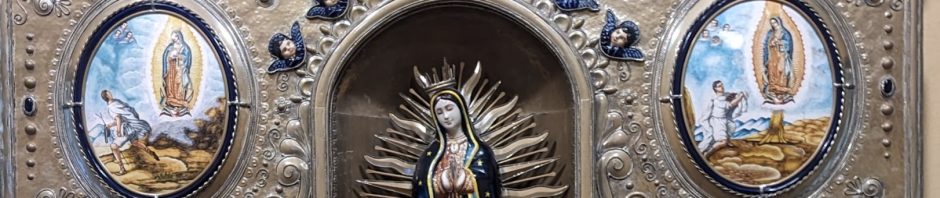
In 1759 in the coolness of an October morning just before dawn in the forest of southern Quebec, English soldiers stealthily crept up to a sleeping Algonquin village. On a signal from their commander, Robert Rogers, his men, the Rangers, attacked the sleepers in their wigwams. The Rangers descended upon one hut, servicing as a Roman Catholic Church, with an altar decorated with silver candlesticks and a silver image of the Virgin Mary. They stole the silver and set the church on fire; the missionary serving the Algonquins was martyred, perishing in the flames. The Rangers took their loot and fled. Algonquin warriors soon pursued the fleeing Rangers, who were weighed down by the silver, so buried it. The Silver Virgin has never been found.
One might question why a silver statue of the Virgin Mary was gracing an altar of a primitive wigwam church in the forest of southern Quebec. In fact, throughout North America there were similar primitive churches in Indian villages with images of the Virgin, dedicated to the Immaculate Conception, where Indians, led by a missionary priest, said Mass, and venerated the Mother and Child. How did this come to be?
Beginning with Columbus’ first voyage in 1492, the Spanish brought with them to America a belief in the Virgin Mary. Columbus named his flagship Santa Maria de la Inmaculada Concepción. Columbus’ favorite prayer was Jesus cum Maria sit nobis in via, “may Jesus with Mary be with us on the way.” Subsequent missionaries brought Christ as well as His Mother to the indigenous people, converting them, teaching them how to pray, bringing the Sacraments to these neophytes.
Then, in December, 1531, something miraculous happened. The Virgin Mary appeared to a simple Aztec Indian named Cuauhtlatohuac.
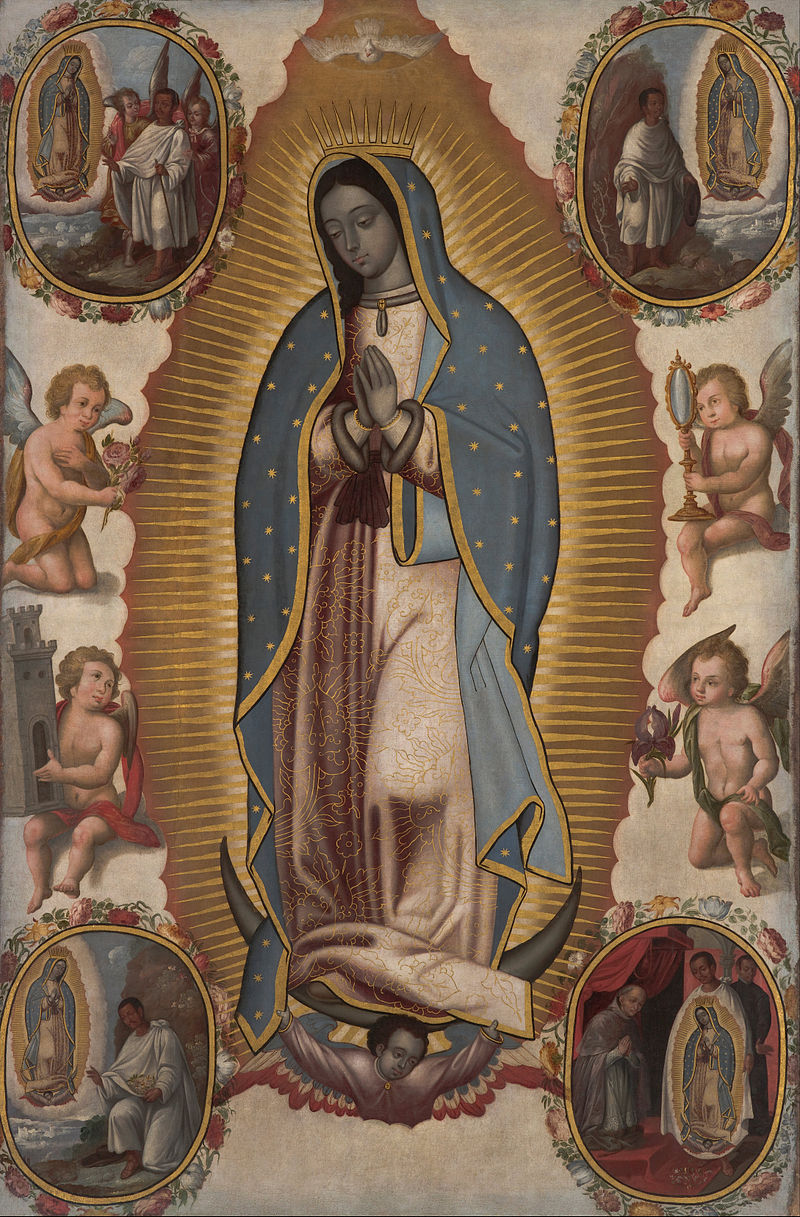
We have all been there. It is a situation in which something occurs, some feeling or intuition or thought, some presence. We are taught to be incredulous, to doubt, to not allow the mind to see something, or hear something, or feel something out of the ordinary. Juan de Zumárraga, an educated Franciscan and bishop of Mexico in 1531, was like this. He believed in the Trinity, in the Sacraments, and had faith, but he was impatient with superstition, with storytelling of this or that miracle. Such is the reason that he was skeptical when an Aztec Indian named Juan Diego approached him with a story of an apparition that he had witnessed, a young woman dressed as an Aztec maiden speaking the indigenous language, Nahuatl, who told him: “Know, know for sure, my dearest and youngest son, that I am the perfect ever Virgin Holy Mary, mother of the one great God of truth who gives us life, the Inventor and Creator of people. . . . I want very much that they build my sacred little house here. In which I will show Him, I will exalt Him, and make Him manifest: I will give Him to the people in all my personal love, in my compassionate gaze, in my help, in my salvation.”
It is not that Bishop Zumárraga doubted the existence of the Virgin Mother of God, or that she might appear or speak to a human, but to appear on a hill outside of Mexico City dressed as an Aztec maiden speaking the indigenous language to a peasant, albeit a Roman Catholic Indian convert, was a bit too much to swallow.
Likewise we might have the same approach to a calling, a feeling, a thought that seems to be from God, and we might doubt that Christ or His Mother would approach us, an individual alone, that the divine is present now, in this moment, reaching out to you, that His will is touching you, asking you to listen and obey.
Bishop Zumárraga naturally told Juan Diego to be a bit more specific and precise, and bring some evidence besides his apparent oversized imagination, before he could seriously give credence to the story, and consider building of all things, a church on a hill.
Juan Diego obediently returned and again saw the apparition of the Virgin. He told her of the Bishop’s incredulity. He suggested that a more important person than a humble peasant approach the Bishop. She responded: “Listen, my youngest and dearest son, know for sure that I have no lack of servants, of messengers, to whom I can give the task of carrying my breath, my word, so that they carry out my will; but it is very necessary that you, personally, go and plead, that my wish, my will, become a reality, be carried out through your intercession.”
God’s providence is the great equalizer. Even a nobody might be given a divine task. Juan Diego could not but obey, so he returned to the bishop, and made the request again. The bishop was unmoved. There must be something concrete, something that Juan Diego could show, to convince the skeptical Zumárraga.
Juan Diego, embarrassed, tried to avoid the Virgin, but she found him, and realizing that her word was insufficient, that there must be had concrete proof, she asked him to gather flowers in bloom, even in December, put them inside his cloak, his tilma, and take them to the bishop. Juan Diego did, and when he opened his tilma to the bishop, replacing the flowers was the beautiful image of the Virgin of Guadalupe that still exists in Mexico City. With such proof the bishop believed.
Blessed are those who have not seen yet still believe. The Virgin had informed Juan Diego that “I am truly your compassionate mother, yours and of all the people who live together in this land.” Recognizing this proclamation regarding the Americas, bishops in the United States in 1846 proclaimed Mary as the Immaculate Conception the Patroness of America. Reading her words to Juan Diego literally, she informs us that she represents her Son, her actions in time makes Him “manifest,” a word that has a sense of urgency and truth, that calls out to us to look here and see the Lord, see the Truth, see He through Whom all things are made. Mary informed us, just thirty-nine years after the coming of Columbus to America, that this continent is Christ’s, and through Him, Her’s as well, that knowledge and worship of Him will be spread, initially in Her church on Tepeyac Hill, subsequently throughout the continents to north and south, and people will come to know the presence of God, His will, and that He reigns.
After the appearance of Our Lady of Guadalupe, the veneration for Mary proliferated. A cult dedicated to Our Lady developed soon after. Seventeenth-century historian Fernando de Alba Ixtlilxochitl wrote that when the indigenous people “heard that the Holy Mother of Our Lord Jesus Christ had appeared, and since they saw and admired her most perfect Image, which has no human art, their eyes were opened as if suddenly day had dawned for them.” An early Franciscan missionary in Texas, Fray Marcos de Niza, approached the Tejas Indians “singing the Litany of Our Lady” carrying “in front a picture on linen of the Blessed Virgin.” Seventeenth-century French missionary Gabriel Druillettes experienced a miracle when the Virgin healed his blindness. The first Ursulines arrived in America after St. Marie de L’Incarnation had a dream of the Virgin telling her, to Canada “thou must go and build there a house to Jesus and Mary.”
One of the impediments to the conversion of the first ordained priest in the United States, John Thayer, had been the veneration of the Virgin, which Protestants derided as fantastic, comparable to children believing in ghosts. But Thayer came to realize “that it was profitable to employ with the Son, the intercession of his holy Mother, and that far from doing an injury by honoring and loving her whom he had so tenderly loved himself, it was the mean[s] of honoring him the more.”
The presence of the Mother of God is now, in the moment, interceding with and for the Son, but more, enacting the will of God, an instrument of Providence—indeed, the Mother of Providence.

 The American Plutarch