Captain John Smith was arguably the greatest of the English explorers, discoverers, and colonists of America. He was as well the first American historian. His human and natural histories include: A True Relation of Such Occurrences and Accidents of Noate as Hath Hapned in Virginia Since the First Planting of that Collony, published in 1608; A Map of Virginia, published in 1612; the Description of New England, published in 1616; New Englands Trials, published in 1620; The True Travels, published in 1629; the Advertisements for the Unexperienced Planters of New England, published in 1631; and his most ambitious effort, The General Historie of Virginia, New England, and the Summer Isles, published in 1624. The General History has quite a story to tell, of journeys and battles, of harrowing escapes from enemies intent on torturing their captives, of explorers penetrating lands and waters hitherto unseen by Europeans, of dramatic episodes involving the American Indians. With so many possible themes—of adventure, romance, discovery—with which to open his book, it is instructive to see how Smith chose to open his General History. The first paragraph reads:
“This plaine History humbly sheweth the truth; that our most royall King James hath place and opportunitie to inlarge his ancient Dominions without wronging any; (which is a condition most agreeable to his most just and pious resolutions:) and the Prince his Highness may see where to plant new Colonies. The gaining Provinces addeth to the Kings Crown: but the reducing Heathen people to civilitie and true Religion, bringeth honour to the King of Heaven.”[1]
Contained in this first paragraph of the General History are the three fundamental assumptions that guided the life and activities of John Smith, and indeed of all the English explorers who journeyed to America in the late sixteenth and early seventeenth centuries, during the Elizabeth and Jacobean ages. Smith identified himself, as well as the English, as a conqueror, a colonizer, and a commissioner: a conqueror who will “reduce heathen people,” a colonizer who will “plant new colonies,” and a commissioner who will “bringeth honour to the King of Heaven.” Further, conquest, colonization, and commission are “just and pious” works that, rather than “wronging any,” will bring “civilitie and true Religion.” Smith argued, in short, that the work of conquest and colonization is the work of the Great Commission, which was the commandment that Jesus gave to his disciples, as recorded in the Gospels, to go, and spread the Gospel to all nations. God directs the English to conquer and colonize a land already inhabited. But in so doing they do not wrong anyone because in carrying out the Great Commission they are carrying out God’s will, which cannot be wrong or evil. God’s will is that the English spread the Gospel to people hitherto ignorant of Christ, thereby bringing Good News of peace, happiness, love, and life to a people, it was presumed, who do not have them, and bringing as well a new culture, a civilization that far surpasses the silvan culture of the American Indian. Smith’s assumption, like those of his contemporaries in Jacobean England, was that civilizing a people goes hand in hand with Christianizing a people.
To use civilization and conversion as the ultimate ends to justify conquest and colonization seems disingenuous to say the least, a crass example of an expedient moral system that defends evil because it results in an ultimate good. Forcing others to convert to Christianity was not Smith’s style, and English discoverers anyway tended not to force religion down the throats of disbelieving Indians. Even so, it often appears that, of the three apparent reasons for European colonization, God, Glory, and Gold, God was least important, mere window-dressing, something that sounded good in theory but was in reality little practiced.
If, however, we allow the words of the English to explain their motives and assumptions, and refrain from judging not lest we be judged, we find that the narratives of English colonization repeatedly cite the Great Commission as the ultimate end for the means of conquest and colonization.
Captain Smith was not, of course, ordained and commissioned by the Anglican or any other Church to spread the Gospel according to the tenets of the Great Commission. But Smith did believe that Jesus’s commandment to his disciples to go, and spread the Gospel to all nations, applied to English colonizing efforts. Smith was, we might say, an ad hoc commissioner who, because of his Anglican beliefs, felt compelled not only to journey to America and colonize the land, but to do so because the Great Commission commanded it, and, as a consequence, to bring knowledge of the teachings of Christ to the American Indians. Smith was joined in this endeavor by other explorers, colonizers, and scientists, such as the voyagers who founded Roanoke in the 1580s, and the men of the Martin Frobisher, Humfrey Gilbert, and George Waymouth voyages. Smith is the best known of the early American explorers, and a person that on the surface would not appear to be inclined toward the concerns of the missionary to spread the knowledge of Christianity to others. But the Anglican worldview had quite an impact on Smith, and he responded with a strong sense of the importance of the Great Commission in the work of colonization.
During Smith’s time, scholars and theologians took the words of the Great Commission literally, at face value. Jesus’s Commission required commissioners who were willing to travel, explore, discover, and engage the peoples and places of hitherto unknown lands. Commissioners spread the word to an unknown people in an unknown world of unknown geography, flora, fauna, and natural history. Some were commissioned by monastic orders or church agencies. Others were ad hoc, commissioners who in the process of exploring, discovering, fighting, investigating, and studying also spread the teachings of Jesus.
The Church of England was involved in the Great Commission from the true beginning of English activities in North America under Queen Elizabeth I. The Church commissioned some missionaries to go to America in an official capacity; yet many other missionaries were self-appointed, commissioners simply because they were Anglicans. Martin Frobisher, for example, soldier and adventurer, made three voyages to North America in the 1570s seeking the Northwest Passage. He made contact, and had pitched battles, with the native Inuit people. One contemporary account of his second, 1577, voyage, explained that Frobisher and his men sought, “that by our Christian study and endeavour, those barbarous people trained up in paganism, and infidelity, might be reduced to the knowledge of true religion, and to the hope of salvation in Christ our Redeemer.” The ordained agent in this goal of spreading the Christian message was Robert Wolfall, an Anglican priest, who was chaplain and missionary with the Frobisher voyage to Canada in 1578. Wolfall, according to contemporary chronicler Richard Hakluyt, “being well seated and settled at home in his owne countrey, with a good and large living, having a good, honest woman to wife, and very towardly children, being of good reputation amongst the best, refused not to take in hand this paineful voyage, for the onely care he had to save soules and to reforme these infidels, if it were possible, to Christianitie.” Wolfull was busy on the voyage with homilies, prayers, and communion: “Wolfall,” Hakluyt wrote, “made sermons, and celebrated the Communion at sundry other times in severall and sundry ships, because the whole company could never meet together at any one place.” There is no record that Wolfull actually converted any of the Inuit to Christianity, though he did counsel Frobisher’s men and performed the “divine mystery” for the crew.[2]
Wolfull was by and large a chaplain, and the relations between the English and the Inuit were more of conflict than peace. A decade later, however, in another part of North America, another commissioner, not ordained but ad hoc, had friendlier relations with the Native peoples, and enjoyed more positive results. Scientist Thomas Hariot accompanied the Grenville voyage, sponsored by Walter Raleigh, to Roanoke Island, off the coast of North Carolina, in 1585. Hariot wrote A Briefe and True Report of the New Found Land of Virginia, of the Commodities and of the Nature and Manners of the Naturall Inhabitants: Discouered bÿ the English Colony there seated by Sir Richard Greinuile Knight In the yeere 1585. Hariot was a naturalist and mathematician, a learned man who communicated, through interpreters, with the native Algonquians about their religious beliefs and tried to impart his knowledge of Anglicanism in turn. He described the Indians as intelligent, having an anthropomorphic and a polytheistic system, including a belief in Heaven and Hell. They were, he wrote, quick to abandon their beliefs in the face of more compelling ideas. Christianity and the Bible fascinated them. “Through conversing with us,” Hariot wrote, “they were brought into great doubts of their owne [religion], and no small admiration of ours, with earnest desire in many, to learne more than we had meanes for want of perfect utterance in their language to expresse.” Hariot, not a priest but devoted to the Great Commission, wrote that “manie times and in every towne where I came, according as I was able, I made declaration of the contentes of the Bible; that therein was set foorth the true and onelie GOD, and his mightie woorkes, that therein was contayned the true doctrine of salvation through Christ, which manie particularities of Miracles and chiefe poyntes of religion, as I was able then to utter, and thought fitte for the time. And although I told them the booke materially & of itself was not of anie such vertue, as I thought they did conceive, but onely the doctrine therein contained; yet would many be glad to touch it, to embrace it, to kisse it, to hold it to their brests and heades, and stroke over all their bodie with it; to shew their hungrie desire of that knowledge which was spoken of.”[3]
Hariot believed that the Indians were attracted to Christianity in part because English science and technology so impressed them that they admired all of the possessions and beliefs of the English. That the Indians succumbed to diseases of which the English appeared to be immune was also impressive. The chief “called ‘Wingina’, and many of his people would be glad many times to be with us at our praiers, and many times call upon us both in his owne towne, as also in others whither he sometimes accompanied us, to pray and sing Psalmes; hoping thereby to bee partaker in the same effectes which wee by that meanes also expected.”[4]
Hariot’s Briefe and True Report implies the interaction of two cultures imparting godly knowledge, one to the other. Of course, one was attempting to colonize, to discover, to exploit, while the other was attempting to survive and thrive in a place they already possessed. During the reign of Elizabeth, the English turned from exploration to colonization, from bringing the Gospel to pagan peoples during voyages of discovery to settling among them and Christianizing them. Such a process was marred by sin. The promoter of colonization and Anglican priest Richard Hakluyt wrote in the Principal Navigations, Voyages, Traffiques and Discoveries of the English Nation that the English failed to establish the colony at Roanoke because they were driven away by “the hand of God,” which “came upon them for the cruelty and outrages committed by some of them against the native inhabitants of that country.”[5]
Such was the typical response of an Elizabethan Christian who believed in God’s active Providence. Failure was obviously a product of God’s will, and failure could best be explained by sin. Hakluyt’s comment implied a larger question: Was it valid to conquer, colonize, and bring the Great Commission to the indigenous inhabitants of America?
The English, and Captain John Smith, answered in the affirmative, in part because the Elizabethan and Jacobean English believed that England was an Elect nation, in part because of their tremendous sense of God’s Providence at work in their own lives and in the world at large. The English Reformation and founding of the Church of England under Henry VIII, its repression under Mary Tudor, and growth under Elizabeth I, had convinced many English that God particularly blessed England, which would carry out His will. God’s providential role in English voyages of discovery and the English assumption that the Great Commission was of necessity the driver of such voyages can be seen in many of the narratives of voyages of discovery from that time. Edward Hayes, for example, who wrote the account of the 1583 voyage of Sir Humphrey Gilbert, argued that planting “the seed of Christian religion . . . must be the chiefe intent of such as shall make any attempt that way”–”whatsoever is builded upon other foundation shall never obtaine happy successe nor continuance.” He admonished adventurers who prosecuted such voyages to beware such journeys for material rather than spiritual gain. Hayes associated the fulfillment of the Great Commission to all corners of the world with the Second Coming of Christ; hence he believed that God had chosen the Elizabethan age as the time to begin to prosecute the Commission in earnest. Likewise a contemporary of Smith, James Rosier, who voyaged with and penned accounts of the journeys of Bartholomew Gosnold and George Waymouth, wrote of the ultimate goal of the Waymouth voyage: “a publique good, and true zeale of promulgating Gods holy Church, by planting Christianity, [was] the sole intent of the Honourable setters foorth of this discovery.”[6]
Smith’s actions and writings reveal that he agreed that England, the Elect Nation, had a particular role to play in the Great Commission of converting a people ignorant of Christ. He defended the English conquest and colonization of America in his book Advertisements for the Unexperienced Planters of New England: “Many good religious devout men,” Smith wrote, “have made it a great question, as a matter in conscience, by what warrant they might goe to possesse those Countries, which are none of theirs, but the poore Salvages. Which poore curiosity will answer it selfe; for God did make the world to be inhabited with mankind, and to have his name knowne to all Nations, and from generation to generation: as the people increased they dispersed themselves into such Countries as they found most convenient.”[7] To Smith, the Great Commission is a historical plan, a commandment of the past guiding people in the present and into the future. Jesus came to earth when the population was not great enough, at that time in the first century, to spread the message of the Gospel to all people. But as time passes and the world’s population increases—and England’s population increases—people have the human and material resources to carry out the Commission. The English colonization of America is therefore part of a great plan. Not to journey to other lands, not to extend the Gospel to other peoples, is to disobey God, indeed to reject God’s plan for history, which in Smith’s time was an even greater sin that using intimidation and violence by which to bring about God’s will.
Part of God’s historical plan is civilizing the human race. Smith wrote, in Advertisements for the Unexperienced Planters of New England, that, “had the seed of Abraham, our Saviour Christ Jesus and his Apostles, exposed themselves to no more dangers to plant the gospell wee so much professe, than we, even we our selves had at this present beene as Salvages, and as miserable as the most barbarous Salvage, yet uncivilized.”[8] It took the courage of other great men, sojourners like Abraham and the Son of Man himself, Jesus, to conform to God’s plan in the face of great danger, even death. Smith and his contemporaries, such as the French explorer and colonizer Samuel Champlain, referred to the Indians as salvages, which appears on the surface to be a a misspelling or inaccurate transliteration of savages. Salvage is, rather, a rendering from the Latin, silva, referring to those who live in the forest.[9] Forest-dwellers rather than city-dwellers will be less sophisticated, lacking accoutrements of civilization such as literacy and metallurgy. Forest-dwellers are not necessarily savage, though Smith was not afraid to use that word; but he more often described the Indians by the less judgmental salvages. He believed that God’s plan, the Great Commission, aims to bring salvages from their ignorant state of pastoral simplicity into a civilized world, the world, that is, of the English and other Christians. God of course first brought knowledge of His Son to the civilized Roman Empire, to the sophisticated Jews. From here, over the centuries, Christianity spread outward to less civilized peoples in northern and eastern Europe, Africa, and Asia; now, in the early seventeenth century, Christianity was spreading to the uncivilized salvages of America.
How actively involved was Smith himself in bringing the Gospel to the Indians? There are many examples in Smith’s writings of his attempts to convince the American Indians of the truth of the Christian God. “Our order was daily to have Prayer,” he wrote, “with a Psalme, at which solemnitie the poore Salvages much wondered.” “To divert them from . . . [their] blind Idolatry,” Smith and his companions “did our best endevours, chiefly with the Werowance of Quiyoughcohanock [Popohanock], whose devotion, apprehension, and good disposition, much exceeded any in those Countries, with whom although we could not as yet prevaile, to God as much exceeded theirs, as our Gunnes did their Bowes & Arrowes, and many times did send to me to James Towne, intreating me to pray to my God for raine, for their Gods would not send them any. And in this lamentable ignorance doe these poore soules sacrifice themselves to the Devill, not knowing their Creator; and we had not language sufficient, so plainly to expresse it as make them understand it; which God grant they may.” Smith believed that his words and actions illustrated the power of God in his life, as he wrote “That God that created all things they knew he [Smith] adored for his God: they would also in their discourses terme the God of Captaine Smith. ‘Thus the Almightie was the bringer on, The guide, path, terme, all which was God alone’.”[10]
Smith never felt that the Indians showed aggression as a counter to the Great Commission. In Advertisements he explained that the Indian attack on Jamestown in 1622 did not occur because the Virginians were Christian; rather, the Indians wanted to plunder the accoutrements of white civilization. Indians would kill to acquire and steal, but not to counter Christianity. Indeed, he wrote, the Indians were attracted to white civilization. Smith implied that to bring Christianity to the Indians was warranted because it did not repel them and they would not kill because of it.????
Smith supported the New England Puritans in their work to establish religious societies and convert the natives. God has decided, he wrote, “to stirre up some good mindes, that I hope, will produce glory to God, honour to His Majesty, and profit to his kingdom.” Smith had himself journeyed along the coast of New England in 1614, and believed that the land was reserved by God for some special purpose, that is, English colonization and the fulfillment of the Great Commission. He thought it was possible that God had purposefully spread disease throughout New England prior to the Pilgrims’s coming, preparing the way for the Lord, as it were. The surviving natives of Maine, New Hampshire, and Massachusetts would benefit from the English goal of “civilizing barbarous and inhumane nations to civility and humanity.” Indeed, the English owed this work to the New England Indians; it would otherwise be a “want of charity to those poore Salvages, whose Countries we challenge, use, and possesse.” Personally, Smith felt that it was his Christian duty to pursue this work. “Our good deeds or bad,” he wrote in Advertisements, “by faith in Christs merits, is all wee have to carry our soules to heaven or hell.”[11]
Smith wrote Advertisements toward the end of his life, when he was reflective about his accomplishments and role in history, and considered what were his greatest achievements. Significantly, he dedicated Advertisements to the Archbishop of Canterbury and the Archbishop of York. In this his final work, he wished to show his dedication to the Anglican Church, prefacing his book with a similar statement of commitment to the Great Commission as he had prefaced the General History. He hoped that the “Plantation of New England” would lead to “the increase of Gods Church, converting Salvages, and enlarging the Kings Dominions.” He called the two archbishops his “Fathers and Protectors unexpectedly.” Smith felt compelled to defend himself for doing whatever he could to begin and sustain the Anglican Church in Virginia during the two years he was there. He wrote: “Now because I have spoke so much of the body, give me leave to say something of the soul, and the rather because I have been often demanded by so many how we began to preach the Gospel in Virginia, and by what authority, what churches we had, our order of service, and maintenance of our ministers, therefore I think it not amiss to satisfy their demands, it being the mother of all our plantations.” The Jamestown colonists established Church as they knew it the best way they knew how: “When I first went to Virginia, I well remember, we did hang an awning (which is an old sail) to three or four trees to shadow us from the sun, our walls were rails of wood, our seats unhewed trees till we cut planks; our pulpit a bar of wood nailed to two neighboring trees; in foul weather we shifted into an old rotten tent, for we had few better.” “This was our church, till we built a homely thing like a barn, set upon cratchets, covered with rafts, sedge and earth; so was also the walls; the best of our houses (were) of the like curiosity, but the most part far much worse workmanship, that neither could well defend wind nor rain, yet we had daily Common Prayer morning and evening, every Sunday two sermons, and every three months the holy Communion, till our minister died. But our prayers daily with an homily on Sundays, we continued two or three years after, till more preachers came.”[12]
Contemplating the continuing growth of Anglicanism in England, Smith worried that such would not be the case in New England, and counseled readers of his Advertisements in what he considered to be the true approach to Christianity, both in England and in America. Smith thought that the strength in Christianity lay in its unity to a common creed and unified authority, both of which were found only in “one God, one Christ, one Church”–of England of course. Dissensions from the Church splintered the belief, making it prey to non-Christians.[13]
The Stuart kings who granted charters for colonies made the Great Commission a priority of colonization. For example when James I granted Virginia a new charter in 1612, he declared the purpose of the colony was “for the Propagation of Christian Religion, and Reclaiming of People barbarous, to Civility and Humanity.”[14] The Virginia Company declared their intention, in True and Sincere Declaration of the Purposes and Ends of the Plantation “to preach and baptize into Christian religion, and by the propagation the Gospell, to recover out of the arms of the Divell a number of poore and miserable soules, wrapt up unto death, in almost invincible ignorance.”[15] The 1662 edition of the Book of Common Prayer, published during the reign of Charles II, prayed: “GOD, the Creator and Preserver of all mankind, we humbly beseech thee for all sorts and conditions of men: that thou wouldest be pleased to make thy ways known unto them, thy saving health unto all nations.”[16]
Alexander Whitaker, the so-called Apostle of Virginia, who pastored to Smith at Jamestown, wrote Good News from Virginia in 1613, proclaiming in the Dedication that Virginia is a “godly Plantation.” Whitaker compared the English fighting to spread the Gospel in the New World with the early Apostles spreading the Word in the wake of Pentecost. God’s Providence underlies the English colonization of Virginia. Whitaker argued that good works are the foundation for the colony’s success. Good works are a sanctifying process for the English, who are not unique in their ability to be converted to an understanding of the gospel. The American Indians, Whitaker wrote, although hitherto worshipers of Satan, are like Europeans descended from Adam; “they have reasonable souls and intellectual faculties as well as wee,” and are as convertible to Christianity as the English were in the distant past of their idolatry. “The promise of God,” he wrote, “is without respect of person.” Like the promise God made to Israel, if the English conform to God’s wishes then He will bless their endeavors.[17]
John Smith shared Whitaker’s view about the importance of good works, and the role of Providence in human affairs. “If you but truly consider how many strange accidents have befallen those plantations and my self,” he wrote in Advertisements, [you] “cannot but conceive Gods infinite mercy both to them and me.” Smith saw himself as a playing an important role in acting upon the Great Commission. God’s “omnipotent power onely delivered me to doe the utmost of my best to make his name knowne in those remote parts of the world.”[18]
Of course, published works are always suspect as a guide to feelings and personal motives, and historians are rightly suspicious to put too much value in the words of a man so concerned with his personal reputation as was Smith. At the same time, people of Jacobean England often wore their hearts on their sleeves, and Smith in particular was a passionate man who could scarcely hide his feelings of anger, despair, hope, and faith. As his published works, and those of his contemporaries, are all that we have to go on with which to reconstruct his life and work, it is best to scrutinize his words and to get under his skin, as it were, to discover who was the real John Smith, and what were his motives. I believe that historians who empathize with the past, to engage in a dialogue with past humans, can reach a level of understanding that echos, fairly accurately, what really happened.[19]
At the same time one must always be on guard against unintentional anachronism. It is all too easy to judge people in the past by means of what happened after their deaths, and what their actions led to in time. This is particularly true of the relationships between Europeans and the American Indians. The horrible things that happened to American Indians cannot be forgotten: the spread of disease among them, brought by the invaders; the aggression in words and actions of the invaders toward the Indians; the destruction of a way of life over the course of centuries. Humans do not, however, always know what their actions will result in. Do you and I know what our words and behavior will lead to in ten years, twenty years, or further in time? No, and neither did Smith and his contemporaries. Smith could not peer ahead in time to see a future United States of America, a future of Indian despair, a future of what has come to be called “cultural genocide” perpetrated by whites against the Indians. He can hardly be held to blame. His worldview was circumscribed by his experiences and the experiences of the English up to that time. He was born right after the Spanish Armada and grew up knowing how precarious was England’s position in the world. He was born at a time when Elizabeth I was attempting to solidify the foundation of the Church of England against a strong Roman Catholic presence and growing Puritan presence in England. In his world, Christians were still struggling to compete against each other as well as other religious systems, the believers of which were aggressive and just as convinced that they knew the truth. The Great Commission was still very much a commandment yet to be realized. Smith lived before Biblical exegesis of the nineteenth and twentieth centuries brought people to doubt the infallibility of the Bible as well as the constancy of Divine Providence in human affairs. To Smith, God was watching his actions even as He compelled time forward and Christ was the Savior welcoming a valiant man home after the work of his life was complete. Civilization as Smith knew it was Christian—there were few if any alternatives. Jesus commanded the spread of His Word and who was Smith or any one else to challenge Him? The Indians were not civilized, that is, not Christian, did not make proper use of the land, and it was inconceivable to Smith that they would want to be left alone. As he wrote in the General History: “But we chanced in a Land even as God made it, where we found onely an idle, improvident, scattered people, ignorant of the knowledge of gold or silver, or any commodities, and carelesse of any thing but from hand to mouth, except bables of no worth; nothing to incourage us, but what accidentally we found Nature afforded. Which ere we could bring to recompence our paines, defray our charges, and satisfie our Adventurers; we were to discover the Countrey, subdue the people, bring them to be tractable, civill, and industrious, and teach them trades, that the fruits of their labours might make us some recompence, or plant such Colonies of our owne, that must first make provision how to live of themselves, ere they can bring to perfection the commodities of the Country.”[20]
In short, John Smith had little reason to hide his true motives or deceive his readers in the General History and his other works, for he wrote in the shadow of God’s grace, and could scarcely evade the searcher of hearts. He lived his life aware of Providence and aware that at some point he would have to account for his deeds. England was an Elect Nation that was clearly appointed by God according to His pleasure that at this time in human history the English were to settle America, make it productive, Christianize the native people, and bring them into the orbit of English civilization.
John Smith’s writings provide a perfect inside look into the motives for exploration and colonization, in which we find that alongside the expansion of English power and wealth is the spread of Christianity. Brute force and the pursuit of wealth and power were insufficient justifications; the teachings of Christ were after all the cornerstone of Elizabethan and Jacobean culture. Smith’s writings shows that the spread of Christianity had to be a foundation in the mix of English exploration and colonization.
The Christian/Anglican worldview was so much a part of each person’s fundamental assumptions about life and work that the English explorers were, like religious leaders in England, completely wedded to the idea that the expansion of English power had to be accompanied by the Great Commission, that it was a fundamental justification for expansion and conquest. The Great Commission here was not merely a convenient excuse, window-dressing to justify more nefarious motives, but was rather a raison d’etre for exploration and colonization.
[1] John Smith, The Generall Historie of Virginia, New England, and the Summer Isles, in Works, 1608-1631, Edward Arber, ed. (Birmingham, 1884), 278.
[2] Richard Hakluyt, Voyages and Discoveries: The Principal Navigations, Voyages, Traffiques and Discoveries of the English Nation (1589; reprint ed., Harmondsworth, Middlesex, England: Penguin Books, 1972), 190; William Stevens Perry, The History of the American Episcopal Church 1587-1883, vol 1 (Boston, 1885), 7.
[3] Thomas Hariot, A Briefe and True Report of the New Found Land of Virginia (London: Privately Printed, 1900), 57, 58.
[4] Ibid., 59.
[5] Hakluyt, Voyages and Discoveries, 304.
[6] “A Report of the Voyage of Sir Humfrey Gilbert, Knight, 1583, by Master Edward Haies” and “A True Relation of the Voyage of Captaine George Waymouth, 1605, by James Rosier,”in Early English and French Voyages, Chiefly from Hakluyt, 1534-1608, ed., Henry S. Burrage (New York: Barnes & Noble, Inc., 1906), 180, 181, 183, 388.
[7] John Smith, Advertisements for the Unexperienced Planters, in Works, 1608-1631, Edward Arber, ed. (Birmingham, 1884), 934.
[8] Ibid., 935.
[9] David Hackett Fischer, Champlain’s Dream (Toronto: Vintage Canada, 2009), 143.
[10] General History, 76, 105, 126.
[11] Advertisements, 926, 933, 935, 936.
[12] Advertisements, 920, 957-958.
[13] Ibid., 959.
[14] Howard W. Preston, ed., Documents Illustrative of American History, 5th ed. (New York: Putnam’s, 1886), 22.
[15] Alexander Brown, ed., The Genesis of the United States, vol. 1 (Boston: Houghton, Mifflin and Co., 1890), 339.
[16] Book of Common Prayer, 1662 edition: http://justus.anglican.org/resources/bcp/1662/pray&thanks.pdf
[17] Alexander Whitaker, Good News from Virginia (London: 1613), Dedication, 6, 24, 25, 27, 32, 34
[18] Advertisements, 944, 945.
[19] For more on this approach to historical inquiry, see my The American Plutarch: Jeremy Belknap and the Historian’s Dialogue with the Past (Praeger, 1998).
[20] General History, 172-173.
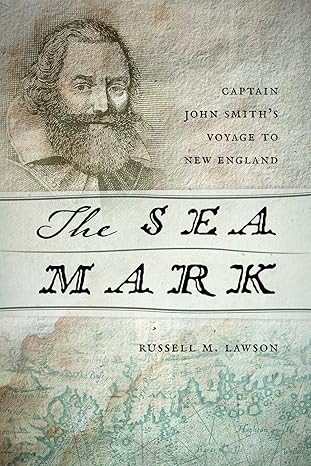
For more, see my book, The Sea Mark: Captain John Smith’s Voyage to New England: https://www.amazon.com/Sea-Mark-Captain-Smiths-England/dp/1611685168

 The American Plutarch