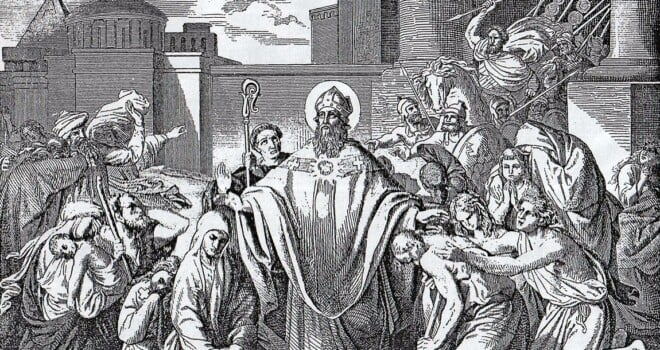
Athanasius (196-373 AD) lived a long and varied life subject to philosophical, political, and theological controversies, violence, exile, and contentious relations with the most powerful rulers of his time, the Roman Emperors. Athanasius is well known for the Creed named for him formulated by his disciples after his death. Athanasius’s significance lies in his valiant defense of the Trinity at a time when this fundamental basis of Christian theology was under attack.
Athanasius was born in Alexandria, which was a center of violence, persecution, and civil conflict as well as one of the great cities of antiquity, a cosmopolitan center of learning and a growing center of Christian thought. Athanasius was of a well-to-do family; he benefitted from an excellent classical and Christian education. When Athanasius was growing up, the Roman Empire came under the control of an autocrat, Diocletian, succeeded by the first Christian emperor, Constantine, who used Christianity as a way to solidify his power. Even though Constantine’s Christianity was underdeveloped, as head of the state religion he mediated conflicts among Christians over doctrine. At the Council of Nicaea in 325, he heard the arguments of the Arians, that Christ was not co-eternal, not the same substance as God the Father, and the Nicaeans, who believed that the first chapter of John’s Gospel proved that Christ, the Logos, was co-eternal, and of the same substance (homoousios), as the Father and the Holy Spirit. Constantine supported the Nicaeans and repressed the Arians. According to the fifth-century historian Socrates Scholasticus, Athanasius was present at the Council of Nicaea as an aid and secretary to Bishop Alexander of Alexandria. Athanasius forcefully presented the arguments for the Trinity. Constantine supported those who believed in the concept of homoousios and he banished the Arians, but only briefly; thereafter, the emperor agreed to end the exile of Arius and his supporters. By this time Athanasius was Bishop of Alexandria and he refused to accept the Arians, arguing that once they had disowned Christ the Logos they could not be forgiven. This earned him the ire of the Arians, led by Eusebius, Bishop of Nicomedia, as well as the emperor, who forced Athanasius into exile.
When Arius died a horrible death in 336, according to Socrates Scholasticus, Constantine was reaffirmed in his Nicaean views. After Constantine died, the empire was left to his three sons: Constantine II, Constans, and Constantius II, who controlled the East, including Alexandria. Constantine and Constans supported their father’s Nicaean creed. Constantius supported the moderate Arian belief that Christ is like (Homoean) but not the same or equal to God.
In the ensuing years, there was a fierce debate between Constantine II and Constans and the bishops of the West against Constantius II and the bishops of the East. In 338, Constantine II tried to re-invest Athanasius in Alexandria, but Constantius in turn deposed him—but only temporarily. Upon Athanasius’s return, his enemies renewed their attack. In the Council of Antioch of 341, dominated by Arians, Gregory of Cappadocia was appointed to the See at Alexandria. Five thousand soldiers accompanied the new Bishop Gregory to Alexandria, forcing Athanasius to flee. He journeyed to Rome and made his case to Pope Julius, who agreed that Athanasius had been wronged. Nevertheless, Athanasius was forced to spend many years in exile away from Alexandria. According to Sozomen, the fifth century author of Historia Ecclesiasticus, Constans supported Athanasius’s attempts to return to Alexandria, even threatening war, forcing Constantius to agree: Athanasius became Bishop of Alexandria again. Constantine II had already been defeated and killed by Constans; when Constans died in 350, Constantius II, as sole emperor of the Roman Empire, became more oppressive to the Nicaeans and their leader Athanasius.
During these years the Council of Arles in 353 and the Council of Milan in 355 renewed the condemnation against Athanasius, again forcing him into exile. But upon the death of Constantius II in 361, the Apostate Emperor Julian came to power. Julian’s rule was brief, followed by the Christian Jovian, similarly brief. Athanasius was in and out of exile during these years. As the recognized leader of the Nicaeans he bore the brunt of the Arian anger. He revealed during these many years resilience, faith in the midst of danger and scandal, and hope in the triumph of the will of God.
Today, we venerate this Doctor of the Church and most forceful proponent of Christ’s divinity and of the eternal Logos, who provides us with an example to fight for our beliefs in the face of ridicule, hatred, and violence. As the 21st century progresses, Christians will find, as in previous centuries, that we will have to rely on prayer, and the intercession of such saints as Athanasius, to support us in patience, perseverance, and suffering in the face of an increasingly atheistic world.
Ephraim Deals (Deal) Sorrels, Arkansas farmer and woodcutter, was a singer and perhaps a fiddler–at least it is clear he had a musical bent. And Van, his son, took after his father. Whether or not Van was a singer is not known, but he clearly was a musician, and a fiddle-maker as well.
Left to right John on violin, Daisy standing, Van on guitar, Susie standing between her parents, Tina on mandolin, and Martha on ukulele
The above picture of Van and Martha and their young family of musicians appears to have been taken around 1905. The family portrait is posed beautifully, and looks as if the instruments were mere props. But they weren’t. Van and Martha, both musical, taught their children to play and christened the Sorrels Family Orchestra. This portrait, then, was perhaps a promotional photograph to encourage would-be planners of feasts, dances, celebrations, and contests to employ the Sorrels family to provide music. Family tradition has it that Van was a fiddle-maker. Did he make all of the instruments played by the family–in addition to the fiddle, the mandolin, guitar, and ukulele? The latter two instruments were relatively new on the mountain folk music scene in early Appalachia, including Arkansas. Some musicologists argue that the guitar wasn’t seen in Oklahoma until the second decade of the twentieth century. If true, then Van was a pioneer in guitar playing so early in northwest Arkansas. The ukulele was introduced to Americans from Hawaii, and became wildly popular among musicians in the early 1900s. An Arkansas music critic a few years after the family portrait was taken wrote mirthfully, “A justly famous music critic announces that the ukulele is not a musical instrument, but an instrument of torture, and that it has no place in modern civilization. But the many new-fangled ways of making people suffer have so crept into our modern civilization that the ukulele has come forward boldly and now has maintained its mournful cadence for several months.” The fiddle had the oldest pedigree among the Arkansas players of the past. Assuming that tradition is accurate, and Van made the family instruments, it reveals not just a man handy with an axe, but a skilled woodworker who could select the finest wood–for musical instruments like the fiddle maple, pine, rosewood, ebony, walnut, and mahogany–using tools such as saws, gouges, chisels, planes, knives, scrapers, callipers, hand screws, and clamps to fashion the instruments. John Broadhouse, who wrote the manual on fiddle-making in 1894, claimed: “A man of fair intelligence, and some aptitude in the use of tools, will be able to construct a violin. Whether it will be a good or a bad violin will depend mainly upon things which will come gradually, and after some failures and many attempts, within the maker’s own control. There is no magic in the art of making a fiddle, but there is a wide scope for the exercise of the mental powers of him who would make a good violin.” One guesses that Deal knew how to make fiddles, perhaps learning from his father, and he taught Van, who perhaps taught his son John. The fiddler of the family, John, who in the family portrait would have been about ten years old, did not have musical training, per se, rather that during winter or rainy days when stuck indoors in the small cabin challenged the hearing of his family screeching on the fiddle until he came to master some of the chords. Doubtless his father and grandfather steered him in the right musical direction. This was the way of fiddlers at the time in rural America anyway, playing by feel, intuitively, without music; hence the fiddler played the same songs but differently every time. Listeners didn’t mind, because the other fiddlers were doing the same thing, and the beauty of the fiddle was the loud reverberations of the strings and exhilaration of the songs.
The fiddle and other stringed instruments highlighted conventions and contests through the American South in the early 1900s. “A typical fiddlers’ convention usually began in early afternoon and continued into the night. At 1:00 p.m., there would be an open-air concert kickoff with as many as a dozen fiddlers playing at the same time. Thirty minutes later, with the convention now in full swing, the tempo changed producing two hours of breakdown music that echoed into the surrounding hills. Its manner mirrored the simple yet often capricious life of the mountainous community.” “The evening continued with a compilation of tunes from a dozen fiddlers sawing away on “Dixie,” “Arkansas Traveler,” “’Billy in the Low Ground,” “Fox Chase” and “Devil’s Dream.” Next came a fiddler, described as having plenty of resin on his bow, fingering and bowing to “Bonaparte’s Retreat.” Seven fiddlers followed by grinding out the ditty, “Goin’ Long Down to Town.” The show concluded with a combination of performers playing: “Fire on the Mountain,” “Leather Breeches,” “Sugar in the Gourd,” “Please Don’t Shoot the Fiddle,” “Down in Bolson’s Hollow,” “Peter Went A Fishin’” and “Sally Goodin.”
Whether or not the Sorrels Family orchestra played any, some, or all of these tunes is unknown. Doubtless they played the most famous and popular fiddle tune of the day, “Arkansas Traveler,” which was a story about a traveler who came upon a shack where lived a rough impoverished squatter who was playing a tune on his fiddle. The traveler asked for directions, which the squatter was reluctant to give, until the traveler pulled out his fiddle and played the remainder of the song the squatter was playing. The squatter was so happy he gave directions, but advised the traveler to stay put instead, offering his hospitality. One popular fiddle contest in northwest Arkansas was held at Monte Ne, a resort founded by Coin Harvey held for several years in a row. During the contest held in June, 1901, the fiddlers each played “The Arkansas Traveler” and the best fiddler won.
Ten years later, there was another fiddle contest at Monte Ne again hosted by Coin Harvey, a local celebrity. At this festivity, held August 9, 1911, after speeches and a brass band playing tunes, as the fiddlers prepared for the contest several stringed orchestras played for the crowd. One of those orchestras was “the Sorrels family orchestra of West Fork.” By this time, Van appears to have dropped out of the orchestra, according to surviving photos. John was sixteen, Tina was fourteen, Daisy was ten, and Susie was eight. The photo inscribed with names by Susie appears to have been taken a few years earlier, perhaps about 1908. Susie omitted (or when she wrote the names forgot) the tall brunette girl in the middle. Who was she and how did she fit the band? One possibility is Ethel Abshier, a friend of the family who often played music with the Sorrels.
Indeed, several years later, perhaps about 1915 or 1916, a photo was taken of a much different family orchestra, in this case combining two families, the Sorrels and the Abshiers. The Abshier family lived nearby the Sorrels and became good friends. George and Tonie Abshier, on the left sitting and standing, George played banjo and Tonie played guitar, and their son Lacy, far right played the violin, and their daughter Ethel, sitting in center played guitar, were joined by Tina Sorrels, standing next to Tonie playing guitar, Martha, playing ukulele standing between Tina and her son John, playing violin, and the two younger Sorrels girls, Susie on the right, and Daisy on the left, with her face partially obscure–both girls playing ukuleles.An obscure notice in the Springdale News for April 28, 1916, reads in full: “Geo. Abshier, his daughter Miss Ethel and Mr. Sorrls and his three sisters of Cove Creek came over for the entertainment and furnished music for the play.” What the reporter meant was that George Abshier and daughter Ethel of Cove Creek, Arkansas, joined John Sorrels and sisters Tina, Daisy, and Susie to provide entertainment at a school play, as schools in northwestern Arkansas in late April, 1916, were engaging in various festivities to bring their school year to a close.
As the woodcutter sawed and chopped and hewed oak, hickory, maple, and pine, he sang songs to the past, to the land, and to the Lord.
His name was Van. He was a simple man. He could read and write but he had no formal schooling. Yet he was a thinker. He was a big man, stout, strong, blue-eyed, a firm gazer, an honest looker, a man whom others trusted, who kept his word, who believed firmly that the Lord watched him always, and knowing this, Van wished his actions to be pleasing to God.
Van had light hair tended toward reddish-brown, hence he fit the surname Sorrell, which literally means, reddish-brown, or auburn–a Norman-English name. Indeed the Sorrells according to tradition were Normans who came to England with William the Conqueror in 1066. Some authorities claim that the Sorrels were Huguenots from France. In America the name has been spelled variously, Sorrel, Sorrel, Sorrels, Sorrells, and so on. The immigrants from the British-Isles are often of Scotch-Irish extraction. Many moved south and west in America. Some of the earliest Sorrell immigrants arrived in Virginia in the first half of the seventeenth century. For example there was a Robert Sorrell who came to Virginia and owned 800 acres in James County. He could have been the same Robert Sorrell who died during Bacon’s Rebellion
This man Van of Norman and English extraction of reddish-brown hair had hard muscles, because he worked from dawn to dusk, most days, cutting trees in the forest, cutting off the limbs, dragging the large trunks to his workshop, hewing the wood into various shapes, squares and rectangles that could be used for fencing, barn and cabin framing, railroad ties, and such. During winter he spent much of his time cutting firewood for customers. Sometimes his work was more intricate: preparing wood for the delicate task of fashioning a stringed instrument. Some of this work took thought, some of it did not; he supplemented the routine actions with traditional songs and hymns, many of which he had memorized, others he had composed based off of the original–his own compositions, his own verse–which he said or hummed, thinking that later in the day, after dusk, he would sit next to the fireplace strumming his guitar, or making the mandolin sing. And his wife would join in, their voices merging together, the mandolin, guitar, or fiddle combining together in joyous tunes of praise to the Lord, the land, and the past.
Van’s great-great-great grandfather William Sorrels lived in Virginia, born in 1735, died in 1780 during the War for Independence. He was a veteran of the French-Indian War, discharged early in the war in 1755. He was once again involved in the War for Independence, even though he was in his forties. A record exists showing that he was part of a medical staff caring for wounded soldiers, including his son Richard, who died from his wounds. William appears to have married Ann Holloway, ten years older, in 1749. They both died in 1780. Although there is a record of a Thomas Sorrell dying in 1777 during the war, it was probably not William and Anna’s son Thomas, who died in 1832. Whether or not such historical records ever occurred to Van, I would doubt, as he was a farmer and woodchopper, not the type to care about the details of his forebears in the Revolution. Perhaps he had good reason, as the records are very vague and uncertain, and it is only speculation that William and Anna and Thomas were his ancestors.
Imagine one November day that found Van alone in the forest about a mile from his cabin. He was hard at work felling a huge oak tree. It was difficult, dangerous work. His ax rang out into the silence of the forest as he struck and struck again and again. The steel blade of his ax attached to a hard ash handle was his pride, his livelihood, an expensive, elegant tool that he kept sharp every day, in the morning before going off into the woods, grinding and whetting the blade until it shined and was ready for the day’s work. This day, Van struck at the oak, the blade digging deeper and deeper, the wood shavings flailing into the air, the smell of the cut wood inundating the air. He knew that his work was life to him and to his family yet death to the tree. This tree was old, much older than Van, and had been in this forest for several score years. Yet Van was bringing about the tree’s demise. He might have thought about this as he swung his ax. He did not sense that the tree felt anything. But to bring about death to anything, any creature–and the tree was certainly a creature, created by God—was solemn work. The forest surrounded him with life. There were countless trees like this one. The forest filled a purpose for him, so that he and his family might live. Such was the course of life and death in God’s creation.
Van swung the ax, in rhythm with time, with the Creation, and he thought of simple words, like a verse for a song. Such is how this simple man passed his days, working in the forest, cutting wood, thinking, singing, perhaps even creating a Psalter in his head to justify his existence, to make peace with God’s creation.
Van’s ax fashioned the cabin, we imagine, in which his young family resided. It was a solid pine cabin with oak flooring. Van had constructed a hearth on the north side of the cabin to counter the coolest winds of the winter. It was a broad hearth that dominated the room, which was altogether spacious for his family, with one part a parlor for sitting and conversing, another part with beds for sleeping, and the hearth itself for cooking, warming, sitting, reading, relaxing. Van had his chair before the fire. He found it stimulated his thinking. His wife Martha had her rocking chair next to his before the fire. Here she worked with her hands, sewing, mending clothes, cutting the vegetables for the family meals, holding her book to read, or sitting quietly next to her husband in the simplicity of daily life. Unlike him she was small, not weak but still delicate, appearing like a fragile flower, at least in Van’s mind. She was pretty in a basic feminine way. Her hair was long; she kept it up in the fashion of the day. She wore long dresses of her own manufacture. She was fond of simple pastel colors: blues, pinks, yellows. She spun her own thread at the spinning wheel, situated at the northwest corner of the cabin. Here she had a basket filled with yarn and thread. She had a small table with scissors, pins, pin cushions, thimbles, and such tools of the dressmaker’s trade. She made her own dresses, and perhaps even made Van’s trousers and shirts.
Van and Martha lived in the forest and hills of northwest Arkansas, in the small town of Rule in Carroll County. Van worked the land he rented. A small part of this land was plowed and planted for subsistence living: they grew potatoes, corn, okra, tomatoes, lettuce, beans, and squash. There were wild fruit trees and vines throughout, such as persimmon, mulberry, blackberry, blueberry. Van made maple syrup from maple trees in the late winter. He supplemented their diet with fishing. Osage Creek, a mountain stream that flowed into the Illinois River, cut through Van’s rented acreage. The river hosted trout for the cunning angler to supply the dinner table. Van spent part of almost every day fishing. It was relaxing, after a long day swinging the ax. And it was important for his livelihood. The shallow river was fresh and cool, perfect for trout. Van made his own poles and flies and was quite a good fisher.
Fishing was a thoughtful, solemn activity. Van stood at the riverbank, or waded close to shore, fishing quietly. Van listened to the water, to the breeze flowing through the trees, and thought of the ways of the Lord, who communicates so silently.
The dangers of the Arkansas forest were many. But Van knew that God was with him and his family. His father, an Arkansas farmer, had taught Van the greatest lesson he sought to teach. Rely on the Lord. Life is filled with happenstance, it seems. There is danger and death. Rely on the Lord. Van was not a man of great words, rather great thoughts. He spoke when necessary.
Van was not a preacher. Preachers were prolific, of course, among the people of Arkansas, and Van knew quite a few, had listened to even more. The Bible was the great source of knowledge of God, not preachers–though they served their purpose. Van believed in reading the Bible, the source of wisdom.
The farmers and laborers of Carroll County met on Sundays at the Baptist church. It was a small, rectangular building fashioned with wood, built by the people of the town. The pews were of hardwood, and they were uncomfortable to sit in in summer when the clothes stuck to the wood and in winter when the fireplace at the north end hardly warmed the place. The preacher told the people that this was a way to mortify themselves, deny themselves, to prepare for the inevitable meeting with the Lord. “You shall meet the Lord soon,” he said; “some of you sooner than others. Prepare yourselves for His wrath.” Van heard the preacher’s message and wondered about God’s ways. Would God send some to Hell, others to Heaven, as the preacher said? Who goes where, and why? These were difficult matters to consider, and Van’s questions and uncertainty matched others in the congregation.
The time we are describing, 1895, provides few records to help us discover much about Van and Martha’s lives. They were married March 27, 1895, in Mountain Home, Arkansas. Mountain Home was Van’s birthplace, and his parents, Ephraim Deals and Sarah Amelia Sorrels, yet lived there. Martha was born in northern Texas, Titus County, to Joseph Wesley and Jerusha Clementine Tully. Her parents had relocated to the town of Liberty in Carroll County, Arkansas, seventy miles from Mountain Home, where she met Van. Soon after their marriage, Van and Martha set up housekeeping in Rule, Carroll County, near where Joseph and Jerusha lived. And, soon after the marriage, Martha became pregnant with their first child.
The people of Northwest Arkansas were mostly whites, descendants of immigrants who came to the original southern colonies; many had relocated to Arkansas from North Carolina and Tennessee. There were few blacks who lived and farmed in Carroll County; before the Civil War there were few slaves in this region. The people generally had not been slave owners, hence opposed secession, as did their forebears in eastern Tennessee; but when push came to shove and it was a choice between the Confederacy and the invaders, the Union troops, the people of Northwest Arkansas went with the Confederacy. Part of the reason for their choice was the presence of armed bands of Union troops, some official army, some Jayhawkers from Missouri and Arkansas, that brought lawlessness to the region. The independent-mindedness of the people did not pay off, as much of Carroll County was overrun with Union troops, who destroyed and confiscated as they marched through the farmlands. Rule was a small town that was founded after the war; the population was scarce and scattered, and Van and Martha had land, wood, and fish but few neighbors. Joseph and Jerusha lived nearby. The land was mountainous, good for apples, grapes, and peaches as well as family gardens. The land was well-watered. Besides Osage Creek, other good places to fish included King’s River and White River. Oak and cedar provided wood for fences, rustic furniture, and the warmth of family hearths. Traveling in Carroll County was a chore in the late 1800s. Even today the highways are few and far between, windy and filled with quick elevations succeeded by rapid declensions in the road. Walking, riding horseback, or traveling by horse and buggy would have been treacherous in a land of contrary weather and quick storms brewing, rough often nonexistent roads, thick forests, and rapid sometimes uncrossable streams. It tended to make people stay put. It is surprising, however, how often Van and Martha, Ephraim and Sarah, Joseph and Jerusha, and other members of the Sorrels and Tully families, moved–it was poverty and want, more than anything else, that forced the frequent movement, usually west.
Lida (Elizabeth) Jane Newcomb was born in San Rafael, California, in 1871; she died at Country Pond, Kingston, New Hampshire, in 1941. She lived most of her life in Maine and Massachusetts, wife to Robert Eugene (Gene) Newcomb, a tinsmith and pipefitter. Lida kept a diary covering the years 1933-36, though for 1933 the entries are sporadic, as they are for 1936. The diary mostly covers the years 1934 and 1935 during the Great Depression.
Lida uses most of the first part of this diary for 1934, then around Sunday May 28 it is 1933, which implies that she began using it in May and then the following year at the beginning of 1934 she used it for a few months
First entry for June 2, 1933. Mr. O. F. Bennett pd R E. Newcomb on a/c $30.00
Friday June 16 1933 O. F. Bennett pd R E. Newcomb on a/c $30.00
Under Jan 2 Garage bill paid to Jan 15, 1934 Apr 15, 1934
(see note Jan. 8)
Jan 5 “Windlin Camp” “Senif.”’ ???
Chestnut St. Everett
Washington St. Haverhill
24 Jane St. West Medford
151 Pine St Wollaston
Jan 8, 1934
O. F. Bennett Pd R. E. Newcomb $30.00 on a/c
Pleasant and warm
Over to Jan 23/34
Tues Jan 9 34
Pleasant and warm
Went down street Pd. A.E.S [[American Eugenics Society?]. Dues and RA [Royal Arch Masons?] Chapter Dues
Wed Jan 10 34
Cloudy most of day Went down to R.s. Gene worked. Don’t feel well. Snowed some, squally.
Mildred and Addie went to beach. Pd H. M. Gleason $3.50 rent to date. [H. Mildred Gleason was landlord renting property, and Addie was a roomer; Mildred was a thirty-five year old dancing teacher; Addie, if she is Adele, in the census, was fifty-six years old]
Jan 11 34
Pleasant. Bobbie’s 9th birthday.
Inserted between Jan 15-18, newspaper article on Resuscitation Saves Lives
Tues Jan 23, 1934
O.F. Bennett paid R. E. Newcomb $20.00 on a/c
Over to Feb 9 1934
Next entry, Feb 9 1934 O.F. Bennett paid R. E. Newcomb $50.00 on a/c
See over to Mar 5
Next entry Mar 5 O.F. Bennett pd $10.00 on a/c R. E. Newcomb
Receipt in these pages: Received of Robert Newcomb $3.20 dues pd Mar 33 for Bradford Grange Jan 1, 1934
Receipt in these pages: Received of Lida Newcomb $3.20 dues pd Mar 33 for Bradford Grange Jan 1, 1934
Receipt in these pages Oct 8, 35 Eggs, 40, Apples, 25, Apples 25, Squash .09, Carrotts, .09 Pd. $1.08 I owe Mr. Collins
Mar 7, 34 O.F. Bennett pd $15.00 on a/c to R. E. Newcomb
Over see Mar 26, 34
Mar 26 O.F. Bennett paid R. E. Newcomb $30.00 on a/c
Mon, see May 7, 1934
Apr 2 1934
O.F. Bennett paid R. E. Newcomb on a/c
May 7, 1934
O.F. Bennett paid R. E. Newcomb $75.00 on a/c
May 28 Sunday [changes here to 1933]
Pleasant and warm. Roland, Livona, Bob and Shirley. Helen Herrin and Willard Hicks called
May 30 Tuesday
Showery. Mr and Mrs Boodry and Guy called
June 2 Friday Pleasant and hot. Mr. B. Paid Gene $30.00 on a/c
June 5 Monday
Pleasant and hot. I went to Haverhill [from Camp] Pd Mrs Marsh $20.00 for garage. [Hence they have a car or perhaps its just for storage]
Pd. $3.00 poll tax. $3.92 electric bill $8 to Mildred Gleason for room 2 wks. Pd to date.
June 6 Tuesday
Cloudy and a little cool. Paid Mrs. Davis $1.20 for milk 12 Qts @ 10 c
June 16 Fri
Cloudy and showery but cleared up at night a little warmer 45 7 in a.m. Mr B pd Gene $30.00 on a/c.
June 20 Pleasant a lovely day. I washed. Dottie Taylor Muriel Stoke called. Had the parent teacher outing at Taylor’s camp.
Emma is better.
June 21
Thursday Showers in morn. Gene went at 9:43 train. Mrs Nichols and Leslie Bean called.
June 24 Pleasant Sent H. M. Gleason $8.00 for two weeks rent.
Insert in pages receipt $8.00 receipt for Newton Junction NH, perhaps train
June 28
Pleasant and very hot
June 29
Pleasant and terrible hot 88 by porch Gene worked
June 30 Friday
Cloudy in AM Very hot O. F. Bennett paid R. E. Newcomb $20.00 on a/c. Roland and family are up here [so at Camp]
July 1 Sat
Pleasant and not quite so hot
July 8
Pleasant and hot; 80 88 at noon in Haverhil. O.F. Bennett paid R. E. Newcomb $10.00 on a/c
July 14
Pleasant and rather cool at night O.F. Bennett pd R. E. Newcomb $15.00 on a/c Sent H. M. Gleason $12.00 for 3 wks rent to July 11 1933 P.O. money order from Newton Jct . N.H.
July 25 Tuesday Pleasant O.F. Bennett paid R. E. Newcomb $20.00 on a/c
July 26 Wed
Pleasant Paid H. M. Gleason rent $8.00 for room to date
July 27 Thursday Pleasant and hot. Roland worked on room
July 28 Fri
Pleasant and a little cooler
July 29 Sun
Pleasant and hot
August 7 Mon
Pleasant and a little cool
O.F. Bennett paid R. E. Newcomb $40.00 on a/c
August 21
O.F. Bennett paid R. E. Newcomb $30.00 on a/c
August 30
Paid Mrs Davis Milk bill up to date
September 5 Tues
O.F. Bennett paid R. E. Newcomb $30.00 on a/c
September 10 Sunday
Cloudy and cool
Livona, Bob and Shirley went home with the Boodrys this afternoon
Mrs Boodry in sick with a bad cold.
September 11 Mon
Pleasant.
Bobbie 3rd and Shirley 2nd started to school at the Burnham School. Bob had Miss Thyne Shirley Miss Mynne Gene worked
September 15 Fri
Some cloudy Livona Bob and Shirley came up with Gene at night. I went to Jct and met them. Roland is working at Y.M.C.A. for 2 wks. Taylor family up to Camp for week end.
September 16 Sat
Rainy all day “Live Gale” terribly in South and along beaches.
September 17 Sun
Rained downpour all day. L. B. and S went home with the Taylors. Pond is up to Mrs. Lones ? steps
September 18 Mon
pleasant, windy and nice and warm. O.F. Bennett paid R. E. Newcomb $30.00 on a/c
I went to Jct and met Gene at 3.27 train
September 19 Tuesday
Pleasant and windy but nice and warm. Gene worked. Paid H. M. Gleasan $16.00 to date for room rent.
September 29 [Fri]
Cloudy and rainy in A. M. but cleared up at night. O.F. Bennett paid R. E. Newcomb $30.00 on a/c.
I went to Jct and met Gene at 5.03 train. Mr Nichols brought us home. Bob and Shirley came up.
October 1 Sunday
Roland and Livonas 14th wedding anniversary. Livona came up on 9.19 train and got Bob and Shirley. Went home with the Boodrys in afternoon. Roland is at church working.
October 2 Monday
Cloudy but cleared up. I went to Jct at night and met Gene.
October 3 Tues
Some cloudy. I went to Jct and met Gene.
October 6 Fri
Cloudy and showery. Bobbie and Shirley came up with Grampy
October 7
Cloudy. A beautiful rainbow at night. Dottie called.
October 8 Sunday
Our 40th anniversary. A beautiful day. Livona came up after Bob and S.
Albert, Dottie, Minerva, John, and Helen called. L and children went home with the Taylors.
October 9
Cloudy and showery
October 15 Sun
Pleasant and warm. Livona came up.
She and Shirley went home on 3.33 train. Bob staid.
October 16 Mon
Pleasant. Bobbie went home with Grampy on 7.25 train ? I washed. O.F. Bennett paid R. E. Newcomb $35.00 on a/c
October 29 Sun
Pleasant and warm. Gene and I was alone all day. We went up the Pond in the boat.
October 30 Mon
Pleasant and quite warm. Washed. O.F. Bennett paid R. E. Newcomb $45.00 on a/c
October 31 Tuesday
Pleasant, cool in morning. I went to Haverhill with Gene on 7.25 train. Pd. H. M. Gleason $24.00 room rent. Pd town ?? $32.40 taxes. Pd Heardning Ins. T.00 (all pd). Pd Exeter ?? Electric Co. $6.21. Took dinner at Roland’s.
November 1, Wed
Pleasant and warm. Gene worked at Amesbury.
November 2 Thurs
Pleasant. Gene was at Amesbury. Mr. B. brought him milo Welders ?? to the boat ??
November 3 Fri
Pleasant and warm. I went to Haverhill. Bobbie came up with me at night. Gene worked. Livona has a bad cold.
November 4 Sat
Pleasant and cold. Gene worked all day. Bobbie and I went to Jct with Mr. Nichols and then went over to Mrs Davis Pd milk bill $13.00 to date.
Gave R. $6.00
November 5 Sun
Pleasant. Mrs. Boodry Albert and Dottie Mr. Nichols and Mr. Bean called. Bobbie played with the Taylor children.
November 6 Mon
Cloudy. We had our first snow in night. Ground all white ? and ? Snow squally all day. Gene worked. Bobbie went home with Grampy. Mr. Albert Nichols birthday 73 yrs
November 7 Tues
Partly cloudy but quite warm. Snow most all gone. Gene worked. I stopped the milk.
November 11 Sat
Pleasant and cold. Armistice Day. I went to Haverhill to see the big parade. N. R. A. and it was grand. Had dinner at R.s Gave R. $6.00
November 12, Sun
Pleasant and a little warmer. Mr. and Mrs. Burns Jean and Jane called. Also Mr. Bean. Snowed the night about 4 “
November 13 Mon
Pleasant and very warm. I went over to Mrs. Davis and paid her 60 c milk bill. Mr. Nichols also Mr. Bean called.
November 14 Tues
Some cloudy today. “Cold” My mother’s birthday. She would have been 82 years today if she had lived. Mr. Bennett moved us down from Camp at night. O.F. Bennett paid R. E. Newcomb $30.00 on a/c
November 15 Wed
Pleasant and cold. I settled in room some today. Gene worked.
November 16 Thurs
Pleasant and cold. 2 below at Reglars and McNamms. Mrs Pietro had breakfast and dinner with me. She cleaned up the house. Gene worked at Hayden Harriers. Gene went down to Rolands in the evening. All well
November 17 Fri
Some cloudy and cold. Gene worked. ? Called at R.s in afternoon.
November 18 Sat
Some cloudy but cleared away not very cold. Gene and I went to Camp and finished shuttering up for winter. Mr. Bennett came up and get rest of goods and then he and Gene went to Amesbury to see about a Oil burner. I came down on train at 6.19 P.M. R. $10.00
November 19 Sunday
Pleasant. Gene and I went to Strand to movies in eve.
November 20 Monday
Pleasant and cold. Mr. B and Gene went up to Camp at night. I called at R.s in evening. Mildred and Addie went to beach Paid H.M. Gleason $8.00 room rent to Nov. 14 1933 [34]
November 21 Tues
Pleasant and cold. 10 above
November 22 Wed
Pleasant
November 23 Thurs
Pleasant
November 24 Fri
Cloudy most of day. I went down to R.s in after noon. Livona and I went to Paramount to see Lionel Barrymore in Our Man, Doug Fairbanks and Katharine Hepburn in “Morning Glory.” O.F. Bennett paid R. E. Newcomb $35.00 on a/c
November 25 Sat
Pleasant and cool. Went down to R.s at night.
November 26 Sun
Pleasant and warm into evening and then it rained most all night. Staid in all day.
November 27 Mon
Pleasant and cold. 12 above in morning went to 27 during day. Went down to R.s in after-noon.
November 28 Tues
Pleasant and cold
November 29 Wed
Pleasant and warm. I went down street in morning and called at R. S.
November 30 Thanksgiving
Pleasant and warm 67 degrees. Gene and I had our Thanksgiving at R.s home. Had a very nice time.
December 1 Fri
Pleasant and cold and very windy. It showered toward morning.
December 4 Mon
Pleasant O.F. Bennett paid R. E. Newcomb $35.00 on a/c
Dec 8 Fri
Pleasant Gene worked in forenoon. Mr. Bennett and Gene went to Manchester N.H. to a Knight Templar time [a Christian freemasonery group]
Dec 9 Sat
Pleasant. Gene worked all day at shop. We went down street to supper at Clam Shell.
December 10 Sun
Pleasant. Gene staid abed most of day. Very tired.
December 13 Wed
Very cold
December 14 Thurs
Very cold
December 15 Fri
Cloudy most of day and cold 7 above
December 16, Sat
Pleasant and dry. Had a sleet storm during night. Rain, snow and sleet. Gene is working in Bob & Art. I went down to R’s in A. M.
December 18, Mon
O.F. Bennett paid R. E. Newcomb $20.00 on a/c
December 22 Fri
Pleasant and dry
I went down street.
December 23 Sat
Dry day and pleasant. Slippery. I went down street in afternoon with Bobbie and Shirley to look around. Gene and I went down at night. Mildred and Addie went to Beach.
December 24 Sun
Some cloudy. Gene went up to Camp. I went down to R.s in eve and helped Livona. Very slushy, warm. Miss Petro went home in afternoon to Revere.
December 25 Mon Christmas
Pleasant cool. Gene and I spent Christmas with Roland and family. Had a tree and a nice lot of gifts.
Dottie Taylor had a little son born at Gale Hospital, 9 a.m.
December 26 Tues
Snowed hard and wind blows. Cold. A regular gale.
December 27 Wed
Very cold. Cleaned up but snow blowed hard and drifted
December 28 Thurs R.’s birthday 36
Pleasant and very cold 15 below here cold everywhere Gene worked.
December 29 Fri
Pleasant and bitter cold 17 below in Boston 15 below between 11 and 12 a.m. Coldest in 60 years
[Last page of book, identification and emergency info]:
L. J. Newcomb 8 Columbia Pk Haverhill Mass
Emergency—Robert E. Newcomb 8 Columbia Pk or Roland K. Newcomb 91 Portland St Haverhill Mass
[Insert in book:]
First killing frost Oct 26, 1933
First snow deep enough to be measured Dec 4, 5”
Coldest for Nov 12 above zero …16”
Coldest for Dec 17 below zero …26”
Coldest for Jan 2 below zero …29”
Coldest for Feby to date 18 below …9”
Feby 22
Total more snow measurements
Coldest on Feby 22 2 above 1918
Warmest 57 above 1912
Flags required to fly in Public Bldgs in Boston
Franklin’s Birthday, Jan 17
Lincoln’s Birthday Feby 12
Evacuation Day Mar 17
Mount Coolidge Custer S.D.Rising ?? by it S. 6000 ft in the air
Was called Lookout Mt and Sheep Mt
1935 Diary
January
1: Pleasant and cold. Gene did not work. Miss Petro here.
2: Pleasant and very cold. I washed. Miss Petro here.
(Upside down on this page, Cut Work 5521 Alice Brooks Household Dept Boston Globe Jan 3- 1936. [Alice Brooks did designs for sewing etc.] #5481 15 c. Transfer for cut out and applique Feb 8 1936, [also for design] 5528 Transfer for Budofmad Garden Motif 15 Feb 15)
3: Cloudy and rained in night. Miss Petro here. Gene worked
4: Pleasant and cold. 8 Below at Newton Jct. Zero here. Miss Petro here.
5: Cloudy cold 6 below. Gene has tooth ache and cold. I went down to Library at night. I got him Great Waters.[probably a book] “Uncle Sams Attic.” [a personal adventure book by author Mary Caldwell Davis] The Century of the Reaper. [By Cyrus McCormick, on how he invented the reaper]
Miss Petro here. O.F. Bennett paid R. E. Newcomb $40.00 on a/c
6: Cloudy. We stayed in Gene has tooth ache and a cold. Mildred Addie and Ralph came home from Alton “got marooned up there in snow” [Mildred is probably their landlord H. Mildred Gleason; Addie might be Adele, who rooms; don’t know who Ralph was; Alton is near Lake Winnipesaukee] gone ??
Miss Petro here with me. [sitting? Company?]
7: Cloudy. Washed. Gene worked. I went to dentist, Dr. Stoper, with Bobby. Teeth cleaned, one filled and one out. Called at Roland’s. All went to Hampton Beach to Mildred’s cottage 10 N. St. a wet town ? Froze
8: Cloudy. Began to rain at night. Warm in 40s. Gene and I went to Strand to see Kay Francis in Mandalay [Kay Francis film]. The Girl who Dared. Claudia Deep. [all movies] Folks all went to Beach in afternoon. Paid H. M. Gleason $16.50 for 3 wks room. Meet to date.
9: Cloudy. Rained at noon. Very warm in 50s. Gene worked. Miss Petro is here at house. Miss Petro and I went up to Mrs. Brenner’s and forth ave and called at Mr Hunkins in Main St. Rained all night hard
10: Cloudy and rained some in morning. Gene worked. I went down street in afternoon, called at R.s. Shirley home sick with a cold.
11: Pleasant and a little colder. Bobbie’s Tenth birthday. Mildred Addie and Ralph gone to Hampton Beach to work on cottage. Gene worked. I ironed.
12: Pleasant and cold. Gene went to Camp came home on 6.19 train. I called at Roland’s at night and got “Beans”. Done general housework and washed. Very windy at night.
13: Pleasant and cold. Bobby and Larry called in afternoon. Staid in all day. Miss Petro here.
14: Pleasant and cold. Mildrede Addie and Ralph came back from Beach. Gene worked.
15: Some cloudy and very cold. 6 above. Snowed in evening. Mabel’s birthday “64” She is at Crescent City Florida at her winter home. Gene worked. Paid H. M. Gleason $5.50 room rent to date. [Mabel is Mabel Sophia Newcomb, who was 64 in 1935; lived in Franklin Mass, married to Frank Barnes; she was Gene’s sister]
16: Pleasant cold in A. M. 4 below at Police Station; 3 below at Kingston, NH; 6 below at Newton Jct. NH; 10 below at Georgetown, Mass. ?? a lot of snow on ground. It melted at noon. Gene worked. [clipping of local temps inserted here]
17: Cloudy, began to snow about 8:30. Not quite as cold. Snowed most all day a little, it melted some. Gene worked.
18: Pleasant and cold at night. Windy. Went down to R.s in afternoon awhile. Ralph went to Beach. Gene worked.
19: Pleasant and cold. Gene and I went to Stand at night. Called at R.s for “beans” [a joke probably about supper] on way home. Mr. Hunkins buried 88 yrs
20: Snowed most all day. Mildred, Addie and Ralph went to Alton. Miss Petro here all day. Gene and I staid in all day. Stopped snowing at night, warmer.
21: Cloudy and not very cold. Miss Petro went in on a Scarlet Fever case in Lawrence St. [so, Miss Petro is a nurse; she is probably one of the roomers in their tenement]. O. F. Bennett Paid R. E. Newcomb $15.00 on a/c.
22: O. F. Bennett Paid R. E. Newcomb $10.00 on a/c.
23: [written on the side]: Karre’s the Sufrer Store Opposite Municipatl Parking Space Lawrence, Mass. Lawrence, Canal, Afefeltons and Methuen Sts, Hours [listed]
24: no entry
25: Stormy. From 4 to 28” snow fell, drifts 20 ft deep in some places. 18 inches fell here in Haverhill all drifted up around an very cold. 48 below in Vt. Greenville M. 16 below. Most storm in 14 years. Many deaths. Autos piled up.
26: Pleasant and very cold. All drifted up. Hardly any sidewalks open only a few st.
27-30: no entries
31: Pleasant and terrible cold: S. Kingston NH 21 below; Newton Jct 21 below; Hampton 20 below; Westville, 20 below; Boston 20 below; S. Groveland Mass 30 below; Salem Ct. NH 25 below; Plaistow, 24 below; Newburyport, 24 below; Haverhill Mass, 16 below; Monument Sq 15 below; Riverside 13 below; N. Broadway 10 below. Gene at home.
February
1: no entry
2: Candlemas Day [observed by mainline churches, Catholic, Lutheran, Methodists] Sun shined a little in day but mostly cloudy. Staid in all day.
3: no entry
4: Pleasant and cold. Gene home all day. We went to Strand at night.
5: Pleasant and cold. Gene at home. Done general work
6: Gene at home.
7: Pleasant and nice. Gene at home.
8: Pleasant in morning, but cold, but clouded up and snow and sleet. Gene went to Camp in morning. [Took] Train come back in 6.19 train at night.
9: Pleasant. Staid in all day. M. and A. and R. went to Beach. And then to Alton and back to Beach.
10: Pleasant and cool. Mildred Addie and Ralph went to E. Jaffery to winter carnival. Bobbie was up at night. Gene staid in all day. I went out an[d] got Globe. [insert from paper, article on woman growing hair after baldness for 27 years]
11: Pleasant and cool. I washed. Gene worked. M and A. and R went to Beach. Staid in all day.
12: Pleasant and cold below zero in morning. M and A. and R. come home. They went to Boston. Mr. Priestley and Mr. Bennett called at night. Staid in all day. I listen to Lincoln Addresses on Radio.
13: Pleasant and cool. Gene worked, but came home at night sick.
14: Squally in A. M. cleared. Gene worked. M. A. and R. went to Alton and then to Comick ME to Carnival. Gene is sick. [clipping of old stamp found inserted]
15: Pleasant and warm. Went down to R.s in forenoon. Saw Helen [Wilson George]. Gene is sick but he worked.
16: Pleasant and warm. Gene feels a little better but I was sick all night with upset stomach.
17: Pleasant and warm. Miss Petro came home [Home?] from Paley’s. Mr. Priestly is here. Gene feels better. I don’t feel very good.
Added below: 1936, Mon 17: Rainy a big thaw. All slope ??. Gene worked about 15 mins in am, home in pm.
18: Pleasant and warm. Mr. P and Miss P. is here. We all went down St in forenoon had dinner at Community Cafeteria and then to Paramount and see David Copperfield, very nice. Miss P gave me some lovely silk for a dress. Gene worked, feels a little better.
19: Showery and very warm. I went down St at noon, to see Gene. Miss P. and Mr. P. here. Gene worked. [Who is Mr. P?]
20: Pleasant and a little cooler. 24 last night at 11 PM. Petie and Mr Priestly here. Petie went up to Mr. Brennens as Micky is sick. Gene worked. I done general work.
21: Pleasant and cold. 7 above. Petie came down an[d] got his uniform in a. m. Gene worked. M. A. and R. came home from Alton and Maine. I went up and done some shopping.
22: Pleasant. R.s family all over to Metheun to Earle’s. Come home at night.
23: Stormy and cold. Sleet in some places in East. West had dust storms.
24: Pleasant and cold. Family all home. Bob and Larry and Shirley and Phyliss was up at night.
25: Pleasant. I went down to R.s in forenoon. Miss Petro come back from Brennen sick with “flue” [Miss Petro is sick] Had Dr. Morris. M. A. and R. went to beach. Gene worked.
26: Pleasant. Warm. Miss Petro about the same. Dr. Morris called. Mr. Priestley was here at noon. Gene worked. Bobbie came down with chick pox. O. F. Bennett Paid R. E. Newcomb $15.00 on a/c.
27: Pleasant. Gene worked. Addie and Ralph came up from Beach for a while. Miss Petro better. Bob about same.
28: Pleasant and warm. M. A. and R. come up and got Miss Petro and they went to Alton. Gene worked. Bobbie don’t feel very good.
March
1: Some cloudy war. Gene worked Mr Priestley call in eve.
2: Cloudy, snowed in night. Very warm. Sloppy 40 above. Gene went to Camp on 1.39 train. I went down to R.s in forenoon and called at night for (beans) I went down to station an[d] met gene 6.40 p.m.
3: Pleasant and rainy 34 at night. A. M. R. and Peter came home from Alton.
4: Pleasant and warm. I went down street in forenoon and at night and met Gene he worked. Called at R.s. Bob is better but Shirley was coming down. Washed.
5: Cloudy, and warm foggy. I went down street and to Library. Paid Gene’s poll tax $2.00. Gene worked. Miss Petro and I went to Strand to movies in eve.
6: Pleasant foggy in A. M. a little cooler at night. I took care of Bob and Shirley at night while R. and L. went to Olde Folks Concert at night. Gene went to Colonial to movies. Gene worked.
7: Cloudy in early morn but cleared up, a little cooler. Gene worked.
8-15: no entry
16: Pleasant and very warm. Go to Portland. My birthday. [she figures what 1925 minus 1871 is equals 54, but the year is 1935! She is 64]
17: no entry
18: Pleasant
19: Cloudy in A.M. Rained in afternoon. I went down to R.s to dinner. Had a cake. Bob and shirl are still at home.
20: Pleasant and warm, Petie was at home. I went down St, Miss Paley and Petie was here in eve.
21: Cloudy in A. M. and rained some. Gene worked Petie went on a case in Height St. M. A. and R. came home. I went down street.
22: Pleasant and cool. M. A. and R. went to beach. Gene worked. I worked on Shirley’s blue dress.
23: Pleasant. R. went to Providence. R ? M. and A. to home.
24: Pleasant. M. and A. at home.
25: Pleasant. Washed. Gene worked.
26: no entry
27: Pleasant. Gene and I went to Camp in 1.39 train. See Mr. Nichols. He is staying at Mr. Hasburgh?? Some snow at Camp.
28: Pleasant. M. A. and R. went to beach
29-30: no entries
31: Some cloudy. Warn 36” Staid in all day. Bobbie called at night.
April
1: Cloudy 40 rained in evening. Gene worked. I washed.
2: Pleasant. Gene worked. I went to library carried my books back.
3: Pleasant. Gene worked. I went to Library to correct about a book that was to be renewed which I took back by mistake. Called at R.s. He was not working
4: Pleasant and warm. Gene worked. I washed and ironed my curtains in every room.
5: Pleasant and warm. Gene worked. Earle called in eve. I cleaned my room. Peter Josline Camp burned at lower end of Pond. [in between pages, a receipt for groceries paid]
6: Pleasant. Gene went to Camp in 8:15 train came back in 6.19. Was at R.s in forenoon and at night. Carried Shirley dresses down.
7: Pleasant and warm. We staid in all day. [Upside down on page: Miss Shirley Hexry Braintree, Mass, bedridden for a number of years by infantile Helped at Harvard by Warm Springs Foundation aided her to get help.]
8: Rained, snowed, and hailed. Ground all covered with snow. Cold about 38. It began in eve. It was pleasant all day most. I washed. Gene worked.
9: Cloudy and cold. 34. Wind blowed hard. Snowed. Gene worked. We went to Colonial to movies in eve. Sent Mr. Priestley’s license to him at Dover.
10: Pleasant and cold. 38 Gene worked. M and A came home from Alton.
11: Cloudy. Gene worked. It snowed some.
12: Cloudy cold. Gene worked. He has a bad cold. Lennox and Briggs Factory burnt $100,000 loss. 13 Co.s called out.
13: On Apr 13 1933 eleven inches of snow fell.
Rained most of day. I was down to R.s with my “beans”. Gene went down street and to shop in forenoon. Mr Nichols staid at his Camp tonight for first time. Gene cold about the same. Paid electric bill $1.00 to Exeter Hampton Co. [for camp?]
14: Cloudy in A. M. Cleared up toward night. Gene went to Camp. Mr. Nichols was at his Camp staying. The Boodrys and Rameys was up. Aunt Etta Morrill [of] Rochester NH passed away. [She was born in Maine, 1855, widow of John G. Morrill: why an Aunt? Just a familiar title? Her maiden name Wellman, from Winthrop, Maine, parents Hiram and Mary Wellman] Mildred, Addie, and Ralph went up at night. Gene coughed hard.
15: Pleasant. Gene worked. His cold about the same. I washed. Wrote to Aunt Em. [Emma McCrillis]
16: Snowed in night. Ground all covered. Cleared away in forenoon. Gene worked his cold is about the same. Aunt Etta buried. Sick with headache all day.
17: Partly cloudy cold 38. Gene worked. Cold about the same.
18: Pleasant in morning but clouded up. Frosty 38 Gene worked. I ironed. Bobby called after school. M. and A. and Ralph came from farm Rochester. Went right back. Pd. H. M. Gleason $16.50 3 weeks rent for room. Pd to Tues. Apr. 16 1935. [insert: dimensions for counter, cupboard, and table]
19: Cloudy Rained in night. Patriot’s Day. Warmer 49
20: Some cloudy. Gene went to Camp. (61) Night (47). Gene staid up to clean up. He raked up the grounds.
21: Pleasant, warm. I went up to Camp in 9.19 train. Mr. Nichols called. Mr. Mitchell and family Ramey family Sheldonfass (Duffells) was all up there Camps
22: Cloudy rained in night an[d] thru day. Miss Petro came home. Gene and I came down from Camp. Gene worked I went down to R.s in afternoon. All well.
23: Some cloudy. Cool. I cut out Bob’s shirt. Gene worked. Miss Petro here. God a cold.
24: Showery all day. Cool. Cut out Shirley’s green dimity dress. Gene worked. Miss Petro here. My cold is in my head do not feel very well.
25: Some cloudy but cleared up in forenoon. Fast Day in N.H. Mr Priestly called. He and Miss Petro. [Union Leader: the Fast Day tradition wasn’t just something from the Puritan era — it actually goes back thousands of years earlier, to the ancient Roman festival of Robigalia, held on April 25 each year. Robigalia’s main feature was an animal sacrifice to ask the gods to protect wheat fields from disease. When Christianity replaced Roman polytheism in 4th century A.D., many former Roman festivals were turned into Christian celebrations. Rogalia became Rogation Days, celebrated in late April or early May by fasting, processions and priests blessing crops in the hopes of a healthy harvest. NH abolished fast day in 1991]
26-May 3: no entries (on page containing Apr 28/9 there is some info jotted down on garden encyclopedia, paramout home service, tree architects service, seed growers?
May:
4: Pleasant and hot 86 Gene west to Camp on 8.15 train. I went down to R.s in forenoon. Miss Petro is here.
5: Pleasant and windy but warm. Growed cold towards night. I went to Camp on 9.16 train.
6: Pleasant. Gene worked. We came down in 7.26 train.
7: Pleasant. Gene worked.
8: Showery. Gene Worked.
9: Pleasant part of day. Gene worked. I went down to R.s and down an[d] met Gene.
10-13: no entries
14: Pleasant. Gene worked. Pd room rent to date.
15: no entry
16: Pleasant and cool. Gene worked. Mr. Brown moved us to Camp. I came up with him by truck ($5.00)
17-19: no entries
20: Pleasant and cool. Gene worked. Gene and I went up to Mrs. Davis’s and ordered dressing and I got a qt of milk and pd 1.24 for it.
21: Pleasant an[d] cool. Gene worked. Began to take a qt of milk a day from Mrs. Davis.
22-23: no entries. [clipping about early bible printed]
24: Pleasant. Bob and Shirley came up with grampy at night.
25: Pleasant. Bob and Shirley went down to Duffells. He took them to ride in auto and motorboat.
26: Bob and Shirley played with Sheldon Loss.
27: Pleasant. Bob and Shirley went down on 7.24 with Grampy to school.
28-29: no entries
30: Pleasant. Bobby marched with the Scouts. Taylors was up to Camp also Boodrys
31: no entry
June:
1: Some cloudy. Gene worked in garden.
2: Pleasant cloudy. Miss Boodry, Dottie and children called.
3: Pleasant. Gene worked. Mrs. Loss and Mrs. Crook called at door.
4: Pleasant until night, showered. Gene worked. Room rent paid up to date.
5: Pleasant part of day. Sewed on Shirley dress. Gene worked
6: Pleasant in forenoon but showered in afternoon. Went to Haverhill and carried Shirley green dimity dress down. Staid to R.s to dinner. Gene worked at bank.
7: Pleasant most of day. Warm. I washed some. Bobby came down with German measles. Gene worked.
8: Cloudy a very little Sun out. Gene painted boat. Albert, John, and Helen up to cottage. Shingled roof.
9: It began to rain in night and it rained all day. Guy called and left “Globes”
10: Rained hard all day and cool. Gene staid home all day on a/c of the rain. He painted boat. I mended an [d] cooked. Mr. Nichols called at night. Shirley’s first recital on Piano at Grace Meth Church. She played and sang (??) Mrs Alley teacher
11: Cloudy and sun shone a little, but showery most of day. Gene worked.
12: Pleasant an[d] very warm. 74 at 5 P.M. Mr. Nichols Mr and Mrs Burns and Joan and Joe ? called at night. I went to Jct and met Gene and sent H. M. Gleason $12.65 for 3 wks and 3 days Room-rent. Pd. To June 4, 35. Wrote to Livona. Bob is better. We set out Asters and Marigold Plants.
13: Pleasant and hot. 78 at 5 P. M. on porch. Gene worked. I cleaned in closet and washed.
14: Pleasant and hot. 76 “ Bobby come up with Grampy on 3.20 train. I went to Jct an[d] met them. Gene worked. Done general housework. Mr. Nichols called.
15: Showery but cleared away in morning. Dottie Taylor called also Mr. Nichols. Willard and Hellen rode? up brought Livona and Shirley up at night. Roland called on his way to Deerfield to Scout Meeting. Had a very heavy thunder shower in afternoon. “poured”
16: Pleasant not quite so hot. Mrs. Boordy and Mrs. H. Boordy called also Willard and Helen and Dottie and Bethel and all the children in neighborhood. Livona and children went home with Helen.
17: Bunker Hill Day. Pleasant and cool. Gene worked. The Boodrys are up. Mr. Nichols and Mrs. Boodry called. At night we had a regular cloud burst, it poured in torrents and wind blew terribly.
18: Rainy. It rained all night hard, col (58”) Mr. Nichols called. Gene worked. Mrs. Boodry called in eve up to leave for keys to auto
19: Cloudy, rained a little in morning, cold (55). Gene worked. I am very lame, cold. Heavy thunder shower at night. I went up and called on Mrs. Davis she is sick. Pd milk bill 36 qts @ 12 c $4.32 pd to date.
20: Showery all day. Gene worked. I did not feel well.
21: Cloudy but cleared away lovely and warm. Gene staid at home today and worked around the Camp. I went to Jct at night for Gazette. Gene carried me down across in boat.
22: Showered in night. Cloudy, showered at night. I went to Jct after Gazette.
23: Some cloudy but warm 62 at 7 A.M. 78 at noon. Mrs. Boodry and Mr. Nichols called. Albert Taylor called.
24: Pleasant and warm “88” Gene worked. Mrs. Loss called in morning. Mr. Nichols called.
25: Showery in morning and showery all day with thunder. I went to Haverhill in 9.45 train came back at 4.57 P.M. with Gene, he worked. Had dinner at Roland’s. Shirley not getting over German measles.
26: Pleasant and hot. Gene worked Mrs. Loss and I went up and called on Mrs. Davis in afternoon. Bobby came up at night.
27: Pleasant and hot 87 Gene worked. Shirley came up at night. Showered in eve.
28: Foggy but cleared up. Pleasant and hot. Gene worked.
29: Pleasant and hot. 88 Roland and Livona came up. Guy and Charlotte [Charlotte might have been a Boodry] was married at 8 P.M.
30: Pleasant and hot. 90 Hellen and Willard was up and R. and L. went home with them. Guy and Charlotte called in evening. The Taylors and Colcords was up to Camp.
July:
1: Pleasant and warm. Bob, Shirley, and I went to Jct at noon to see the Streamline Train at 12:45. Gene worked.
2: Pleasant and warm. Gene worked. Willard and Hellen brought Livona up in eve at 10 P.M. Roland came up but went back again. Frost in swamp [?]
3: Pleasant and cool. Gene worked. I went to Jct and met him. Roland came up at night. Frost in swamp.
4: 82 72 at night 89 Some cloudy. Earle and Ruth and Donald Willard and Helen was up. Children had a good time with fireworks. [Unintelligible last sentence]
5: Pleasant and hot 92 In Boston 89 in ? I went to Haverhill on 9.45 train came back on 4.57 with Gene he worked. Roland and family kept house.
6: Some cloudy an[d] not so hot. 85-72. Hellen and Willard and Jed Herrin was up for a swim.
7: Foggy in A. M. an[d] steamy at night. Mrs. Boodry and Mr. Nichols called.
8: 81 am 71 pm Showery all day Roland went home in 7.24 and Livona and children in 6.13 at night. Gene worked.
9: Foggy 64 and cool. It rained most all afternoon and warm. Gene worked. Mr Nichols called at night.
10: Boston 77 at 9 a.m. Rained most all night hard but sun is shining this morning. Gene worked. 82 by porch. Mrs. Wallace called. Mr. Nichols called at night also Mr. Wallace
11: Pleasant and hot. 98 at Kingston 86 on Camp’s porch. 96 at Haverhill. I washed, Gene worked called on Mr. and Mrs. Burns in eve. Gene and I et Dr. and Mrs. Miett and son an[d] daughter. Mr. Nichols called.
12: Pleasant an[d] hot 70 at 6 a.m. 88 at 5 p.m. very hot. Gene worked. Bob and Shirley came up
13: Heavy thunderstorm in night. Cloudy an[d] very muggy. 82 at 2: 45. 76 in dining room.
14: Pleasant an[d] not so hot. Mrs. Boodry Mrs. and Mr. Harold Boodry and Charlotte and Guy Mr Nichols Mrs Harrier and Hellen and Willard. Paul Staple and wife and baby Albert and Dottie and all children around called Roland and Livona came up on A. M. train.
15: Cloudy and foggy in AM Gene worked Roland’s family went home all except Bob.
16: Some cloudy. Gene worked.
17: Cloudy and windy Hot Showered. Gene worked. 62 a.m. 80 in p.m. I called on Mrs. Cronk in afternoon.
18: Pleasant and hot. 82 at morn 88 at night terrible hot Mr and Mrs. Colcord and children was up for a swim. Gene worked.
19. Gene worked. Pleasant and hot 71 at 6 a.m. 84 at 10:30 88 at night. Had a heavy thunder shower at 4 p.m. Shirley cam up.
20: Cloudy in A.M. but cleared away quite hot. Roland and Livona came up on 6.08 train. Mrs. Boodry called.
21: Very foggy in A. M. Not so hot. Mrs. Boodry called. Cool at night.
22: Foggy in morning, cool. R and L an[d] Shirley went home on 7.24 rain in a.m. Gene worked
23: Cloudy an[d] hot 70 at 6 a.m. 56 at night. Heavy shower at 5 p.m. Mrs. Wallace called in afternoon. Bethel at noon. Gene worked. Shirley came up at night.
24: Pleasant in morn. 74 at 6:45 am 80 10:45 am Very muggy. Clouded up. Gene worked. Mrs. Mitchel called.
25: Coudy an[d] showery in p.m. ? 70 at 7 a.m. Gene worked.
26: Pleasant an[d] a little cooler 62 in a.m. I went to Haverhill to take Bobby down. Gene worked.
27: Pleasant an[d] cool. 62 at 8:30 a.m. Livona came up on 6.08 train. Roland an[d] Bob went on a trip to Pawtuckaway Boulder in NH Scout trip.
28: Pleasant an[d] cool. 50 in D. Room 62 in Piazza. Livona went home with Harold and Flose in afternoon.
29: Rainy an[d] cool. Gene worked.
30: Pleasant an[d] warm. Bobby came up at night. Gene worked.
31: Cloudy in morning but cleared away hot 84 in porch at 4 p.m. Dottie, Ruth, Earle an[d] Donald called at night. Gene worked. Mr. Wallace and Mr. Nichols called.
August:
1: Pleasant and windy. Quite hot. Gene worked. Mrs. Wallace and Bethel called.
2: Some cloudy, cool. Windy. Quite cool tonight. Mrs. Wallace and Bethel called. I ironed most all day
3: Pleasant an[d] hot. Mr and Mrs. Goodry Elizabeth Beaucage brought R. and L. up.
4: Pleasant and cool
5: Cloudy. Thunder shower in night. R. and L. went home. L on 9.45 train R on 7.24 train
6: Pleasant and warm
7: Pleasant and cool. 62 on porch at 7 a.m.
8: Foggy 56 porch 50 dining room. See June 19. Gene worked. Paid Mrs. Davis $1.98 for 94 qts
milk at 12 c a qt. Pd to Aug 8
9: Pleasant and cool. Gene worked.
10: Pleasant and cool in A. M. but grew hot at noon. R. and L. came up on 6.08 train. Dollie and Mrs. Boodry called. Shirley’s 9th birthday.
11: Showery in morning. R and L an[d] Shirley went home with Boodrys at night. Mrs. Boodry called.
12: Pleasant and hot. Gene worked.
13: Some cloudy a.m. hot 86 at 5:15 p.m. Gene worked Mrs. Wallace and Bethel called.
14: Pleasant in morning but hot. Showery at noon. Bob and I went to Haverhill to see L.’s cousin Stella [Stella Clough worked in 1935 as a Junior HS teacher in Montpelier NH; previously she had been a teacher in New Haven. Born 1892 died 1984, never married] from N.J. Gene worked. Constance Quertin was married. Bookkeeper at Mr. B’s.
15: Pleasant and hot. Mr. and Mrs. Godon and R. and L. and Shirley and Mary McPhee came up Sat night for a swim. Gene worked. Mrs. Wallace and Bethel called. Will Rogers and Wiley Post killed in airplane accident in Alaska.
16: Hazy and hot 68 at 8:30 a.m. Mrs. Wallace and Bethel called in a.m. Gene worked.
17: Pleasant an[d] hot 85 at 2 p.m. in porch. 76 in d. Room also at 6:15 p.m. 85 at 6:15. Roland and Livona and Shirley came up on 6.08 train at night. [Bob is probably at scouting event[
18: Pleasant and hot. I was sick all day. L done the work. R. and L. and S. went home with Guy and Charlotte. The folks had a wiener roast on beach at 6:30.
19: Pleasant but not quite as hot. Gene worked.
20: Pleasant an[d] hot 85 Fires are burning valuable timber land in Maine. Wash Co. Bethel and Mrs. W. called. Mrs. Agnew was here. Gene worked.
21: Cloudy part of day a little shower at 1 o’cl. Gene worked.
22: Cloudy in morn. Showery in p.m. Went to Jct and met Gene. Bob went up to Benson’s Animal Farm with Richard Ford. Gene worked.
23: Pleasant an[d] cool. Mrs. Agnew and Mrs. Hart called, staying at Boodry Camp. Gene worked.
24: Pleasant and cool. 68
25: Pleasant an[d] cool 60 at 8:20 50 in dining room. Mrs. Boodry called. Gene has got a sore on his arm.
26: Cloudy in morning but cleared away. Only 56 at 7 a.m. on porch. Gene arm about the same. He went and had Dr. Michalson [Nicholson?] open [?] it. Shirley came up with Grampy at night. Mrs. Wallace and Bethel called.
27: Sun was beautiful but it clouded up. Rained a little at night. Gene had his hand dressed a carbuncle. Gene worked at Bradford Academy.
28: Some cloudy. R. and L. came up at 1.29 train. Gene worked. Had arm dressed.
29: Pleasant Gene worked
30: Cloudy and showery. I went to Haverhill. R. and L. and family kept house. Gene worked. Had arm dressed.
31: Pleasant and cool. Gene worked. Mrs. Dr. Nicholson died at Gale Hospital. Earle and Ruth and Donald came up to Camp on 9.29 train. See Sept. 1
Sept.
1: Pleasant and cool. Quite cool at night
2: Pleasant and cool. Gene had his arm dressed. Went down in 9.45 train. Earle and Ruth went home.
3: Pleasant and cool. R. went down with Dad to work. R. came up on 6.29 train for night
4: Cloudy cool. Showery. Livona went home on 9.45 train. It rained all the evening, a terrible wind. Gene worked.
5: Cloudy. It rained hard all night and very windy. Caused lots of damage. Tropical storm in Florida lots of lives lost. Mrs. Wallace and Bethel called.
6: Cloudy part of day. Warmer. Gene worked. Dr. George called at 4 p.m. to see Gene about his arm. Mrs. Wallace called. 7: Pleasant and warm. 70 Gene and Mr. N. went out after thorough meet ??. Roland and Livona came up on night train. I went down to Jct and got Gazette
8: Some cloudy. Mrs. Boodry, Dottie Taylor an[d] Mr and Mrs. Haines called.
9: Rainy all day. Gene worked. R. and L. went home on 9.45 train. Mrs Burns carried them to train.
10: Rained all night and some cloudy today
11: Pleasant and warm. Gene worked.
12: Pleasant and hot a beautiful day. Gene worked. Livona came up on 6.08 train. I called up to Mrs. Mitchel in forenoon.
13: Some cloudy. Looked like rain all day. Gene worked at Bradford Academy.
14: Some cloudy. Roland came up on 6.08 train.
15: Cloudy part of day. Showered all night. It is warmer to-day. Mrs. N. called also Mrs. Boodry.
16: Pleasant and nice. R. went home on 7.24 train and came up on 6.08 train at night. Gene worked. But was cool at night.
17: Pleasant and nice. R. went down in 7.24 an[d] Livona and Shirley at night on 6.13. Gene worked. The Boodry’s came up in p.m. in vacating.
18: Pleasant and nice. Mrs. Boodry called. Gene worked. I went up to Lowell to Harold’s with the Boodrys had a nice time went in evening.
19: Pleasant and war. Gene worked. 72 @ 7 p.m. The Boodry’s went home. Charlotte was sick. I called on Mrs. M and Mrs. W and Behel. They closed their camp also Burns closed theirs
20: Pleasant and warm. 74. 70 in D. Room 74 in Porch at 2:45 p.m. Gene worked came on 6.08 train. Bob and I went over to Sands an[d] met him.
21: Pleasant in morning. 60 but some cloudy during the day. R. and L. and Shirley came up on 5.24 train. Bob and I went to Jct at night. Mr. Nichols called.
22: Pleasant an[d] warm. R and L an[d] children went home in 3.23 p.m. train. Bob had Richard Ford Billy Cranstan Sheldon Foss to play with, Shirley had Evelyn Hulgrum. Mr. Nicholas called in eve. Boodry’s came up at night in vacating.
23: Pleasant an[d] cool 46 on porch. 42 D. Room. Gene worked. I am sick today an upset of bowels. Rode home with Mr. N. [perhaps the Dr.?] Schools began in Haverhill. Bobby goes into 5th grade at Fox School. Shirley in 4th at Burnham School.
24: Pleasant an[d] cool. Frost in some places. 38 in Porch 36 in D. Room. Mr. Nicholas called. Gene worked. Rode home with Mr. N. Do not feel very good.
25: Cloudy in morn but cleared away. Warmer 78 and 76. Gene worked. I went to Jct an[d] met Gene in 5.21 train an[d] stopped and talked with Mrs. Stansfied in Bean Camp.
26: Pleasant most of day an[d] warm 76 at noon. 74 at 4 ?? ?? Gene worked.
27: Cloudy an[d] warm. Gene worked. Phyllis Nidecour up with Shirley at night. Mrs. Boodry called. Been on trip to N.Y. Brought me home a ?? vase or jug.
28: Rained all night an[d] all day. Cold. Shirley and Phyllis played around house.
29: Pleasant an[d] warmer. Mrs. Boodry called also Mr. Nichols an[d] Gene went to Hampstead with Damon Bennett in afternoon. A beautiful rainbow at night.
30: Pleasant an[d] windy warm. Shirley an[d] Phyllis went home with Gene on 7.24 train. Gene got home on 6.29 train. Late. Mr. Nichols called.
October:
1: Pleasant and lovly 60 Gene worked. R and L. 16th anniversary. Guy and Charlotte came up to stay a week. She is sick.
2: Rained in night. 50 a.m. but cleared away lovely not very cold. I called on Guy and Charlotte. She is better.
3: Pleasant an[d] very windy cool. Heavy frost last night killed lots of plants 32 to 36. Gene worked.
4: Pleasant an[d] not so cold. Gene worked. Got a letter from Mildred going to move from apt ?? I went to jct an[d] met Gene on 5.21 train. Rode down with Mr. Nichols. Guy and Charlotte brought us into Pond on a/c of boat.
5: Pleasant and warm. Gene and I went to Haverhill in 9.45 train to look for an apt. Going to have one at 28 Vine St in two weeks. Mr. Connell’s. Called at R.s. Came home in 4.57 train. Went to Colonial to movies in p.m. Had dinner at Clam Shell.
6: Rainy an[d] cloudy about all day. Mr. Nichols called in eve. Gene set up stove in living room.
7: Pleasant and cool all day. Guy called. Gene worked.
8: Pleasant and warm. Frost last night. Coldest night of season (34). I went to Jct and met Gene he worked. Our 42” ?? ?? Paid Electric bill $5.30 Exeter and Hampton Electric Co P.C. [purchase] money order at Jct.
9: Pleasant and warm. Gene worked. I ironed. Guy and Charlotte went home.
10: Pleasant 70. Gene worked. Paid taxes to Town of Perry Maine $16.80 P.C. money order at Newton Jct NH. Met Gene and came up with him at night.
11: Pleasant and warm. Gene worked. Bobby and Shirley came up with Grampy at night. The Boordry’s came up in afternoon.
12: Pleasant. R. and L. came up on 6.24 train. Shirley and I went to Jct at night. Mrs. Boordry called.
13: Pleasant and warm. Bobby was sick all day, an upset stomach. Richard Ford and Mr. Nichols called also Albert, Dottie, Minerva and Helen also Mr. Burns
14: Pleasant and warm. 74. Gene worked. Roland went home on 7.24 train also Shirley and Bob an[d] Mother on 9.45 train. I went to Jct an[d] met Gene at night. A beautiful eve.
15: Pleasant and windy. 70, an[d] a little cooler. Gene worked. I washed and mended all day. A lovely evening. Light as day. Lovely moon.
16: Pleasant an[d] cool. Gene worked. I wrote to Bobby. I went to Jct an[d] met Gene at night. Mr. Nichols came up with us. He had been to Reading. He had supper with us.
17: Pleasant an[d] cold. 29 here. 26 Wilders Grove. 17 in Haverhill. Gene worked. I went to Haverhill for the day. Pick up some things at apt. Saw Petie. Had dinner at R.s
18: Pleasant an[d] warmer. 76 Bob and Shirley came up at night. Gene worked. A little shower in P.M. but cleared away lovely. [Added in different handwriting:] 2 Double Beds and cot Mrs. Jackson 2 trees 5/2/75 (R.R.) downstairs
19: Pleasant an[d] warm 72. R. and. L. came up on 6.29 train. I went to Jct at night.
20: Pleasant an[d] warm. We all went in for a boat-ride up the Pond. Lovely.
21: Pleasant [an] cold. 32 I an[d] family all went home on 7.24 train. Gene worked.
22: Pleasant an[d] hot. Gene worked. I went to Haverhill an[d] began to get ready to move. Mildred gone to Rochester N.H. to live. We go to 28 Vine St. I got the key to day. Had dinner at R.s.
23: Showery most all day an[d] hot. 78. 2nd warmest in 63 years. ? 9:00 it was 80. Thunder shower. Had dinner with Petie. Mrs. Duny sent in our dinner. Gene worked. I was in Haverhill getting ready to move.
24: Pleasant an[d] cold. 30. Gene worked. We moved to 28 Vine St. at 1 P.M. Mr. Brown moved us. Mildred moved some to Hampton Beach. Called at R.s
25: Pleasant an[d] cold. 28 on Porch. 30 in D. Room. Gene worked. Bobby came up with his Grandpee at night.
26: Pleasant an[d] warm. 72. Gene worked in wood. I done house work. Mr. Nichols called. I an[d] Bob went to Jct at night. Mrs. Boodry called in Eve
27: Pleasant an[d] warm. Mrs. Boodry called.
28: Pleasant an[d] warm. I went to Haverhill with Bobby on 7.24 train. Had dinner at R.s. Gene worked.
29: Very foggy most all day. I rode to Jct with Mr. Nichols. Gene worked.
30: Foggy all day. Find grapes for juice. Gene worked. He went over to Nick’s in eve.
31: Foggy all day. Warm. Mrs. Nichols called in Eve. Gene worked.
Nov.
1: Foggy and rained at 1:30 p.m. not very cold. (60) Gene worked. Mrs. Nichols called.
2: Heavy shower in night. Cloudy in A.M. (60) Mr Nichols called Gene went to Jct. Bob and Shirley came up on 1:45 train 64 at night.
3: Pleasant an[d] warm. 64 Gene raked leaves. Livona and I called on Mrs. Boodry at her Camp.
4: Pleasant an[d] not very cold 64. Gene worked. He went over to Mr. Nichols in eve—he has a bad cold. I washed.
5: Cloudy but cleared away in morning. 6 am 64 7 68 70 pm A nice afternoon an[d] warm. Gene worked. He has a cold an[d] is lame. I made Pepper relish in afternoon.
6: Cloudy an[d] a little cooler. Sunshine just a little. 58 all day. Gene worked. Mr. Nichols birthday. He is sick with a bad cold.
7: Cloudy front of day. 70 Warm. Lovely sunset. I went to Jct to meet Gene. Gene worked.
8: Showery in a.m. but cleared away. 58 Gene worked.
9: 30 at 7 a.m. Pleasant an[d] cool. Down to 30 this a.m. Water frozen barrell but not the ground. Gene worked in wood. Bobby and Shirley came up in 1.50 p.m. train an[d] came in to White Sands and Grampy went after them. Bob and I went to Jct at night for Gazette.
10: Pleasant an[d] a little cool. Roland and Livona came up. Walter Child an[d] Helen came up from Vermont. Staid a little while in forenoon. Mr. N not any better.
11: Armistice Day. Pleasant most of day. Gene home all day. R. and family went home on 6.13 p.m. train. Mr. Nichols about the same.
12: Foggy in A.M. an[d] then it rained most of day. Mrs. Boodry and Guy called. Mr. Nichols very weak. Miss Aiken took him down to Merrimac for awhile. Gene worked at Merrimac today.
13: a.m. 42. Cloudy an[d] cool. Rained at 2 p.m. quite hard then showery. Gene worked. I mended all day.
14: Mother’s 84th birthday. Cleared away in the night. A lovely day but just a little bit cooler. I washed. Gene worked. I went to Jct an[d] met Gene on 5.24 train an[d] some some trading at Cheney’s. A lovely evening. And beautiful moon.
15: 40 at 6 a.m. 48 at 2:30. Cloudy an[d] cool in the morning but cleared away lovely but cool. Gene worked. [scrap of paper with figures in between pages]
16: Cloudy an[d] cool but cleared away some. 40. Gene went to Jct an[d] paid Kingston taxes $41.50. Pd money order. Dorothy and Pauline Nason called in forenoon. Mr. Collins and Cushman Bakery was around. I went to Jct at night an[d] got Gazette. Lovely out.
17: 30 Rain and sleet all day. 4” snow an[d] 1.74 inches of rain. Wind 60 miles an hour. Terrible on the coast. Wires and telephone out of order. First snowstorm of the season. Gen and I alone all day at Camp.
18: 38 Cloudy and rained an[d] sleet during day. Not very cold. Gene worked. Walked to Jct. I ironed and done general work.
19: Cleared away in night an[d] a lovely pleasant day. Gene worked went down in boat. [sometimes he takes boat to jct but bad weather walks]
20: a.m. 38 Cloudy an[d] very foggy all afternoon. Gene worked. Snow melted very fast. Warm.
21: Pleasant an[d] a little cooler. Gene worked. Paid $20.00 on milk bill of $26.94 from Aug 8 t Nov 21st. Paid it to Mrs. Davis
22: 42 Cloudy an[d] showery all day. Gene worked. I work on green and white quilt.
23: 44 Cloudy an[d] then sleet and snow. Snow hard in P.M. Dorothy was in over here all the forenoon. Gene worked in wood. Bakery cart called. Gene went down across in boat to the Jct after the Gazette. Mr. Vosburg called.
24: Partly pleasant an[d] not very cold, quite a lot of snow on the ground. Cleared up an a nice day. Gene an[d] I alone all day
25: Pleasant an[d] cold 15 above at Newton Jct 18 at Haverhill. Ice froze on pond. First time, but all went away. Warmer at night. I went to Haverhill on 7.24 train with Gene. Gene worked.
26: Pleasant an[d] warm. Pauline Nasim {Mason?] called.
27: Some cloudy. R. and family came up on 1.50 train. Warm today.
28 [Thanksgiving] Pleasant, and warm, Roland and family was with us today. A very pleasant time. We were at Camp.
29: Cloudy in Am. M. but pleasant, cleared away. R. and family are here. Gene worked. L.. and I mended. R. an[d] children took walks.
30: Warm. Pleasant. Gene worked in wood. R. and family was here. They all went to Jct at night.
Dec
1: Warm. Pleasant in A. M. but clouded up an[d] began to snow at 1:30. R. and family went home on 2.23 train.
2: Squally not very cold. Snow melted. Washed. Gene worked.
3: Pleasant, a little ice at foot of Pond but all went away not very cold. Some snow on ground. Gene worked.
4: 32. Cloudy in morning but cleared away cold N. E. wind. Gene went to work on 9.45 train. (Took Boat out of Pond)
5: Pleasant an[d] very cold. Newton Jct 2 above. Police Station Hav 6 above. Lowest temp since 1908 when it was 3 above Dec 6 Gene staid home and worked in wood [maybe worked in wood means with wood, woodworking]
6: Pleasant an[d] cold. Gene worked. Newton Jct 6 above at midnight 10 above at 7 a.m. City Hall 8 above at midnight 6 above at 7 a.m. Newton Lower village 20 above at 7 am. Nathan Nasim [Mason] come up an[d] got warm. I stopped milk.
7: Pleasant an[d] warmer. 8 above in a.m. but grew warmer. Gene went to Jct an[d] got Gazette at night.
8: Pleasant an[d] cool. Ice skating on Pond. Muriel Cronk broke through ice an[d] came near drowning.
9: Rained until P.M. Gene worked at Golden Hill. I went down to Jct. Had a card from Miss Aiken. Mr. N. is in hospital some better.
10: Pleasant an[d] cold. Picked up things to move. Mrs Vosburgh called for Gene to mend tea kettle. Gene worked.
11: Rained all night an[d] rained until noon and then cleared, cool. Mr. Brown moved us down to 28 Vine St. apt in forenoon, $8.50. I came down with him. R. helped me settled rooms. I had lunch with R. I went down street. Had our supper in new apt. Mrs. V. called an[d] got kettle. Gene worked. Bob and Shirley had supper with us.
12: Pleasant an[d] cold. Gene and I went to Strand at night. Ticket drew a 32 piece set of dishes. Bob had supper with us.
13: no entry
14: Pleasant an[d] cold. Gene and I went down st. at night. Ordered a studio couch at Athertons $36.50 pd 20.00 on a/c rest in 30 days. Gene and I went to Camp in 1.39 train an[d] shut up Camp. Back in 6.13. Dot and Albert was up and fixed roof of Camp.
15: Pleasant an[d] cool.
16-17: no entries
18: Pleasant an[d] cool. Gene worked.
19: Pleasant an[d] cool. Gene worked.
20: Pleasant an[d] cold. Delivered couch in afternoon. Gene worked.
21: Pleasant an[d] cold. Gene an[d] went down street shopping for Xmas. Ruth and L. and Shirley called an Earle came in.
22-24: no entries
25: Pleasant an[d] not very cold. We had dinner with Roland and family. A Xmas tree a nice time an[d] good gifts.
26: Pleasant an[d] very windy an[d] very cold. Gene worked. Mr. Bennett fell an[d] broke his left wrist compound fracture at Gale Hosp.
27: Pleasant an[d] windy an[d] cold. Gene worked.
28: Pleasant. Gene went to shop to help Mr. B. in b/c of hand. Roland’s 38th birthday. He and Bob called at night, an[d] Livona and Shirley here for supper. I took care of Shirley and Bobbie in Eve R. and L. went to Movies. Livona baked my beans for me. Rent paid to date.
29: Pleasant an[d] very cold. Shirley an[d] Mary McPhee called at night. Staid in all day. My cold a little better.
30: Pleasant an[d] very cold. Gene worked. Washed. My cold about the same.
31: Pleasant an[d] cold. Gene worked. Roland called at night, brought my little table down. Cold about the same.
Jan 1st 1936 wed. Aug
Pleasant an[d] cold. Gene went to Camp in B.. to Plaistow about noon. Mr. and Mrs. Boodry Guy and Charlotte Albert an[d] Dot Mr. and Mrs. Colcord and Mr. and Mrs. Lohnes was at Camp also The Burns and Rameys Cronks at Boys Camp. My cold about the same. R. and family went to Methuen for the day.
Jan 2 1936 Thur Sept
Some cloudy. Gene worked. Mrs. Crowell called in afternoon. My cold about the same.
I mended all day.
Jan 3 Fri Oct
It snowed in night and heavy rained all rest of night snow all gone in morning. Rains hard this A. M. Gene worked. Cleared away about 3 p.m. warm.
Jan. 4 Sat Mon
Pleasant an[d] very warm. I went to library with books and up to Roland’s with Beans. R. called at night.
Jan 5 Sun Dec
Began to rain in night an[d] a little snow. Rained part of day, warm. We went to Colonial at night. Gene has a cold.
Jan 6 Mon
Pleasant an[d] warm. Gene worked. Went up to R.s in forenoon. Bob home sick with stomach
Jan 7 Tuesday Pleasant. Gene worked. I a bad cold and Shirley called at noon. Pd rent to Jan. 4th.
Jan 8, Wed
Pleasant an[d] warm. Went down st and pd E and Hampton Electric bill $5.35 Gene worked
Jan 9 Thursday.
Cloudy and rained an[d] snowed at night. We went to movies at the Lafaette. Wiley Post an[d] Ralph Bellamy in Air [Hawks]. Gene worked.
Jan 10 Friday
Cloudy but cleared up. Gene worked. He has a bad cold. I went down street.
Jan 11 Sat
Partly cloudy. Bobbies 11th birthday. I gave him a brown sweater. Gene went to Camp. I went down street and up to R.s
Jan 12 Sunday
Pleasant an[d] a little cooler. Bob was down an[d] had dinner with us.
Jan 13 Mon
Cloudy. I washed. Gene worked, but it clearly lovely, a little cool. I went up to R.s an[d] down street. Bob called an[d] showed me his new dungarees (16 yrs)
Jan 14 Tuesday
Cloudy in morning, but cleared away lovely an[d] warmer. Gene worked.
Jan 15 Wed.
Some cloudy Gene worked. It rained hard all night and very heavy wind. It done lots of damage. Rainy and wind. Gene worked.
Jan 16 Thursday
Look at Wed for rain Pleasant and cold in afternoon. Mr. Peke called. Pd Haverhill gas bill $2.00. Gene worked.
Jan 17 Fri
Pleasant an[d] cold. I went down St and met Gene. We paid Atherton Co $16.50 to finish up payment of couch. All paid now. Gene worked.
Jan 18
But not so cold. Snowed in night an[d] snowed until in afternoon an[d] thaw, it hailed. I went up to R.s with beans.
Jan 19 Sun
A big storm. Snowed an[d] blowed all night an[d] a terrible day. Every thing all drifted up. Snow an[d] sleet. Bob called.
Jan 20 Mon
Pleasant an[d] cold broke streets out all drifted up. Gene worked. I washed.
Jan 21 Tues
Pleasant an[d] nice. I went to library, Gene worked. R. had supper with us. I went down an[d] met Gen at shops. We went to Strand at night.
Jan 22 Wed
Pleasant and warm. Gene worked. Shirley called at noon. Bob and Shirley had supper with us. R. and L. went to church supper.
[On side:] Aug 7 Bethel Aug 7 Guy Aug 8 Willard Aug 10 Shirley Sept 26 Charlotte
Jan 23 Thursday
Pleasant an[d] cold. Gene worked. Rained in night. Came very cold.
Jan 24 Fri
Pleasant an[d] cold. Gene worked in Groveland. 8 above. Bob called at night went to Metheue. Newton Jct 4 below. Kingston zero.
Jan 26 [25] Sat
Pleasant an[d] cold. Gene went down st pd H. Electric Light bill $2.91. I went up to R.’s in afternoon. Newton Jct 7 below. Kingston 6 below. H. 3 above.
Jan 26 Sun
Pleasant an[d] cold. R. and Bob called in afternoon. Gene and I went to Colonial Theatre to movies see Lily Pons and Frida [both singers] I Dream to Love [movie with Joan Crawford]
Jan 27 Mon
Pleasant an[d] cold. Gene worked.
Jan 28 Tuesday
Pleasant an[d] cold. Gene worked.
Jan 29 Wed
Pleasant an[d] cold. I went down street. Paid R. and A. M. [Royal Arch Masons] dues. $8.00. Gene worked
Jan 30 Thurs
Pleasant an[d] cold.
Jan 31 Fri
Pleasant an[d] cold.
Feby 1 Sat
Pleasant an[d] cold.
Feby 2
Pleasant an[d] cold.
Feby 3 Mon
Pleasant and a little warmer.
[The diary ends and she now lists addresses:
Mrs. Ralph Richarson was Miss Mary Petro 13 Cottage St. Beachmont, Mass. Revere 2137 W
H. Mildrede Gleason Alton N RFD#1 for telephone call Grace Berry Alton NH Tele 43 Ring 41 Or Call Ernest Heurd “Milkman” at Hampton Beach “Dunbrack” “Garage” “Gleason” 10 N. St. Hampton Beach
H. Mildrede Gleason 34 Academy St. Rochester NH. She is at Rochester NH living now.
Miss Mary Akeen 2 Adams St. Merrimac Mass.
[penciled in later:] passed away Jun 27, 1939
Albert Nichols 294 North Main St. Reading Mass. c/o Charles Anderson
Mrs. B. W. Barnes, Crescent City, Flor. And E. Charlmont Mass
Beachwood [name for residents on their side of lake?]
Mrs Woodbury
Aaron Hoyt
Chester Hayes
Foss
Mary Aiken
Annie Mitchell
George Boodry
Robert Newcomb
Albert Taylor
Frank Burris
Lillian Ramey
George Maloof
Raines
Amanda Bean
Jenz
Hulgrens
Duffell
Doctor Perkins
Ford
Chaison
Pete Barat Joslin [his camp burned in April, 1934]
Arthur Ciruk
Boys Club
Feb 1937
Dimensions for dress she is making for Shirley length, arm, skirt, neckband, breast, waist, arm size
It has been twenty-one months since my pup Ted died. He was only nine years old. After several months dragging his left paw along on walks, and after multiple tests by veterinarians, it was discovered in June that he had a tumor growing on his spine; it was inoperable and terminal. We watched Ted struggle over the summer, losing his ability to walk on all fours; as the cancer forced his left leg to curl up, it became completely unusable. He never lost his will to live, his desire for food, for petting, for love. In November I had to take him to the vet and let him die in my arms. The pain of that day, of watching my baby die, is still with me.
I adopted my first dog when I was 13 years old and have had six others since then. As I aged and experienced the lives of my dogs, I realized that they were changing me. I was beginning to see just how intelligent, how loving, how wonderful they are, and how their lives seem just as significant as any life, even my own.
Ted taught me this lesson, about the value and wonder of life. His big eyes would penetrate through me, staring at me, taking me in, in complete loyalty, complete love. The loyalty and love were reciprocal, of the same level, one for the other.
Teddy
He had such a distinct personality. He was vivacious, full of enthusiasm, jumping up and down for his food, excited to go outside. He loved to play chase games. He would run and run and go to a spot, like in tag, where he was safe. Then he would jump off the safe space and zoom around—he had the “zoomies,” we said. He loved his familiar places, his special spots, to lie and rest or sleep. He was a prodigious jumper for such a small dog. He was a mix, part chihuahua, part pit, and many other parts, about 30 pounds, a foot and a half off the ground. He had small, chubby legs—not chubby really, more muscular; he was a powerful little dog. His fur was incredibly soft, like velvet, and a golden brown. He had little ears, a little snout, and big brown almonds for eyes.
I knew he was special, unique, a gift from God. God does this to us, creates these wonderful beings that surround us, flying about, swimming about, crawling about, running about. There are billions and billions of these wonderful creatures, and humans are no better, no worse, just life, like these creatures that inhabit our Earth. Some of these creatures we really get to know, to find out what is unique and special about them. This is the blessing of pets, that we get to know them, know another being like yet different from ourselves. And it opens up worlds for us, to see these other creatures, to experience them, to know them, to love them. For knowledge is love. But with love comes an end, at least on this Earth, so dominated by time. And love, relationships, at least physically, will come to an end. Death intervenes, comes about in time. But is it the end? Something tells me that Ted still exists, that he has a spirit, a soul, just like my own, and that he and I are going to the same place after death, where all life goes, and there we experience another form of existence, though it is still, like our existence on Earth, dominated by Love.
Buzzy
There are others like Ted. His twin brother, Buzzy, is still with me. But I know it will end, this relationship, probably in his death first, and the pain will reoccur, the pain of loss. And I will struggle to bridge the gap of pain and loss, even though I know love is still there, and existence is still there. This faith I have in existence, in love, in the origin and sum of existence and love, that is God, helps me to bridge that gap being having and not having, between physical love and loss, with just knowing that these other creatures, humans and animals, still exist, and I can still love them, reach them, and I will in time. Such will be the reward of my own passing.
My community allows unrestricted fireworks of any type on July 3 and 4 until 11:00 p.m. Many people complain but those who enjoy shooting them off and making noise late at night argue that it is the “sound of freedom,” so get over it. These same people are living in nice cushy homes far away from war and the horrors that go along with it. The sound of freedom is, rather, perfect quiet and contentment.
If a person lives during a time of war, as during the War for Independence, the last thing such a person wants to hear is “the sound of freedom”—loud pops and blasts of muskets and cannon. For these sounds mean that the enemy is nearby, and one’s home and life are in danger—no one wants to hear these “sounds of freedom.”
Anyone who thinks that a person wishes to hear the blasts of gun and cannon, except on the movie screen, is wrong, at least respecting those who live during war.
Life is only filled with such noise when society and government have broken down and chaos reigns. The sound of peace is quiet, with the sound of wind and birdsong, not the blasts of artificial means of death and destruction.
So my neighbors who want to hear the “sound of freedom” actually want to hear the sound of war, or an imitation thereof—they wouldn’t know what to do if the real thing came along.
One of the blessings about where I live in the Arkansas River Valley is the prolific numbers of birds. Today I watched astonished as two red-shouldered hawks danced above me in the clear morning air, calling to each other. They were clearly mates, enjoying the cool air and sunshine, enjoying life. Watching them stirred some thoughts . . .
The hawks called to mind comments made by the 19th century naturalist and ornithologist Thomas Nuttall, who wrote of birds: “They play around us like fairy spirits, elude approach in an element which defies our pursuit, soar out of sight in the yielding sky, journey over our heads in marshalled ranks, dart like meteors in the sunshine of summer, or seeking the solitary recesses of the forest and the waters, they glide before us like beings of fancy.” “Their actions are directed by an uncontrollable instinct of provident nature”—the will of God directs their actions and instincts.
And Psalm 24 reads: “The earth is the Lord’s and the fullness thereof, the world and those who dwell therein, for He has founded it upon the seas, and established it upon the rivers.” Or as Jesus said in the Gospel of Luke: “Consider the ravens: they neither sow nor reap, they have neither storehouse nor barn, and yet God feeds them.”
Observing nature, walking through a forest, strolling by the sea, watching the birds flitting in an about like fairies–such is what God calls us to do respecting the earth: treasure it, protect it, enjoy it.
The eighteenth century in America was a time of awakening from the slumber of the past. Light was shed on the darkness of superstition, irrationality, autocracy, aristocratic privilege, and dogma. The individual, weighed down by the chains of time, institutions, thought, and traditions, became unencumbered, liberated. The new science taught Americans the value of reason, the laws of motion, the tools of empiricism. Political and social philosophers on both sides of the Atlantic discovered the laws of nature that applied to society and government. Religious thinkers broke from the constraints of orthodoxy, presenting Christians with the gift of choosing how best to recognize, worship, and serve God. The Great Awakening, beginning in the 1730s, was a reaction to the limits of the past and to the social and economic constraints of the present. The awakeners shared a vision of a society based on the recognition that God’s will was the basis for human actions, thought, institutions, history, existence.
CALVINISTS AND PURITANS
American history, indeed, seemed to be shaped by the will of God. So argued seventeenth-century New England Puritans such as William Bradford (in Of Plymouth Plantation) and Cotton Mather (in Magnalia Christi Americana), who believed that divine providence led religious reformers to America to fulfill the visions of the first protestant reformers, in particular John Calvin. As Jeremy Belknap wrote in his History of New-Hampshire (1784), “It is happy for America that its discovery and settlement by the Europeans happened at a time, when they wee emerging from a long period of ignorance and darkness. The discovery of the magnetic needle, the invention of printing, the revival of literature and the reformation of religion, had caused a vast alteration in their views, and taught them the true use of their rational and active powers.” Likewise Calvin believed that God shed light upon His will and His works for those who could discern it and act upon such knowledge for the sake of His kingdom. Calvin thought that the cornerstone of the Protestant Reformation was the individual examination of God’s holy word in scripture and in nature. The awareness of what is the true and original expression of Christianity would lead to active reformation of those abuses in contemporary Christianity that were inconsistent with God’s will and word. Calvin, educated in French legal scholarship and the texts and assumptions of the Renaissance, envisioned congregations of devout Christians working in concert to achieve virtue in civil society that was never accomplished by secular governments. These saintly citizens of the bible commonwealth were to reform the world according to the model of the heavenly city of God found in the Old Testament and New Testament. Calvin and his followers organized these self-perceived Christian saints (those bound for heaven) into active soldiers fighting for the word of God. This joining of political and social concerns and actions with deeply held religious beliefs had a revolutionary impact on Europe, England, and America.
Calvin’s followers in England, for example, sought to purify not only the Roman Catholic Church but the Church of England (the Anglican Church) as well. Each congregation of these Puritans performed illegal, treasonous actions in refusing to abide by all of the requirements of the Church of England, which included use of the Book of Common Prayer and obedience to the hierarchy of church authorities, culminating in the Archbishop of Canterbury and the Crown. Puritans believed in action to accomplish God’s will. Their singular devotion to a perceived divine cause resulted in dramatic consequences, the two most important of which were the English Civil War and the Puritan migration to North America.
American Calvinists such as John Winthrop saw in the examples of the Old Testament patriarchs and the teachings of the New Testament apostles models for uniting political and religious order under one system of government. The New England Way was very close to a theocracy, basing governing on religious belief and participation in religious activities. These first New England Puritans perceived themselves engaged in an errand into the wilderness, a notion that continued to guide religious and secular thinkers alike in coming centuries. The errand was to create a religious commonwealth, to civilize hence Christianize the wilderness and its native peoples, to stay true to the covenant that united themselves to God, to exercise constant restraint in material and secular matters, and to reform as much as possible human institutions.
As the decades passed, however, the errand into the wilderness was forgotten and ignored, its institutions altered, its ideals trod upon. Some Puritan ministers called upon the flock to repent and to form a new covenant with God, but in vain. Change forever has an impact on religious beliefs and institutions. The anxiety and uncertainty of sixteenth-century Europe brought about a religious response, the Protestant Reformation. Likewise social, economic, political, and intellectual changes in America during the late seventeenth and early eighteenth centuries brought about varying religious consequences. Trade grew, particularly with England. Merchants became wealthy, inspiring in others the same goal. Population expanded because of immigration, better diet, and growing medical knowledge. As a consequence cities emerged from the wilderness. Success breeds jealousy and aggression among contestants for land and wealth. British Americans contested with Native Americans and French Americans over the rich frontier and important waterways of the Piedmont and lands west of the Appalachian Mountains. Wars in Europe yielded wars in America. The expanding frontier brought with it a host of political problems. Meanwhile Americans became aware of new ideas in science about the universe and its governing laws; in the philosophy of science and government; in the origins, progress, and significance of Christianity. Bombarded by the new and unknown, uncertain what were right and wrong, good and bad, some Americans rejected Christianity as untenable, others embraced it all the more. Such was the setting for the Great Awakening of the 1730s and 1740s.
OLD LIGHTS AND NEW LIGHTS
George Whitefield, an itinerant preacher from England, personified the uncertainty and restlessness that resulted in the Great Awakening. A man without a parish in America, a wanderer intent on attracting notice by dramatic speeches rather than solid theology, Whitefield caught the attention of masses of men and women, young and old, seeking release from life’s daily drudgery, searching for alternatives to the sermons of college-educated clergy who always had the same message. Whitefield was different. Theology meant little to him. Denominational distinctions, the intricate variations of the sacraments, the learned discourses of the educated, were meaningless next to the horror of the dread consequence of sin and the joy of salvation through Christ. Whitefield’s appeal to the emotions fit well the character of a people devoted to the practical and commonplace who eschewed thought for action, who were experiential and intuitive rather than logical and sophisticated. Whitefield tapped into common American qualities that transcended the individualism of a capitalist, frontier society.
Imitating Christ in his choice of venue, Whitefield preached in open spaces, fields, and meadows. Farmers journeyed from far and wide in response. Whitefield’s discourse, filled with imagery and drama yet void of doctrinal intricacy, fit well in such unpretentious, familiar surroundings. People listened in common, and responded en masse. The old ways of religious habit and perfunctory faith, a nod to God on Sunday and a return to sin on Monday, vanished as the multitude felt anew the presence of a Redeemer disgusted with the sinful neglect of His people, demanding wholehearted repentance and complete abandonment to His will.
Christianity has always thrived on loneliness, despair, anxiety, meaninglessness, pain, and fear. The Great Awakening brought such suffering, an awareness of its causes and consequences, to the surface, where it lost its illusory singularity and achieved common recognition. Personal anxiety, fear, suffering, and pain were revealed as universal human experiences. One could sob and wail in the open, surrounded by strangers, and yet feel the comfort of releasing a burden to one’s intimate friends. Surprised by joy amid suffering, one could laugh and shed tears of happiness without embarrassment. Religious affectations became emotions to share with others rather than to experience in private. This was an awakening of fundamental humanness. New light was shed upon the darkness of the soul.
Jonathan Edwards, the Yale-educated pastor of Northampton, Massachusetts, understood these feelings of loss and hope, repentance and redemption, the abandonment of self to God, that were products of the New Light experience of the Great Awakening. In A Treatise Concerning Religious Affectations, Edwards argued that the emotions rather than the intellect were the true foundation and expression of religious belief. Who can have an intellectual understanding of the Incarnation or the Resurrection? One can only feel Christ’s sacrifice, empathize with it, and make the experience one’s own. In A Divine and Supernatural Light, Edwards showed that reason relies on intuition, thought is dependent on emotion. Knowledge of God comes from God, who makes Himself known in the human heart and soul–only later does the mind acquire recognition. Edward’s Personal Narrative provides wonderful insights into his own religious journey, his abandonment of reason and thought to his base feelings of sin and depravity, and his joyful emotions of healing and redemption through Christ, not self. Yet Edward’s A Faithful Narrative of the Surprising Work of God, which focuses on the revival in Northampton, describes the Great Awakening as a group rather than an individual phenomenon.
For some clergy, the emotional response of tears and wailing and writhing on the floor of the New Lights did not fit at all the decorum, piety, and restraint required of the pilgrim when worshipping in the house of the Lord. The Boston clergyman and theologian Charles Chauncy responded to Edward’s joyful tracts with literary attacks on the enthusiasm, spontaneity, and emotions of the masses. The uneducated common herd of mankind could hardly know how best to worship God. Emotion is not an adequate tool to measure God’s will and ways. Christ requires piety, forbearance, silence, reason, order in His worship. Chauncy’s Enthusiasm Described and Caution’d Against, published in 1742, was welcomed by the solid middle and upper classes, the well-educated and professionals, who were suspicious of the immediacy of New Light religious conversion. Their experience taught them that God revealed Himself to the intellect not the emotions–conversion took time, was a subtle occurrence rarely recognized until by learned hindsight one could trace it and accept it. Chauncy and other Old Lights, content with the ways of their fathers, could hardly accept Edward’s description of hell, in Sinners in the Hands of an Angry God, which was graphic, horrifying, and intent on eliciting the most emotional response. The uneducated lacked the intellectual resources to decide such matters of God’s benevolence, justice, and love for themselves. The Old Lights refused to accept the logical contradiction of a just and loving God who condemns His children to unending torment in Hell. New Light arguments–that human sin is universal, inherited from the first man and woman, Adam and Eve; that all humans deserve condemnation; that God for unknown reasons mercifully saves some from hellfire; that humans do not have the free will to determine their own eternal fate–did not accord with a rational God currently being fashioned in Europe and America by Arminians and Deists. Chauncy and the Old Lights, raised in the Calvinist theological environment of Congregationalism, slowly rejected Calvin’s claims and the revolutionary consequences of Calvinist social thought.
Portrait of Charles Chauncy
RELIGION AND REVOLUTION
Indeed, it is not surprising to learn that as the eighteenth century progressed the Old Lights were less apt to embrace the revolutionary political arguments of Whig statesmen, unlike the New Lights, who could accept the paradoxes and dangers of the American Revolution simply because their theology taught them that life is full of paradox, that human reason is limited, that God Himself threatens all of His sinful children with eternal damnation, that security in mind, body, society, and institutions is illusory. The Great Awakening taught its adherents that God does not respect class, inheritance, fame, and power. All humans are equal in respect to God, who alone is separate, elevated beyond all others. New Light religious beliefs did not allow them to accept the pretensions to power and rank of the British aristocracy, the House of Lords and House of Commons, the King. Politics made little sense without religion, and if religion taught equality among all men and women, politics must follow. The revolutionary tendencies of the Great Awakening spilled over into the revolution against Great Britain.
Neither theology nor politics are black and white, and sensitive eighteenth-century Americans often found themselves caught between the Old Light/New Light debate as well as the struggle between Loyalists and Patriots. It was difficult to reconcile the order and decorum at the meetinghouse on Sunday and the disorder and chaos of town meetings on Monday. Some Old Lights such as the Boston clergyman Mather Byles, refusing such contradiction, became notorious (if consistent) Tories. Others, such as the New Hampshire pastor Jeremy Belknap, sought ways to avoid the confrontation of religion and politics by questioning the traditional beliefs of his fathers. Belknap was raised in the still Calvinist environment of mid-eighteenth century Boston. Belknap was descended from Increase and Cotton Mather on his mother’s side. He found as a communicant of South Parish a mentor in the Rev. Thomas Prince, a clergyman interested in science and history. At Harvard College Belknap discovered the writings of Jonathan Edwards, which inspired in him a search for God’s saving grace. His great uncle Mather Byles counseled the young pilgrim not to seek the type of emotional conversion described by Edwards. But Belknap was dissatisfied with a rational approach to God. He refused to consider the ministry until he experienced the saving change of God’s grace, which occurred during the long New England winter days of 1766. Belknap became the pastor of the First Parish of Dover, New Hampshire, in 1767 and proceeded to try to inaugurate an awakening among his parishioners. But Dover was not Northampton. Belknap found a few close associates willing to allow emotion and intuition to guide them; but his religious zeal alienated many others.
Eventually Belknap, like many clergymen, turned his religious zeal toward political issues. He became a firm if conservative patriot, like many of his colleagues of the cloth who were alumni of Harvard or Yale. The pastor and his family suffered economic privation during the war, and rarely were free from the dismal feeling of possible doom should the British gain the upper hand in the war. Belknap’s solace was his historical and scientific studies. But as a clergyman he was called to study the Scriptures as well. One bleak day in 1778 Belknap experienced a revelation while reading the book of Daniel in the Old Testament. He felt sure that Daniel prophesized the eventual defeat of Britain and American independence. In other words, it was God’s will that America become free. Excited and astonished, Belknap preached a sermon and told his friends and family about his insight. For the remainder of his life, twenty years, he lived according to this revelation of the divine will.
That the divine will might enter into and direct society and government was not a new idea. Pagans and Christians, Muslims and Jews, if devout, rarely purposefully act in contradiction to what they perceive to be God’s will. The uniqueness of the Protestant Reformation was the range of interpretation of God’s will. Calvin channeled the perception of God’s grace that he and his fellow saints had purportedly experienced into an active crusade to spread Christianity and the awareness of God’s will on earth. It is slightly absurd, of course, to proclaim the omniscience and omnipotence of God and in the same breath proclaim that notwithstanding the limited perspective, clouded by time and sin, of one’s life one still knows God’s will. Some Christians, both New Light and Old Light, turned their freedom of the will into God’s will, and vice versa. Jonathan Edwards, in his essay Freedom of the Will, argued that free will, which obviously exists, is not will itself, just like human goodness is not the good itself. These were not new ideas. What was new was the unique situation of eighteenth-century America. Edwards and his parishioners felt the presence of the Holy Spirit, God’s overwhelming will, even as they felt called upon to exercise their respective freedom to choose. This differed from John Calvin. One senses from Calvin’s Institutes a sense of the inexorable will of God that no human can reject. Calvin needed the help of the community of believers to substantiate this feeling that he was chosen, against his will, but according to God’s will, to act for the sake of God and His kingdom. Calvin manufactured a kind of certainty amid all the overwhelming uncertainties of life. And yet he still felt terrible anxiety, knowing that his will was never perfectly free, yet bound to Another.
Uncertainty and consequent anxiety are the sine qua non of life. Some respond in silence and humility, become a monastic in theory or in fact. Others give voice to their fears in writings and confessions, hoping to solicit a silent empathy from listeners and readers. Still others are driven by anxiety to join in common with others equally in despair, where numbers and a collective voice drown out solitary cries, giving energy, even if elusive and fleeting, to one’s individual impulses. It feels so much better, when afraid, to act when others are acting as well. Collective action gives legitimacy to individual actions. One person might not challenge the world but a host can; one person might not challenge authority unless joined by countless others; one person might not speak in tongues, or scream and faint in the presence of the congregation, unless others have removed its singularity. To do something strange or untraditional requires a certain anonymity, which the collective provides. If the Great Awakening had been the awakening of one soul to God, it would be a footnote not a chapter in the pages of history. Social, religious, and political movements require the subjugation of the individual self to the collective self, which ironically legitimizes and strengthens individual self-perception. Scores of people believing and acting give credence to the claim that it is God’s will that drives such actions.. It felt good to Edwards to reduce his freedom to a single spark in the light of Freedom. Likewise, it felt good to Thomas Paine and Thomas Jefferson, and all the other Patriots who rejected tyranny for freedom, to universalize their feelings, to make their cause the Cause, to make their perceptions self-evident to all humans. Jefferson’s Declaration of Independence reads like a religious tract in its focus on the will of the people, the necessity of history, the laws of nature and God. Some Patriots, like Jeremy Belknap, applied Jefferson’s secular, deist tone to a religious format. But clearly Jefferson’s vague allusions to the divine and concrete images of human experience and action struck a chord with the mass of Americans, who by 1776 had been awakened to a recognition of God’s will, no matter what form it might take.
Hence the Great Awakening succeeded, but only through transformation, adjustment to the perceived realities of the Enlightenment. The Enlightened thinker of the middle to late eighteenth century had come to realize the power of human reason. Yes, there might be this vague universal force, Reason, but it was distant, growing more anonymous, giving a perfunctory nod to Reformation and Revolution. Freedom of the will grew in stature before, during, and after the American Revolution. There might be a transcending Will, as the French believed in their Declaration of the Rights of Man and Citizen, which legitimized the violence of the French Revolution, but even this transcendent force was the General Will of the people rather than the universal will of God. Social and political movements still sought St. Augustine’s City of God but with a secular twist. Theirs was a heavenly city, a utopia, on earth, where all humans would find happiness; disease, starvation, poverty, ignorance would be eliminated. The millennium still beckoned, could still be inaugurated on earth. The millennium of the enlightened philosopher of the eighteenth century, of the utopian thinker of the nineteenth century, was still eschatological, still divinely sanctioned, however vaguely. Yet this millennium lacked Christ. It lacked the Second Coming, the sound of trumpets, Armageddon, Judgment. It was a secular millennium that the philosophers and quasi-religious called for and expected.
THE SELF-RELIANT BELIEVER
Social and ideological movements of the late eighteenth, early nineteen, centuries were still caused by uncertainty about life, anxiety brought about by the fear of change and death, the manifold wars, epidemics, famines, and the like. The mind struggles to make sense out of disaster, mortality, and suffering, and finds answers to fit the times. The answers of the early nineteen century were of an astonishing variety: Deism, Universalism, Unitarianism, Transcendentalism, Millennialism, Mormonism. The apparent diversity of these responses to the uncertainty and anguish of war, revolution, and industrialization should not blind us to their similarities. Groups who take political and social matters into their own hands, who rise up and revolt and realize their power, understand sovereignty not according to the exclusive right of kings and aristocrats but the inclusive right of all people. They experience power as a possession, an expectation, a fundamental right. Having experienced such power, they will hardly relinquish it to others, human or divine.
The years before and after the American Revolution, then, hosted the unabashed awareness of the power of the human mind. Deists allowed human reason to penetrate all facets of the human and natural past. Thomas Paine referred to his time as The Age of Reason (1794), where superstition and the supernatural took a back seat to science, mathematics, historicism, and empiricism. “My own mind is my own church,” he proclaimed. Unitarians used logic and experience to proclaim that God is a Unity rather than a Trinity. Universalists assumed that their kind of God would not contradict human expectations of goodness and justice in condemning humans, both guilty and not guilty, to eternal torment in Hell. Unitarians and Universalists, like Transcendentalists, ignored revelation, sources of truth and inspiration such as the Old Testament and New Testament, preferring instead their own reason and experiences to gauge what is truth and what is falsehood, what is divine and what is not. Taking a page from the Old Lights, the Unitarians and Universalists could not countenance beliefs and institutions based on the fundamental assumption of human sinfulness, for humans are inherently good, and Adam’s fall has no bearing on the present.
A good example of the movement toward a less rigorous Christianity, a more accommodating spirituality of love, goodness, and peace, was the Transcendentalist Henry David Thoreau. Thoreau and his friends and associates, such as Ralph Waldo Emerson, believed that the route to truth lay within the human heart. Intuition, not reason, nor revelation, nor tradition, taught the individual self what to believe and how to act. Self-reliance, independent thought, personal authority, personal knowledge: these were the credos of the early nineteenth-century Romantic. Thoreau and his type rejected the rationalism and empiricism of the Enlightenment thinker and Old Light as well as the energetic acceptance of God’s will of the awakened New Light for the self in search of meaningful human experience. The only authority was the scripture of self, searching for and finding God within oneself via the conduit of Nature. Emerson felt “perpetual youth” in nature, and childlike innocence as well. Sacrifice, suffering, atonement, redemption, crucifixion, resurrection, blend in, become lost in, the untold variety and plenty of nature, where all is good and life is peace. The phenomenon of social movement, the idea of a Great Awakening, were ignored, become inconsequential, to Transcendentalists such as Thoreau and Emerson.
Self-reliant philosophies such as Unitarianism, Universalism, Deism, and Transcendentalism could hardly sponsor-rather could only eschew-the religious concerns of the mass of people. In retrospect a Second Great Awakening was inevitable given the confident, passive tone of early nineteenth-century religion and philosophy and at the same time the overwhelming anxiety caused by modernization. Americans, particularly in the northern states and especially the growing middle-class, were going through a dramatic period of questioning and seeking answers. Independence brought with it a host of concerns. How could a society based on the Declaration of Independence, the Constitution, and the Bill of Rights sponsor such glaring abuse to people of color, slave and free? How could the factories of the north continue to rely on the raw materials of the south grown through human suffering and despair? What would be the price of the coming Industrial Revolution? How could Americans avoid unstoppable growth, urban blight, increasing poverty and inequality? How best could ambitious young people best utilize their talents and energies in a society and economy exploding to the west, up rivers and canals, over the Appalachians, down the Ohio and Mississippi, up the Missouri, across the Rockies? The decade of the 1830s repeated the experiences of the 1730s-the change, the anxiety, the search, the discovery, the answer.
For some Americans the answer to economic and social change was religious change-a new ideology, new scripture, new church, new life. John Humphrey Noyes at Oneida, New York, headed a community of believers who reveled in their perfection-and their sexuality. Shaker communities in New England practiced celibacy and awaited Christ’s imminent return. Joseph Smith proclaimed his revelation that Christ had all along picked America as His chosen land, the place where He would return to reign for a thousand years, a millennium.
Indeed, millennialism was on the minds of quite a few people during the first half of the nineteenth century. The Second Great Awakening of the 1830s resulted from new ideas about Christianity, the sinner’s relation to God, Christ’s role in redemption, and the millennium. The great spokesman of the Second Great Awakening was Charles Finney, who preached to the farmers and shopkeepers of New York, particularly upstate New York along the Erie Canal. Here were towns and cities undergoing tremendous change. Rochester, for example, experienced a population explosion, new trade and business; it was a bustling atmosphere with young people willing to work hard, intent on achieving material success. Finney like Edwards and Whitefield of a century earlier was a grand orator who could hold the audience of the hopeful in the palms of his oratorical hands as he recreated hell and suffering for sin, then painted a picture of redemption and heavenly success. For Finney, the sinner can achieve salvation completely by his or her own means. Just as the businessman needs to change his lifestyle to succeed, so the sinner needs to change her lifestyle to reach heaven. But before death bids us to such joy, the redeemed sinner, having made the conscious decision to reject sin for salvation, will enjoy signs of heaven on earth. Material prosperity awaits the person who chooses to be saved. Gone from Finney’s sermons were God’s anger and the damnation of sinful souls, born in sin, predestined for hell. The preceding century had taught rational Americans that God left the choice of salvation entirely in each person’s hands. Self-reliant, independent, freedom-loving Americans could experience do-it-yourself salvation. Conversion does not come from some hidden, unexpected source in response to one’s appeal to God for help. Conversion is a conscious decision to succeed, rather like the choice to go into business.
Portrait of Charles Finney
One can imagine the enthusiastic response to such a doctrine of salvation and success open to all with very little inconvenience. The people of the industrializing north, the people of Rochester, embraced such ideas and put their hearts to the grindstone to learn to be “perfect, as Christ is perfect.” Christ’s perfection, of course, resulted in terrible suffering and death. But the atmosphere of business, materialism, success, Americanism, and free will of the 1830s would hardly accommodate such a negative theology. Life had changed during eighteen hundred years, and so too had the church, the elect, sin, and salvation. Gone were the days of priests, confessions, the damned, God’s wrath, suffering, and the cross. The Second Great Awakening and consequent evangelical movements gave the American in approaching the afterlife what he had always had in life: free choice, self-reliance, independence.
Religious social movements in America from 1730s to the 1830s possessed a peculiar irony. Americans responded to anxiety and uncertainty by allowing themselves to be caught up in a movement involving large groups of people who conformed to the requirements of the majority, and who accepted the teachings of the religious spokesman. Yet these teachings tended to contradict the nature and function of the revival itself. Social movements sweep up the individual, make him a part of a whole, force him to relinquish some of his freedom, demand the merging of his identity with that of the group. The sacrifice of the individual earns rich dividends in return. By becoming a part of the group one feels more an individual. By giving up freedom to act on one’s own one achieves the freedom of salvation. Free will is elusive in theory yet in practice one can revel in it. And best of all, one can agree that the teachings of Christ-humility, peace, acceptance, poverty-are best realized in the pride of conversion, the violence of reform, the pursuit of progress, and the rich signs of salvation.
The mirror of the past is the only way to peer at the image of what is human. The reflection is darkened by time and sin. Specters of the dead, haunting the dusty stacks of long-ago thoughts, turn up repeatedly, if indistinctly, on library shelves and in the dens of archivists. Storytellers such as the Greek Homer, abstract philosophers such as the Athenian Plato and John the Evangelist, poets such as King David and the Italian Petrarch, historians such as the Romans Livy and Tacitus, biographers such as the Greek Plutarch and the Physician Luke, essayists such as the Roman Seneca, the emperor Marcus Aurelius, and the Frenchman Michel de Montaigne, lived the past, made it their own, spoke to it and heard a response. Such writers expressed empathy toward past lives that span the ages. They engaged in a dialogue with the past, a discussion of self in light of others, creating a sensitive portrait, based on the varied experiences of humans at particular places and times, of the image of God in human, apparent throughout the ages. This is true history.
This site is called The American Plutarch as a paean to the writer, philosopher, historian of ancient Greece, Plutarch, whose lives of ancient heroes drew me, many years ago, into the world of the classical past, made me yearn to resurrect past lives, to find in the past the clues to contentment in the present and ways to meet the future. Plutarch’s ability to empathize with past lives became my goal as a writer, philosopher, and historian: to empathize with human lives, those of the past and present. As the years have passed, I have come to realize that empathy to past and present lives should not be limited to human lives, but should be expanded to all lives: all that lives, has lived, will live, on this Earth. Plutarch, too, believed in respecting all life on the Earth–he continues to be a model for what I believe.
The bits and pieces of writing and thinking at this site, The American Plutarch, represents a variety of turns of mind I have experienced during my previous scores of years living on Earth. You will find a bit of the skeptic, a bit of the humanist, a bit of the naturalist, a bit of the existentialist, and a bit of the theist. Life has taught me that what we think we know is more of a shadow of reality than reality. These shadows can be haunting, darkening, hiding the true light of reality. I am unprepared to say that something does not exist just because I have not seen it. I have experienced the presence of the supernatural in my life that discounts all of the pretenses of the skeptical humanist and atheist, who appear downright arrogant and misguided to me. I believe in keeping an open mind about everything. How can anyone, living moment to moment in time, actually know very much? I’ve learned this lesson over the years, and feel content in thinking, listening, learning, seeking wisdom with the perspective of a child, which, after all, is what we all are, no matter our respective age.
Please read my thoughts, ponder them, respond to them if you will, and help me to engage in a dialogue with the past (and the present)!
For religious reflection check out my Kindle book, God is Love: Reflections on the Psalms, which is an ecumenical, spiritual, meditative, historical reflection on the 150 Psalms of David. The book is meant to inspire reflection on the historical and existential purpose of the Psalms, an active search for and communication with God, a meditative dialogue with God’s words that links the meditative person with so many like seekers and thinkers over the centuries. The book can be purchased here:
Also, Science in the Ancient World: From Antiquity through the Middle Ages, which is a full narrative account of ancient thought. It can be purchased at Amazon at this link:
In 2015, I published a complete reappraisal of Captain John Smith, in which I examine Smith’s role as an explorer and ad hoc missionary: The Sea Mark: Captain John Smith’s Voyage to New England.
Published in June, 2018, a biography of the explorer and missionary Daniel Little, who repeatedly journeyed to the eastern Maine frontier before and after the American Revolution: Apostle of the East: The Life and Journeys of Daniel Little.
Several ambitious publications include a book juxtaposing Jesus of Nazareth with his time, 2000 years ago: Metamorphosis: How Jesus of Nazareth Vanquished the Legion of Fear.
Why does fear continue to overwhelm humans, even today, in the 21st century, with our many labor-saving, health-generating, information-gathering, and technological savvy devices? Why should not happiness and contentment be the dominant feelings rather than fear and foreboding?
Like so many today, I believe that ancient wisdom has something to say about this perplexing question. Ancient philosophy and religion provide so many answers to the questions that face us.
And yet … As I have spent many years studying Eastern and Western Scriptures and books—the Taoists, Buddhists, Hebrews, Platonists, Stoics, and Skeptics—I never really quite arrived at the answer.
Then I discovered, largely by happenstance, and unexpectedly, that one ancient source summarizes, even is based on, the knowledge and wisdom of the ancients: the New Testament and its great teacher, Jesus of Nazareth.
Seeking to understand how the New Testament and the teachings of Jesus reflect ancient thought, I wrote this book:
My argument is that the New Testament writers, following the life, teachings, and actions of Jesus, represent a culmination of ancient thought and provide a solution to vanquishing the legions of fear that still plague humanity today.
All of the blog posts found at this site are copyright Russell M. Lawson. If you use words and ideas from any post please site them accordingly.
American Catholics: An Encyclopedic History: Beginning with North America’s contact with three imperialist powers (Spain, France, and England), this narrative account tells the story of how Catholicism became and continues to be part of the basic religious and cultural fiber of North America. The book follows a narrative chronological and thematic format, focusing on people, events, practices, social and cultural phenomena, and institutions. People discussed include the well-known, such as Christopher Columbus and Junipero Serra, and the not-so-well-known, such as Juniper Berthiaume and Jean Louis Berlandier.
With 33 chapter divided into 7 parts and all drawing on primary sources, this book engages with topics such as the overwhelming violence against Indigenous people and the religion’s role in wars, politics, and modern-day culture.
The Lawsons of the American Southern Hill Country: The Lawson family in America were often common people who made their way south and west in colonial America, many of whom in time dwelt in mountainous areas, such as the Appalachians and foothills as well as the small mountain chains of Arkansas, Missouri, and eastern Oklahoma that make up the Ozarks and Ouachitas. Before the twentieth century, they tended to be farmers, generally sufficiently poor not to own slaves in the South, hence relying on the common work of large families and strong kinship networks. Lawsons often lived by each other and often moved to new places, such as in Arkansas, together. They tended to be evangelical Protestants and believers in hard work and traditional family and community values. A history of some of the Lawsons over the past several centuries exemplifies what many American families experienced in the transitional period in American history from the eighteenth-century colonial period to the new nation of the nineteenth century and the onset of modernization from the mid-nineteenth century to today
Van Sorrels: The Woodcutting Musician: This is the story of a woodcutter who lived in Northwest Arkansas. Van Sorrels was a simple man. He could read and write but he had no formal schooling. Yet he was a thinker. He was a big man, stout, strong, blue-eyed, a firm gazer, an honest looker, a man whom others trusted, who kept his word, who believed firmly that the Lord watched him always, and knowing this, Van wished his actions to be pleasing to God. Van was a musician who made his own stringed instruments and taught his family how to play, forming a family orchestra. The time described in this book is the late 1800s, early 1900s. Van Sorrels, son of Deal and Sarah Sorrels, was married to Martha Tully, daughter of Wesley and Jerusha Tully. This man Van of Norman and English extraction with reddish-brown hair and hard muscles worked from dawn to dusk, most days, cutting trees in the forest, cutting off the limbs, dragging the large trunks to his workshop, hewing the wood into various shapes, squares and rectangles that could be used for fencing, barn and cabin framing, railroad ties, and such. During winter he spent much of his time cutting firewood for customers. Sometimes his work was more intricate: preparing wood for the delicate task of fashioning a stringed instrument. Some of this work took thought, some of it did not; he supplemented the routine actions with traditional songs and hymns, many of which he had memorized, others he had composed based off of the original, which he said or hummed, thinking that later in the day, after dusk, he would sit next to the fireplace strumming his guitar, or making the mandolin sing. And his wife and children would join in, their voices merging together, the mandolin, guitar, and fiddle combining together in joyous tunes of praise to the Lord, the land, and the past. The book is as well a genealogical study of Van’s forebears and his descendants, focusing especially on his grandparents, his granduncles and grandaunts, his parents, and aunts and uncles, his cousins and second cousins, and his children, their spouses, and their children.
The Memories of Lida Newcomb: Lida Newcomb’s life was never easy. Before her third birthday, her father died, and Lida watched her grieving mother sink into depression. The family soon traveled from California to Maine, where Lida spent her formative years. Through the struggles of life in turn of the 20th century New England, Lida found joy in the little things: family, children, and the beauty of Country Pond, her most beloved place in all the world. Though she passed away in 1941, her memories live on.
The Memories of Katie Perkins: The Story of the Perkins and Related Families of New England
This story of Katie Perkins and her family and friends is centered around hundreds of photographs portraying Victorian and Edwardian life in New England as well as hundreds of postcards with messages about family and friends covering the period from 1902 to 1922. Katie kept these photo albums and postcards, and they were passed down to the present by means of her brother Will Perkins and niece Florence Beatrice Brown Phillips. Along with the photos and postcards are diaries, letters, family documents, news clippings, and other such primary source documents from the late 19th and early 20th centuries. These documents inform us of a variety of local and family affairs relating to the Perkins and related families: the Reynolds, Phillips, Brown, Cash, Follett, Tyler, Wilcox, Church, Tourgee, and Prosser families of New England and the Crawford and Lennox families of Scotland.
The Christmas Miracle: This novella is a fictional account of one person’s search for God, for love, as he arrives at the final moment of his life.Calvin is a middle aged husband and father dying of cancer. He is spending his last days in a hospice. The book examines his last day of life, Christmas Eve into Christmas Day. Amid the pain and suffering, Calvin experiences a recurring dream in which he is searching for truth, attempting to fill in a scroll with words of truth. In an imaginary dream town, he tries various means to uncover the truth, without success. Finally, in the late afternoon of Christmas Eve, he finds himself standing in line in an alley of the town. He converses with several people–a smoker, a knitter, a professor, and a little bald man. As they wait for the end of the line, they try to figure out what the line is for. Their conversation takes a religious turn, and the professor tries to convince everyone that Christianity is nonsense. He is skeptical and secular. The little bald man tries to counter the professor’s arguments, generally without success. As the line proceeds outside of town into a hilly environment, and as darkness falls and fog envelops them, they cease their conversations. Calvin is alone with his thoughts. He is not sure why he is in the line, where it is taking him. Eventually, at dawn, he comes to a hill on which is a ladder. Unsure why, for what purpose, he scales it anyway, and arrives at a long wooden horizontal post with a hammer and nails. There are notes hammered to the wood. Calvin reads them. They are confessions of error, pain, suffering, and sin–to whom is unclear. Meanwhile Calvin, in the hospice, goes in and out of sleep. He is experiencing horrible pain, and knows he is close to death. The dream intrigues him. As he grows closer and closer to the end, the dream reaches a culmination as well.