The search for the self can take many paths. I especially like the path of the past. Past lives open up so many avenues for exploration of self. I love to engage in a dialogue with past individuals: the way we communicate is by means of existing records and my historical imagination. In particular, I believe each one of us is comprised in part by our ancestors. Ancient peoples knew this, and venerated their ancestors. I might not go that far, but I do believe that the personalities and experiences of my ancestors are in me, are a part of me, in ways that I cannot know scientifically, rather intuitively. I can sense the presence of the past in me. This is what draws me to investigate and to try to recreate the lives of my ancestors. For example, the Lawsons.
The Lawsons of America derive from the MacClaren Clan of Scotland. In the 1600s one branch of the many Lawsons who came to America was a family who lived along the Falling River in central Virginia. These are called by genealogists the Falling River Lawsons. One family was that of William and Isabella (Kennedy) Lawson. William was born about 1680 in Henrico County, Virginia. He was possibly the son of Joshua and Ann (Smith) Lawson. When William was a young man he moved along with his family to the Falling River region, what came to be called Lunenburg County. Here he lived and farmed until his death around 1754. Lunenburg County is in south central Virginia north of the North Carolina border, west of Norfolk, southwest of Richmond, southeast of Lynchburg. It was a forested, fertile region with a warm southern climate good for growing grains, tobacco, and eventually cotton.
William and Isabella had at least three sons, John, Jonas, and Bartholomew. Bartholomew was born sometime in the 1720s in Lunenburg County. In the 1750s he married Susanna Simpkins, born around 1731, daughter of John and Elizabeth Simpkins of Lunenburg County. John Simpkins purchased land at Falling River in 1746 making him a neighbor of William Lawson. It is unknown when Bartholomew and Susanna married. They made their home in Lunenburg County like their respective parents. In local records, Bartholomew is often called Bartly, Barclay, Bart, and Bartlett. Bartholomew and Susanna moved south to North Carolina in the early 1760s. Some genealogists report that Bartholomew died in 1765. However, in a court record from 1848 a very old Randolph Lawson, Bartholomew’s son, reported that his father served under the same Captain Gholston as he did around 1780 in the Revolutionary War. It is likely, therefore, that Bartholomew died shortly thereafter, in 1782. Susanna died about five years later. The number of their children is uncertain, but possibly included two girls and six boys, including Randolph Lawson.
Randolph was born probably in November 1752 in Cumberland, North Carolina. According to a court record in 1835, Randolph informed the court that he was 82, having been “born in Cumberland Co, NC in the fall or winter of 1752.”
When the War for Independence broke out, many of the Lawsons participated on the Patriot side. These included Randolph’s brothers John, Morman, and William and their sister’s husband Moses Carrick. Randolph’s father Bartholomew most likely also fought during the war. Randolph served in 1780 and 1781 in battles in North Carolina and South Carolina. In court testimony fifty-five years later, Randolph recalled that he enlisted as a militia soldier in July 1780 under a Captain Coke (or Cox) under the command of a Colonel Knowles. The exact nature of his service is unclear. His papers were burnt in the early 1800s, and his memory was not precise when he tried to get a veteran’s pension in the 1830s and 1840s. The records indicate that he served to protect the baggage train during battles and also briefly served as a scout.
Randolph married Susannah Cross on 13 June 1791 in Patrick County, Virginia. Born in 1765, she was the daughter of William and Sarah Elizabeth Cross. Anecdotally, over the course of their marriage Randolph and Susannah had eleven sons and thirteen daughters. The reality was probably not so prolific. Compared to many couples of the time and since, this was a rather late first marriage for Randolph, being thirty-nine; Susannah meanwhile was twenty-five, again, rather late for the first marriage of a young woman. One obvious explanation is the disruption of war; Susannah lived through it, and Randolph fought in it, hence it disrupted their lives, and many pressing things in life, such as marriage and begetting children, would have to wait. But then again, the war ended eight years before their marriage, which is a long time to delay it. It is possible, therefore, that their 1791 marriage was a second marriage for either one or both of them. This would explain the presence in the record of a daughter born in 1786. Either Randolph and Susannah had conjugal relations long before their marriage, or their daughter, Elizabeth (Millie) was the product of an early marriage of either of her parents.
The young couple after their marriage moved to Montgomery County, Virginia, living there until 1797. They relocated to Hawkins County, in eastern Tennessee after the turn of the century. They bought one hundred acres in the Puncheon Camp Valley on Clinch River. Puncheon Camp is in northeast Tennessee about forty miles south of the Cumberland Gap. At Puncheon Camp their son Maxwell was born, on May 5, 1802. It was around this time, according to Randolph’s 1838 court testimony, while living in Hawkins County, that “his house was burned and all papers destroyed.” This tragic event must have precipitated the move to Campbell County, perhaps in 1803. The family stayed in Campbell County for thirty years. They lived near the present town of Huntsville in the hilly, forested part of northeast Tennessee. They lived on land near the mouth of Paint Rock Creek where it flows into New River.
At this time, Paint Rock Creek in Campbell County was a complete frontier with few inhabitants or towns. Jehu Phillips, son of Elizabeth Lawson “Millie” Phillips and grandson of Randolph Lawson, when he was a very old man early in the twentieth century recalled that “in those days one could see deer by the gangs, and there were plenty of bears, wolves, wild cats, foxes and turkeys and a few panthers.” The land had to be cleared with the ax before the seed planted. Once a harvest provided for steady food, split rail fences went up to designate one’s land holding. The families wore home spun made of linsey (linen clothes made of flax fibers) and moccasins. The boys wore coonskin caps. There were no churches, though sometimes an itinerant Baptist preacher held a service. There were no schools, stores, etc. Salt had to be imported. Phillips recalled that “lead was brought from Virginia to Jacksboro and the people here had to go to Jacksboro to get lead. At that time lead was worth about 25 cents per pound. . . . the people used to make powder by hand. . . . Everybody had flint lock guns.” He recalled also the “plenty of fish in the streams in this county. Father had a trap in New river just below the mouth of Bull Creek and we got all the fish we wanted.” The inhabitants entertained themselves with “log rollings, house raisings and corn shuckings,” which “would always be followed at night by a frolic and I tell you the people used to have some good old times in those days. At the frolics there was always one or more fiddles. The fiddles were home made but I tell you they were good ones.”
Jehu Phillips was in error (or there was a typo in the printed recollection) when he recalled a Reynold Lawson as one of the few inhabitants of Paint Rock Creek. This was undoubtedly Randolph Lawson, who according to Phillips “built the first water grist mill in the county.” Earlier in his document he had reported that his mother Millie lived where there was a “water grist mill near the mouth of Paint Rock,” that is, on her father Randolph Lawson’s land. A grist mill was for grinding grain into flour. Inhabitants from the region would bring their harvested grains to the mill and for a fee in cash or kind grind the grain. If it is indeed the case that Randolph Lawson built the first grist mill, this would have been quite an accomplishment requiring a lot of skill. In fact, a grist mill was the ultimate expression of technology in such a frontier environment. It required a craftsman to create an exact waterwheel that the falling water of a spring would turn. The waterwheel would connect by a piston to gears within the structure of the mill. These gears in turn drove a large flat stone in rotation against another flat stone, which would grind the grain. To contrive such a machine required the skills of a blacksmith and wheelwright.
Downstream from Randolph and Susannah Lawson their daughter Lakey Kattie Lawson and her husband Thomas Chambers lived at the mouth of Buffalo Creek. Next door to Randolph and Susannah lived their son Thomas Andrew Lawson, who married one of the daughters of an early settler, William Jeffers; her name was Nancy. She and Thomas married in 1822. Next to them lived one of her brothers or uncles, Jacob Jeffers.
Jehu Phillips recalled that there were no roads in Campbell County at the beginning of the nineteenth century. Inhabitants moved about on foot or horse. Crops were brought to the mill via sled. People grew corn and potatoes and raised hogs. People drank water, though some fermented drinks from stills were common. Generally the inhabitants “were all very healthful and there was very little sickness.”
Driving through the region even today one can easily imagine the wildness of the land two hundred years ago. The region of northeastern Tennessee is still largely rural, with dense forests cut by small streams and rivers. The people are heavily given to the Baptist church, as were their forebears of two centuries past.
In the nineteenth century, the farmers were poor and the land not the type to sponsor slave labor, hence there were very few slaves in Campbell County, and indeed the people of northeastern Tennessee were against secession from the Union in 1861.
In the 1830 federal census for Campbell County, the Randolph Lawson family had five people living with them. Next door was their son Thomas. Two doors down was Robert Lawson, two people living there, and next door to Robert was Blackburn and Lucretia Lawson Thompson, with ten people in their family. Down the way was Samuel Lawson, two people in his family. Thirty lots away was Maxwell and Anna Lawson, with seven people in their family. There was also Randolph’s son Elisha Lawson nearby.
Trying to determine the exact line of descent of one’s ancestors is dependent on historical sources. The Lawsons of Campbell County were widespread, so much so that even today there are landmarks named for the family. There is a Lawson Mountain and a Lawson Cemetery. Several different families of Lawsons from Virginia and North Carolina inhabited the region. Many shared similar given names, such as Robert and Randolph.
Some Lawson genealogists believe that Maxwell Lawson was the son not of Randolph and Susanna but Robert “Robin” Lawson and Anne Goad Lawson, he being the son of William Lawson of Scotland, she being the daughter of Abraham Goad and Anne Ayers Goad. Circumstantial evidence for this claim, besides tradition, includes the following: Robert and Anne lived in Campbell County, and he lived near other Lawsons, such as Randolph, Maxwell, Samuel, and Thomas. There is a record that he fought in the American Revolution. Indeed, the Montgomery, Virginia court records list that in 1778 joining Capt. Jonathan Isom’s militia company was Abraham Goad, James Goad Sr., James Goad Jr., Randolph Lawson, Robert Lawson Sr., and Robert Lawson Jr. One might assume that one of the Robert Lawsons so mentioned ended up living in Campbell County, Tennessee. And it is possible that this Robert Lawson was the father of Maxwell Lawson. But I think that tradition and evidence lean more toward Randolph Lawson. Added to this evidence is Ancestry Thrulines, which clearly indicates that Randolph was the father of Maxwell.
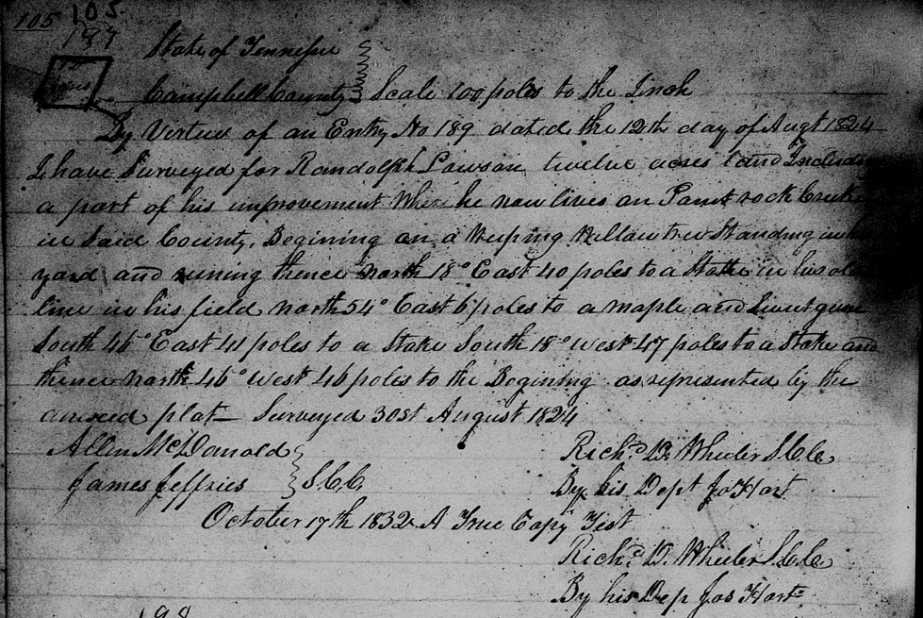
In the late 1830s Randolph and Susanna relocated to Illinois, then moved to Clinton County, Kentucky, where they would die, she in 1844, he in 1848.
Although all of these states in which Randolph and Susanna lived—Virginia, North Carolina, Tennessee, and Kentucky—practiced slavery, Randolph and his descendants appear not to have owned slaves.
Randolph and Susanna, like many of the Lawsons of the southern Appalachian hill country, had many children. Their first child, Elizabeth “Millie”, was born June 10, 1786, in Montgomery County, Virginia, living there until 1797. She moved with her parents when an infant southwest to the Cumberland Plateau, in northeast Tennessee. Here she lived until her death. She married Joseph Phillips and would die in Scott County, Tennessee in 1838.
Their second child, Lakey Kattie, was born in 1792; she married Thomas Chambers and died in 1838 in Scott, Tennessee. Lakey’s twin sister Lucretia “Lucy” married Blackburn Thompson and moved to Wesley Arkansas along with her sibling Maxwell. Other children: Elisha was born in 1793 and died in 1870; Sophia was born in 1794 and died in 1880; Mary Louis was born in 1797 and died in 1870. When Randolph and Susannah relocated to Hawkins County, in eastern Tennessee, they bought one hundred acres in the Puncheon Camp Valley, on Clinch River. Here, south of the Cumberland Gap near Hawkins and Campbell counties, Tennessee, daughter Maggie was born in 1800. She would die young in 1812 in Campbell County. Also at Puncheon Camp their son Maxwell was born, on May 5, 1802. It was around this time, according to Randolph’s 1838 court testimony, while living in Hawkins County, that “his house was burned and all papers destroyed.”
This tragic event must have precipitated the move to Campbell County, perhaps in 1803. The family stayed in Campbell County for thirty years. Here, their son Thomas Andrew was born in 1803. He lived in Campbell County but eventually moved to Erath County Texas, where he died in Feb. 1891. He was married to Nancy Jeffers. Also in Campbell County their daughter Clary (Clarissa) was born in 1812. She married William Jeffries, and died in 1897 in Barry County, Missouri. Son Madison Addison was born in 1814 and would die in 1870. Their last child Milton was born in 1820.
For a history of the Lawson and related families of the American South, see The Lawsons of the American Southern Hill Country | Ash Hill Publishing


Thanks very much for this article! I descend from Samuel Lawson (b. ca. 1800-1804) of eastern Tennessee, supposedly a son of Randolph Lawson & Susannah Cross, with Randolph in turn being a son of Bartholomew Lawson & Susannah Simpkins.
Interesting. What is the evidence that Samuel was a son of Randolph and Susannah?
Why does my reply keep getting deleted?
(I replied to this a few days ago and saw the reply posted, but now it seems to have vanished. Trying again). The evidence of Samuel being a son of Randolph & Susannah seems to be circumstantial. Although I do have at least one DNA match with a descendant of Bartholomew’s son Elisha “Lisha” Lawson, b. ca. 1753. We share 10 cM of DNA. But this match and I are 7th-cousins, so I realize that’s quite a stretch. But we’ve tried for several years but have been unable to determine any other family lines by which we might connect other than through the Lawsons.
Would not Elisha be more likely to have been your ancestor?
On Ancestry.com I have 643 DNA matches under Randolph, so……
Ron Lawson son of Marvin, grandson of Powell, great grandson of Tucker Lawson, Jr. of Tazewell Co. Southwest Virginia that’s as far back as I have knowledge of heirtage.