The Mysterious Mr. Lee

Almost 200 years ago, in 1819, a scientist from England, Thomas Nuttall, journeyed up the Arkansas to near this spot, the Three Forks, the confluence of the Arkansas with the Verdigris and Grand rivers. Nuttall was exploring what had been the southern Louisiana Territory, purchased from France by the United States in 1803. He was collecting specimens of flora and fauna, making notes on the local peoples, examining the Almost Almost 200 years ago, in 1819, a scientist from England, Thomas Nuttall, journeyed up the Arkansas to the Three Forks, the confluence of the Arkansas with the Verdigris and Grand rivers. Nuttall was exploring what had been the southern Louisiana Territory, purchased from France by the United States in 1803. He was collecting specimens of flora and fauna, making notes on the local peoples, examining the geography and landscape. To help him traverse the wilderness west of here, he hired a local hunter and trapper, a man named Lee. Lee led Nuttall west along the North Canadian River to the Cimarron River to the Arkansas River. It was a harrowing journey, and Nuttall almost lost his life, save for the resourcefulness of Mr. Lee.

Hardly anything is known about the life of Mr. Lee. He is one of the billions of humans of the past about which nothing is known of their lives.

Recently, in 2015, there appeared at the theaters an action film, The Revenant, showing through sound and vision the experience of an American trapper, Hugh Glass, in the 19th century. The movie was digital storytelling at its best.

Such a dramatic movie, using computer effects to re-create a grizzly bear attack on Glass, is, in the theater, riveting, engrossing, and the viewer can hardly walk away without being affected–indeed such a movie is the kind of theatrical experience that invites the viewer to believe it is true, because, after all, the viewer has seen it with his/her own eyes.

Because I am a historian, who focuses on trying to re-create the past and past lives based on what passes as the facts, I try to be as incredulous as possible, yet this movie, like all good movies, causes me to pause and consider what it must have been like to have been such a man as Hugh Glass living such an adventurous life. In other words, the movie entraps me into its interpretation of reality, and it is very difficult indeed to separate myself from it.

The movie has hundreds of people involved in its production. It has famous, highly talented actors. It has a screenplay co-written by the director. The movie, and its screenplay is, based on a novel, a work of fiction, and the author, Michael Punke, or the publisher, Macmillan, state clearly on the copyright page that this is solely a work of fiction. It is a story, made-up.

However, the author also includes a list of sources at the back of the book, which tells us that though the work is fiction, nevertheless it is “based on a true story.” This phrase, “based on a true story,” has become a catch-all phrase in the movie industry, indeed in the general popular culture, for saying that even though a story is fiction, and turned into a more fictional and fantastic screenplay, it is still based on fact—for many people, it is therefore, the truth. But, of course, it is not.

The appendix of the novel lists the sources upon which the author re-creates the past. These are books written by historians about the old west, about mountain men, and about Hugh Glass. There are scattered records and traditions left behind about the life of Hugh Glass, which are not altogether consistent, and biographers of his life, such as Jon Coleman in a 2012 biography, and John Myers in a 1963 biography, go out of their way to indicate that the sources for the life of Hugh Glass are largely anecdotal, not direct primary source documents.

In short, The Revenant is completely fictional, not fact, but by presenting itself on the screen in so realistic a fashion, it will be taken as fact by the majority of viewers. This is what modern digital storytelling is like, it seems to me: it enlarges upon traditional oral storytelling, and traditional written storytelling, to bring the visual to bear on the viewer’s credulous mind; and with 21st century special effects, computer-generated, digital storytelling via the theater is exercising a profound impact on the mind of the simple viewer out for an evening’s entertainment.

At the same time, of course, the visual has always been part and parcel to storytelling. There are photographs of mountain men, and paintings and drawings of mountain men, and maps detailing the regions and routes of mountain men. Frederic Remington painted, sculpted, and drew dozens of images of the iconic mountain man of the Old West. Jim Bridger was one of the most famous of the mountain men, who was also a good storyteller; his stories helped to make his reputation and fame. I remember as a child being inspired by his exploits.

There were, of course, thousands more trappers, hunters, and mountain men who traversed the wilderness of the Great Plains, the Rocky Mountains, and mountains and deserts of the West coast and Canada. Most of these men are unknown. Their lives are unrecorded. There is no statue, book, novel, movie, even gravestone, to mark their lives. They are among the vast majority of past humans who are anonymous to us in the present. Their lives, while significant for them and their associates, no longer matter, at least in terms of present awareness of the past.

One such trapper and mountain man was unknown generally during his life and after his death save for the isolated record in a book published in 1821 by scientist Thomas Nuttall. Nuttall was arguably the greatest naturalist in early 19th century America. He explored, as a scientist, the Ohio River, Great Lakes, Mississippi River, Missouri River, and Arkansas River. In 1819 he journeyed up the Arkansas River to this region, the Three Forks, where the Verdigris and Grand rivers join the Arkansas. Here, Nuttall hired a guide, a trapper and hunter known as Lee. Nuttall did not provide his Christian name, nor describe his physical appearance, or provide hardly any details about the life of this man. He appears in the pages of Nuttall’s A Journal of Travels into the Arkansas Territory as Mr. Lee. There are no other records of his life.

There have been no movies made about Mr. Lee. There are no screenplays or novels. There is no biography of his life. His life, in short, is a mystery: Thomas Nuttall tells his readers enough to discover a bit about Lee’s life and personality, but then, after Nuttall’s two-month excursion in 1819 with Mr. Lee over the Oklahoma prairies and down the Cimarron and Arkansas rivers, nothing else is known of Lee’s life.

If we wish to re-create what we can of his life, to resurrect, as it were, his life, we have to rely on more traditional means of storytelling: maps, journals, narrative histories, the spoken word. For the former, maps, there is no better map of the region in which we first encounter Mr. Lee than Tom Meagher’s Sketch Map of the Three Forks. Meagher was a student at Bacone College (Indian University) in the 1890s, was a veteran of Teddy Roosevelt’s Rough Riders, and was a local historian in Tulsa; he produced a map of the Three Forks in 1940. It illustrates the environs in which Thomas Nuttall first encountered Mr. Lee, at Bougie’s Trading Post on the Verdigris River. Meagher’s map is unique in its combination of history, legend, and storytelling by means of drawings of places and peoples.

The next means by which we might resurrect the life of Mr. Lee is through Nuttall’s published journal. In it, we read that on August 11th, 1819, “I left the trading establishment of the Verdigris to proceed on a land journey up the Arkansas, accompanied by a trapper and hunter named Lee, who had penetrated across this country nearly to the sources of the Red river, and followed his present occupation for upwards of eight years.” We learn further, on the 14th that “Mr. Lee . . . began to trap for beaver, and the last night caught four of these animals.” On the 26th, Lee informed Nuttall that he had “nearly lost his life, and all his property, last autumn, by falling in with the Cherokees near the banks of the Canadian.” Lee was a very resourceful man, who, after they had reached the Cimarron River, and having lost his horse to quicksand, “no resource for proceeding remained for my companion, but to construct a canoe, and so descend by water.” Around the region of modern Tulsa, they arrived at an Osage camp. “One of the men was a blind chief, not unknown to Mr. Lee, who gave him some tobacco, with which he appeared to be satisfied.” But others of the Osage were not. When Lee and Nuttall departed the Osage camp, “Mr. Lee, as he descended, now observed two men on the shore, who hid themselves at his approach, and began to follow him as secretly as possible. They continued after us all the remainder of the day, till dark. We knew not whether they intended to kill or to rob us, and endeavouring to elude their pursuit, we kept on in the night, amidst the horrors of a thunder storm, the most gloomy and disagreeable situation I ever experienced in my life.” They escaped, but because Lee was in a canoe and Nuttall on horseback, “unable to keep up with Lee and his boat,” “at noon we agreed to part.” Nuttall went overland to the Verdigris, and Lee followed the descending Arkansas to the Three Forks. We never hear of Lee again, either in Nuttall’s journal or any other source. He disappears from the pages of history.

A good story is based in part on fact. Homer used snippets of the past to re-create the story of the Trojan War, the Iliad, and the story of Odysseus’s journey back to Ithaca, the Odyssey. When I wrote my narrative history retracing Thomas Nuttall’s journeys, in particular his ascent of the Arkansas and journey across Oklahoma, I relied on his journal and other sources, which I elaborated upon by examining the places that he went to, and using my imagination, tempered by my understanding of the time and place, I endeavored to re-create the past in as consistent a way as possible with what I expect actually happened. I used this historical imagination in particular in my account re-creating experiences of Mr. Lee in my book, The Land Between the Rivers: Thomas Nuttall’s Ascent of the Arkansas, 1819.

Here is an example of what I wrote:

Lee’s grandest moment came in late August, 1819, when he and Nuttall were descending the Arkansas River and just departed the Osage camp but realize they were being followed by at least two warriors. Nuttall was on horseback, Lee in his canoe. Late afternoon brought billowing clouds building upward and outward. The rolling mass, reflecting the light of the late day sun, rose to an astonishing height. Observation gave way to imagination, as the massive anvil grew closer, and awe as it darkened the sky and halted the hot southern wind. A brief calm and distant rumbles exploded into a sharp north wind and claps of thunder, lightning piercing all in its path. The glare of the noon sun was a distant memory during the twilight of day. Massive thunderheads, white and gray mushrooms in the sky, filled the horizon. Dusk had an eerie, green look about it. The fascinating show of light streaking across and within the thunderheads became the immediate peril of dancing bolts of lightning, sporadically and unpredictably erupting into terrifying concussions of sound and light. Torrents of rain and hail blasted shrubs and turned the driest earth into sticky mud. Rushing runoff had its way with the soil, creating deep furrows, eroding a path toward neighboring gullies and instant creeks, soon filled with the dull, red water. The two men knew the peril of the storm, but they welcomed its onset all the same. Lee paddled his dugout canoe furiously in apparent utter futility considering that escape from the randomness and instantaneity of the lightning stroke was impossible—especially when the level plane of the river made a canoe and its occupant stand out, a perfect target for the thunderbolt. The situation of Nuttall was even worse. Nuttall urged his horse on in the storm, through sandy beaches, uncertain shallows, and the ever-present danger of quicksand. The unaccommodating riverbank forced man and horse to cross the river repeatedly. The scientist found everything equally terrifying. The principles of electricity, he knew, made he and his horse perfect conductors for the electric charge. The river was, however, as threatening. Its current was still lazy enough, and the water was shallow. But the bottom was completely uncertain. The horse repeatedly stumbled, fell in deep holes, dunking both beast and rider. Then the hapless animal became stuck in quicksand, which unmercifully sucked in both man and horse, their cries for help being drowned out by the sounds of the storm. Fortunately, the hunter Mr. Lee had developed a protective attitude toward his inexperienced companion. Lee was ever watchful for Nuttall’s safety. Nuttall soon felt the rope and heard Lee’s command to tie it around the horse’s neck. With difficulty Lee pulled them to safety. They escaped the storm and the Osage warriors. Somehow, amid all this action, Lee contrived to kill a buck; that night they feasted on venison around the dim light of a campfire, which Lee knew was a beacon to their enemies.

Telling a story of the past is almost old as writing itself. To tell a story of the past in the present enables the listener, the reader, the watcher, to re-live the past, to engage in a sort of dialogue with past lives, to rescue, as it were, the past in the present.

https://press.umich.edu/Books/T/The-Land-between-the-Rivershttps://press.umich.edu/Books/T/The-Land-between-the-Rivers
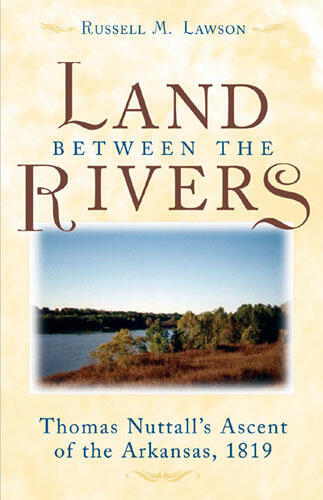
Cover of The Land between the Rivers - Thomas Nuttall's Ascent of the Arkansas, 1819

Posted in American History, Biography, books, History of Science, Natural History | Tagged , , , , , , , | Leave a comment

You Shall Know the Truth, and the Truth Shall Set You Free

This is the gist of remarks I made before students and faculty at the spring 2017 Matriculation ceremony at Bacone College.

Many years ago I was a student at a university on the East coast. This university had a large library filled with books—the kind of library that a person can get lost in rummaging around searching for knowledge. On one side of the building, on a large granite face, were these words: You shall know the truth and the truth shall set you free. I used to walk by this building just about every day, and I would see these words. Admittedly, I was not sure exactly what was the source for these words. I knew they were found somewhere in the Bible, but precisely where, I was not sure. But the words daily made me pause and think. What could they mean? You shall know the truth and the truth shall set you free.

To know the truth: what is meant by, the truth? At the time, as a college student, I vaguely was aware that I sought the truth. Isn’t that what I was doing in college, anyway? The only reason to go to college is to acquire knowledge, to learn, to become educated—in other words, to seek the truth. But what is the truth, and how does a person know if they have come to possess it, to know it?

And the truth shall set you free. Now this second part of the proclamation carved onto the granite face of the library was even more perplexing. Free? Free from what? In what way am I not free? We live in America, the land of the free, correct? What do these words mean?

You shall know the truth and the truth shall set you free: the implication of these words is that if you don’t know the truth, then you are not free. So, if I have not yet arrived at sufficient knowledge, if I have not yet completed my education, then I am not free, I am a slave. To what?

This was all very perplexing to me, so many years ago at this university on the East coast. I could not claim at that time—nor can I claim today, so many years later—that I know the truth. I am in pursuit of the truth. This is one reason why I like to be a professor, as I enjoyed being a student: I feel like we are all in pursuit of the truth. But what kind of truth is it? Scientific? Humanistic? Artistic? Moralistic? Religious? Well, yes—all of the above.

As time passed I became aware of the source of the quote on the granite wall of the library: the Gospel of John. Jesus of Nazareth said these words. I think the key to understanding what he meant is to focus on the second part of the statement: And the truth shall set you free. By free, he did not mean freedom to do and act, freedom to vote and speak: he meant freedom to think. The problem is, that although we all think—some more than others—there are always constraints on our thinking. Sometimes social and cultural norms, ideologies, pressure from friends and colleagues, direct our thinking into certain patterns and accepted paths.

To have freedom to think is to have freedom from something. What? Fear. The reason why humans are not free is because of the fear that dominates our lives. Jesus was saying, that when you know the truth, you will be free from fear.

Fear? Of what? Fear comes to us, confronts us, in so many different ways: fear of the future, fear of being wrong, fear of offending, fear of not conforming, fear of being different, fear of being the same, fear of making a mistake, fear because of making a mistake, fear of what we are feeling and thinking, fear of where we are living and what we are doing, fear of life. Fear, in short, overwhelms.

You shall know the truth and the truth shall set you free: the more that we learn, the more that we know about others and ourselves, the more that we think and understand, the more we will not allow illusions, and rumors, and the opinions of others, and the actions of others, and the future, to dominate us, to shackle us with fear. To think, to know, is to conquer fear. The more we think, the more we learn, the more we break down what is false, the more we come out of the darkness into the light, the more we can understand ourselves, and understand others. As another great thinker of the New Testament said, “Love knows no fear.”

So, yes, You shall know the truth and the truth shall set you free.

Posted in books, Christianity | Tagged , , , , , | 1 Comment

Superstition and Science

In July, 1819, up the Arkansas River several score miles from here, a remarkable conversation took place that could have only happened in the Old West of cowboys and Indians. The conversation involved an Indian, but not a cowboy, rather a scientist, a dandy from Liverpool, England. This transplanted Englishman in the early nineteenth-century American West was Thomas Nuttall, who conversed with a chief of the Osages, whose name was Clermont. Nuttall was out from Philadelphia, from whence he had departed nine months earlier, intent on journeying on foot and by boat across Pennsylvania to the Ohio River, down which to the Mississippi River, down which to the confluence with the Arkansas River, up which to the western prairies, eventually the southern Rocky Mountains. That was at least his intent. Having arrived at the Arkansas River in February, he had ascended the river with the help of traders and French boatmen, landing at Fort Smith in April. At Fort, Smith Nuttall had befriended the army physician, Thomas Russell, and had, on the invitation of the post’s commander Major William Bradford, journeyed with the troops to the Red River in May. Returning to the post in June, he had awaited passage up the Arkansas, had hitched a ride with French boatmen paddling a pirogue, and had arrived at Three Forks, at the confluence of the Arkansas, Verdigris, and Grand rivers, in July.

Nuttall was one of the premier naturalists of early America. He was an expert on America’s flora, having made numerous journeys throughout America beginning with his arrival from Liverpool to Philadelphia in 1808. He was, then, a young former newspaper apprentice who had began to teach himself about botany. In Philadelphia, Nuttall became the protege of Benjamin Smith Barton, one of the preeminent botanists of the early nineteenth century. Barton introduced Nuttall to the Philadelphia scientific community, honed his latent talent for identification and categorization of plants, and sent him on numerous journeys of discovery, the most significant lasting two years and taking Nuttall to the Great Lakes, down the Mississippi, and up the Missouri in the company of French and American fur traders. Nuttall sat out the War of 1812 in England, returning to America in 1815. His mentor Barton having died, Nuttall became the leading botanist in America, publishing in 1818 the Genera of North American Plants and a Catalogue of the Species to 1817. Restlessness and wanderlust, however, drove him forward. He departed Philadelphia in October, 1818, on a journey that would take him over a year. His goal was to make a complete examination of the flora of what had once been the southern Louisiana Territory: the lower Mississippi, the Arkansas and Red rivers, tributaries to these great rivers, and the eastern edges of the southern Rocky Mountains.

Nuttall wore many hats. He became a leading ornithologist in nineteenth-century America. The study of geology and zoology fascinated him. He had a great interest in the American Indian, and made it incumbent upon himself, whenever chance led him into their presence, to record their culture, customs, history, and habits. This he had faithfully done on his journey, meeting with and describing, in particular, the Quapaws and the Cherokees. Presently, in July, 1819, Nuttall met the Osages of the western Arkansas Territory and learned about their superstitions and science. Of the latter, Nuttall wrote that “habitual observation had taught [the Osages] that the pole star,” or north star, “remains stationary, and that all the others appear to revolve around it.” Examining the winter sky, the Indians had become “acquainted with the Pleiades,” the cluster of seven stars during winter in the northern hemisphere, “for which they had a peculiar name.” Nearby in the winter night sky, they “remarked the three stars of Orion’s belt.” Like many cultures past and present “they recognized [the planet Venus] as the . . . harbinger of day.” Familiar with the Milky Way galaxy, they called it “the heavenly path or celestial road.” The “filling and waning of the moon” guided their sense of time, “the concomitant phenomena of the seasons,” and “the natural duration of the year.” Beyond these simple astronomical observations, Nuttall said little else about the Osage’s proclivities toward rational thought.

He had much to say, however, about their proclivities toward superstition. They perceived the sun and the moon as spiritual beings. They considered dreams clear prognostications of reality, and would alter plans and behavior accordingly. They likewise believed in “the observance of omens, the wearing of amulets, and the dedication of offerings to invisible or miraculous agents, supposed to be represented in the accidental forms of natural objects.” They invoked in their prayers the “four quarters of the earth” according to the medicine wheel, and “before going out to war they raise the pipe towards heaven or the sun, and implore the assistance of the Great Spirit to favour them in their reprisals, in the stealing of horses, and the destruction of their enemies, &c.” “Their priests or elders” served as physicians, administering “charms” to the “sick.” “They fear, but do not adore bad spirits.” “Anticipating the contingencies of a future state of existence, they . . . inter with the warrior his bow and arrows.” Their anarchic lack of formal government, Nuttall argued, and “want of legal restraint,” kept the Osages from reaching the level of civilization of their white neighbors.

Nuttall discovered on his journey up the Arkansas that the Osage were not exceptional among American Indians in having far more superstition, and far less scientific thought, than their white American counterparts. “The Quapaws” of the Arkansas valley, he wrote, “are indeed slaves to superstition, and many of them live in continual fear of the operations of supernatural agencies.” The Cherokees, whom Nuttall perceived as happily approaching civilization, nevertheless continued to be overwhelmed with the typical Indian penchant toward blood vengeance to right perceived wrongs.

Nuttall’s experience of observing and communicating with the American Indians on his Arkansas journey, his growing understanding of their superstitious proclivities mitigated by sporadic hints of enlightenment, suggested their comparative place in relation to other human societies over the course of human history. Contemplating the Osages, Nuttall perceived a resemblance between their culture and that of the ancient peoples of Asia, as recorded in the Greek historian Herodotus’s Histories. Reflecting on other tribes, such as the ancient Natchez of the Mississippi valley, Nuttall believed that Indian ceremonies worshiping the sun and burying the dead were similar to those ascribed to the ancient Greeks by Homer in the Iliad. He thought that the customs of the Cherokees, on the road to civilization, were comparable to other “imperfectly civilized nations,” past and present.

The Indians were superstitious, yes, but Nuttall thought that they never quite embraced nonsense and irrationality to the fullest extreme. North American Indians refused to believe in sorcery, nor did they embrace “that kind of irrational adoration called idolatry.” Nuttall would disagree with exaggerated claims of some Americans that the Indians worshiped the devil. Rather, not altogether unlike their white counterparts, Nuttall wrote that “all the natives acknowledged the existence of a great, good, and indivisible Spirit, the author of all created being. Believing also in the immortality of the soul, and in the existence of invisible agencies, they were often subjected to superstitious fears, and the observance of omens and dreams, the workings of perturbed fancy. By these imaginary admonitions, they sometimes suffered themselves to be controlled in their most important undertakings, relinquishing every thing which was accidentally attended by any inauspicious presage of misfortune.” But Nuttall refused to allow their irrational belief in fate to mask the contrary observation that the Indians had a certain common sense, even elevated thought, in their perception of the deity.

All of this is to say that Nuttall, like other naturalists of his time who viewed the Indians with interest and understanding, while agreeing that Indian thought and society had not yet reached civilization, nevertheless perceived the Indians as moving toward a nascent state of civilization, similar to the ancestors of Western civilization and science, the ancient Greeks and Romans. The development of ancient Greek science two thousand five hundred years ago, for example, was superstitious and irrational at the same time as it began to approach the rational analysis and superb conceptualization of the natural world for which they are justly famous. It is well to remember that even the greatest Greek scientist, Aristotle, believed in the geocentric universe, thought that the planets of the solar system were perfect, god-like spheres, and thought that all forms of matter naturally tend toward the center. Even so great a scientist as the Roman physician Galen believed that dreams heralded reality. Greeks and Romans were just as credulous about fate, astrology, and magic as the American Indians. One of the great scientists of first-century Rome, the Elder Pliny, was convinced of the efficacy and reality of alchemy. Greek and Roman soothsayers read the future in the shape of a goat’s liver or the patterns in the flight of birds. Indeed, even more modern thinkers, such as the seventeenth-century European and American scientists Tyco Brahe, Isaac Newton, and John Winthrop, Jr., believed in the hidden powers of the supernatural world.

At the same time, the scientists of the late Renaissance and Enlightenment, from 1600 to 1800, were the ones to establish the bases of modern physics, chemistry, biology, and mathematics. Their achievements in calculus, geological sciences, Newtonian physics, and human anatomy and physiology established a clear difference in rational, empirical science from their predecessors, the scientists of Medieval and Ancient Europe. English, French, Swiss, German, and American philosophers and scientists such Locke, Hume, Newton, Lavoisier, Voltaire, Linnaeus, Kant, Franklin, and Jefferson established such clear, apparently objective knowledge about the universe, world, and human existence that they moved far beyond the apparently primitive speculations of proto-civilized people such as Nuttall confronted on his Arkansas journey. This distinction would remain true if the there were such clear differences between the objective, scientific mind and the subjective, intuitive mind, the former represented by Euro-American science since the eighteenth century, the latter represented by Indians and other such primitive, tribal peoples worldwide. Twentieth-century anthropologists such as Robert Redfield, in his book The Primitive World and Its Transformations, were convinced, for example, in the clear distinctions between the primitive and scientific mindsets: the former, primitive mindset, is focused on the organic and alive, on feelings and beliefs, on the oneness of life and being, on nature as an extension of self, on the mythical and mystical, on the subjective; the latter, scientific mindset, is focused on the concrete, objective, rational, methodical, controlling, reducing, materialistic, and utilitarian.

Theorists of science, however, since the mid-twentieth century have challenged the notion of objective, positivist science. Thomas Kuhn, for example, in the Structure of Scientific Revolutions, argued against the old perception of empirical science, where scientists worked collectively toward the common goal of absolute knowledge. Kuhn presented evidence of the subjective element of science. He and other theorists have posited that faith and intuition have quite a bit to do with science, that science is not so much the individual pursuit of a great mind pursuing absolute truth as a collective pursuit of people (university professors) who essentially indoctrinate others (graduate students) into a received belief in a group paradigm, which is defended as fervently by the devoted as would the religious an object of faith.

If we entertain the challenges to the notion of a clear distinction between subjective and objective knowledge, should we not also entertain the apparent distinction between superstition and science? Superstition refers to a non-rational, non-objective approach toward understanding nature. It is a belief in magical, irrational forces at play in cause and effect relationships in the natural world. The superstitious believer in magical, irrational, supernatural forces believes in an “Other” outside of the self; it is, in other words, a belief in outside forces, both natural and supernatural; and these forces have to be understood, used, and manipulated, by an expert or specialist, whether it be a magician, or medicine man, or shaman. This attempt to understand and to manipulate such outside supernatural forces is similar in principle to what a scientist does in attempting to understand and to manipulate natural forces. Indeed, historians of science argue that modern science owes much to the alchemists and practitioners of white magic in Medieval and Renaissance Europe. We may speculate that there were times in the past when the supernatural and natural merged, when superstition met reason in trial and error, and when the specialist, that is the medicine man or shaman, stumbled upon an actual rational and natural causal agent. For example, Indian medicine men often used hollow tubes to suck out evil spirits that caused sickness. The sucking might be directed toward a wound with pus. In sucking the wound to extract the evil spirit, the medicine man unwittingly sucked bacteria out of the wound, aiding the healing process.

The process from superstition to science involved trial and error, the formation of elementary hypotheses and similar elementary tests in the wild to arrive at a basic understanding from which more sophisticated knowledge might grow. The eighteenth-century explorer Jonathan Carver noted in his accounts of journeys in the upper Midwest that Indian healers, while superstitious, were experts in curing external wounds. “They exercise their art,” Carver wrote, “by principles which are founded on the knowledge of simples,” that is, elementary observation, “and on experience which they acquire by an indefatigable attention to their operations.” The Indian shaman observed what sick animals ate, and tried it out on humans accordingly. Thomas Nuttall’s mentor Benjamin Smith Barton, in his 1798 essay, “Collections for an Essay Towards a Materia Medica of the United States,” commented on what he perceived to be the simultaneous ignorance and knowledge of American Indians:  “what treasures of medicine may not be expected from a people, who although destitute of the lights of science, have discovered the properties of some of the most inestimable medicines with which we are acquainted?” These treasures, exploring naturalists such as Nuttall discovered, included the white oak, the bark of which steeped in tea was useful for its antiviral and antiseptic qualities. Indian healers brewed the leaves and bark of the American beech in tea or applied it as a poultice to treat burns, rashes, and asthma. Likewise, the leaves, pitch, and bark of the white pine helped with wounds, colds, and arthritis. The balsam fir was an important analgesic. Indians treated skin ailments, fevers, lung, and intestinal complaints with the hazelnut and witch hazel trees. Kidney stones were treated with the American elm. Hemlock, Indians discovered, was an analgesic and astrigent. Asthma was relieved by skunk cabbage. The sassafras tree, according to historian and naturalist Jeremy Belknap, “affords a valuable ingredient for beer as well as for medicinal purposes.” Indians used sassafras bark and root tea for intestinal complaints and to treat arthritis.

Nuttall discovered on his own journeys examples of the superstitious Indian having a materia medica that had clear healing properties. Journeying up the Missouri River in 1811, for example, he met and interviewed through an interpreter an Aricara medicine man whose satchel of healing herbs included kinnikinnick, which he used for religious smoking to invoke the Great Spirit. At the same time he carried “the ‘down” of the cattail (Typha latifolia), useful for treating burns and other skin problems; wormwood (Artemisia), useful for intestinal problems and malaria; and Rudbeckia (black eyed Susan and green headed coneflower), used to treat burns, skin irritations, [and] snake-bite.” At Three Forks eight years later, Nuttall learned that the Osage materia medica included “the nettle bush (Urtica), the leaves of which, steeped in hot water, form a tea that Indians and settlers alike used for ailments ranging from arthritis to intestinal and urinary problems.”

Over the course of his many journeys Nuttall discovered the subtlety of the Indian understanding of the environment. He learned the different levels of science and rational thought required to live on the frontier, ranging from the practical arts of hunting techniques, weapon development, and canoe and wigwam construction, to more sophisticated techniques of identifying healing plants and devising remedies that are efficacious in healing, to even more rational and objective forms of observation, such as elementary astronomy, mathematics, and communication. In all of these activities, from hunting and canoe building to mixing healing herbs to observing the constellations, Indians used their minds to rise above primitive magic and superstition.

But Indian science? Was there such a thing? Several years ago I edited a three volume encyclopedia on the history of science in America. In selecting the scores of topics that comprised the book, I focused naturally on mathematics, chemistry, physics, geology, medicine, biology, Nobel Laureates, devotees to the systems of Linnaeus and Newton, and some of the greatest thinkers of all time such as Franklin and Einstein. At one point in the editing process, it dawned on me that there might be room for an entry on the science of the American Indian, even though I was not entirely sure how users of the book and reviewers would greet such an entry. I acquired the services of a specialist, Clara Sue Kidwell, formerly of the University of Oklahoma and Bacone College, to write the essay. She wrote quite a convincing piece claiming that, yes, the Indians did practice science. Her argument fit in quite well with my previous studies on a variety of naturalists of the seventeenth, eighteenth, and nineteenth centuries–besides Thomas Nuttall, the New Hampshire natural historian Jeremy Belknap, the traveler-physician John Josselyn, the geographer Jedidiah Morse, the English botanist John Bradbury, and the French-Mexican scientist Jean-Louis Berlandier. Belknap, for example, a historian, scientist, and clergyman who studied the indigenous people of New Hampshire, remarked in his History of New-Hampshire on the inherent, natural intelligence of the native peoples, whose “invention was chiefly employed either in providing for their subsistence, by hunting, fishing and planting, or in guarding against and surprising their enemies.” “Some of their modes and customs have been learned by our own people, and are still retained.” “We have . . .  learned from the natives,” he wrote, “to dress leather with the brains and fat of the animal, which render it extremely soft and pliable.” Their knowledge of herbs has been passed on, and “some of their medicinal operations are still practiced.” They knew how to prevent bites of venomous snakes and knew antidotes to snakebites. The Indians also devised intricate traps to take game. An example was the culheag, which, according to Belknap, who had examined one, “is a forceps, composed of two long sticks, one lying on the other, connected at one end, and open at the other. . . . In this enclosure is placed the bait, fastened to a round stick, which lies across the lower log, the upper log resting on the end of a perpendicular pointed stick. . . . The animal having scented the bait, finds no way to come at it, but by putting his head between the logs. As soon as he touches the bait, the round stick, on which it is fastened, rolls; the perpendicular gives way; the upper log falls, and crushes him to death in an instant, without injuring his skin.” The culheag allowed the Indian hunter to clothe himself and his family in the warm, durable furs of the ermine, raccoon, beaver, wolverine, rabbit, lynx, mink, and martin. Indian hunters traveled to hunting grounds using two of their inventions, snowshoes in winter and the birch-bark canoe at other times; the canoe, white settlers realized, was clearly the best conveyance over rivers and streams. John Bradbury, sometime traveling companion of Thomas Nuttall, noted in his Travels in the Interior of America that the Sauk and Fox Indians of the upper Mississippi had mastered the art of smelting lead ore.

Jean Louis Berlandier, who is little known today, was born in France and educated in Geneva, and traveled to Mexico in 1826, where he joined a military commission that journeyed to the Rio Grande and the Texas Gulf Coast in 1827. Berlandier ended up spending the remainder of his life in Matamoros, Mexico, just across from Brownsville. He was like Thomas Nuttall an explorer and jack-of-all-trades scientist, though by training a botanist. Berlandier actually came to know the American Indians much better than Nuttall. He befriended Kickapoo hunters and went hunting with Comanche warriors. Their practical, scientific knowledge astonished him. Their ability to reason, to conceptualize, to deduce, seemed as advanced as any white scientist who lived in a similar wilderness environment. Berlandier would not disagree with an argument today that the Indians of the eighteenth and nineteenth centuries did indeed practice science.

In short, scientific thought is dependent upon the experience of the natural environment. That is to say, Indian science was limited, but sufficient for their needs; for their time and place, nothing more was needed to live well. Thomas Nuttall discovered this in Oklahoma in August, 1819, when he journeyed west across the prairies from Three Forks heading west toward the source of the Cimarron River. Accompanied by a hunter named Lee, Nuttall journeyed into lands hunted and protected by Cherokee and Osage hunters. If Nuttall had any doubts about the harshness of the environment, the difficulty of surviving in such an unforgiving land, they were quickly dispelled almost immediately, when he became terribly ill after drinking from a tepid pool of stagnant water. He spent several weeks following the hunter Lee trapping for beaver, following a tributary of the Canadian River, moving toward what is today Oklahoma City then north to the Cimarron River, all the while burning with fever, growing delirious, and coming very close to death. The hunter cared in a rough way for the ill scientist, feeding him honey and finding cool places next to beaver ponds to camp and rest. Lee built a dugout canoe, Indian style, to descend the Cimarron and the Arkansas to the Three Forks. Along the way the Osage pestered the hunter and his ill companion, but the wily Lee, thankfully for Nuttall, outwitted the similarly wily Osage warriors, and Nuttall returned. He made his way, eventually, to Fort Smith in September, 1819, where he stayed for several weeks while fever raged all about him, taking the lives of the garrison’s physician Dr. Russell and many other inhabitants. Nuttall learned first-hand the practical skills and applied science required to survive in the early nineteenth-century Arkansas Valley.

For more Nuttall, see my book,

Cover of The Land between the Rivers - Thomas Nuttall's Ascent of the Arkansas, 1819, published by University of Michigan Press, at:

https://press.umich.edu/Books/T/The-Land-between-the-Rivers

Also for a general treatment of the history of science, see my Science in the Ancient World: From Antiquity to the Middles Ages, published in an affordable paperback on Jan 22, 2026, by Bloomsbury: find it at: https://www.amazon.com/Science-Ancient-World-Antiquity-through/dp/B0FSW74DKZ/ref=books_amazonstores_desktop_mfs_aufs_ap_sc_dsk_0?_encoding=UTF8&pd_rd_w=6oCC7&content-id=amzn1.sym.299f645c-0a78-440a-94a2-fb482e7cb326&pf_rd_p=299f645c-0a78-440a-94a2-fb482e7cb326&pf_rd_r=142-5197957-8175817&pd_rd_wg=Erb81&pd_rd_r=7cdd0d6a-0a38-49cf-a2ba-a

Posted in American History, books, History of Science, Natural History | Tagged , , , , , | Leave a comment

The Crisis in American Politics

What the 18th century Framers of our government feared, abuse of power and corrupt politicians taking control of our system of government, has apparently come to pass, if this election season and those who are our choices for President, are any indication.

The Framers—people such as Washington, Franklin, Adams, Jefferson, Madison, Jay, Hamilton, Dickinson—feared that Democracy would result in demagoguery, as it did in ancient Athens, and Republicanism, if not checked and balanced, would result in unbridled power, especially in the hands of the Executive.

The Framers were particularly influenced by the ancient Roman Republic, which was a very successful government for a time. The success of Rome was because of the checks and balances on executive power: two consuls were elected annually, could not be re-elected, and had the veto over the other; the Senate, the membership of which was comprised of former magistrates, also had a check on the power of the consuls, who were charged with enforcing laws and commanding the military—as does the President of the United States.

The Romans also had a worldview based on moral principles that seemed appropriate for Republican government. They believed in pietas: piety–respect for elders, respect for ancestors, following the ways of tradition; gravitas: gravity–seriousness, commanding respect, and stolidity; and virtus: virtue—prompt and effective action in the face of problems, tasks, and enemies.

Some of our Presidents have had these characteristics: Washington had gravitas; Roosevelt had virtus; Lincoln had pietas.

I wonder: what quality does our current President have that sets him apart from others? What quality does Hillary Clinton or Donald Trump have that would fit pietas, gravitas, and virtus? Clearly, it is difficult to answer these questions, in part because the highest office has increasing succumbed to arrogance, vanity, hubris, callousness, corruption, and demagoguery. The President of the United States is far too powerful a person to elect anyone who cannot show humility, restraint, wisdom, piety, dignity, strength of character, honesty, and foresight.

Based on our choices and who we have had for the past eight years, I would say that the American people have their work cut out for them, to find a solution to the demagoguery, corruption, political correctness, and subordination to special interests, that dominate our politics, and have effectively made the President and the Executive Branch a tool of ideologues and their political interests.

Posted in American History, Government | Tagged , , | Leave a comment

There are Trillions of Lives–What about Me?

There are 7.5 billion humans residing on this small Earth, which is 15% of how many people (demographers estimate) that have lived on this Earth over the course of its 4.5 billion year history. Therefore, more people are dead, have died, on this planet than those currently alive. What is more, there are more dead of anything that has lived on this planet than things currently living. Most species of life that have resided on this Earth, say scientists, have become extinct. Most extinct creatures became extinct long before humans, so we don’t have to blame ourselves for those!

Incredibly, there are millions of species of animal types sharing Earth. The numbers of individual animals are in the hundreds if not thousands or millions of trillions, as researchers with a great capacity for counting (at the National Science Foundation) have estimated that there are at least one trillion species of microbial, plant, and animal life residing on Earth.

These numbers should please the Atheist, who cannot believe that such meaningless multiplicity can have a supernatural origin. How could there be a personal deity involved in the lives of trillions of beings?

At the same time, these numbers should please the Theist, who believes that such multiplicity can have nothing other than a divine origin, created and cared for by an omnipotent, omniscient, loving Being.

But if God is watching over plants, microorganisms, birds, snails, snakes, foxes, dogs, and insects, is He also watching over me? How can I know?

Posted in Christianity, God's Providence | Tagged , , , | Leave a comment

Of Snakes

Ever since the serpent beguiled Eve, and God condemned the serpent to crawl on its belly in the dirt, serpents, or snakes, have seemed to most of us as disgusting, horrible creatures, little better than spiders and scorpions. That they are sometimes venomous, even lethal, adds to the revulsion and horror that humans often feel.

I have recently been struck by the debate over whose lives matter, especially because the debate has been circumscribed to human racial divisions. But life is, of course, much more than this.

All lives matter: humans, birds, toads, bees, cows, pigs, dogs, cats, insects, fish, and yes, even snakes.

I have not always believed this. I have killed my fair share of snakes. Indeed, about five years ago a huge rat snake showed up in my back yard. I did not want to kill it, and tried to remove it, but it would not cooperate. Was I to allow it to reside on my property? Of course not! So I killed it with a shovel. But it put up a good fight, and it took me a good fifteen minutes to drag it from a defensive position it took up. I took many blows to kill it. Afterwards, I felt terrible. I killed an innocent creature for no other reason than that it was an inconvenience. What right does one being have to take the life of another being merely because of inconvenience?

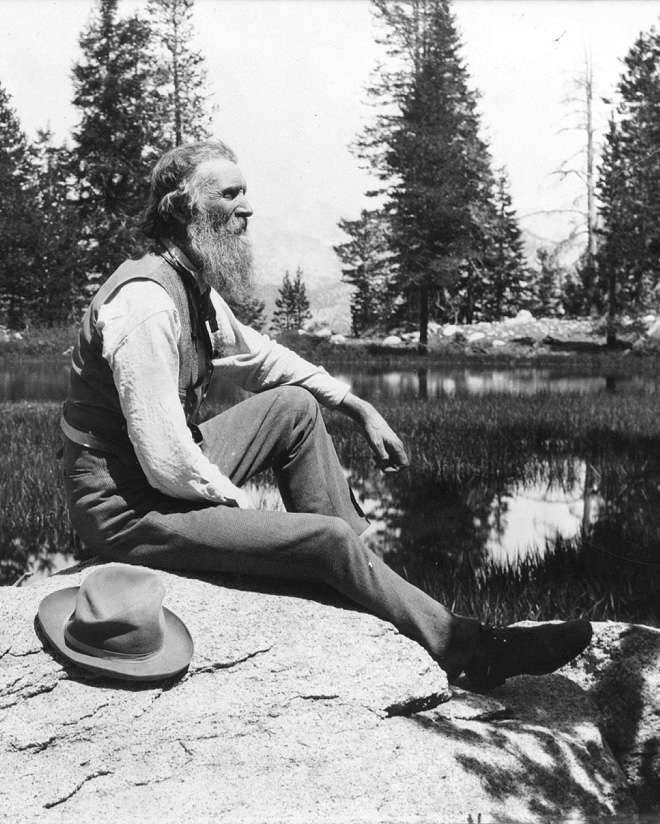
The definitive statement on behalf of snakes was made by the naturalist John Muir early in the twentieth century, in his essay, Yellowstone National Park. Rattlesnakes, he wrote, are an “irrational dread of over-civilized people” who fear too much. “Poor creatures, loved only by their Maker, they are timid and bashful . . . and. . . seldom, either by mistake or by mishaps, do harm to any one.” Nevertheless, the question is repeatedly asked: “’What are rattlesnakes good for?’ As if nothing that does not obviously make for the benefit of man had any right to exist; as if our ways were God’s ways.” Ultimately, rattlesnakes are “good for themselves, and we need not begrudge them their share of life.”

Life is an end in itself. And it takes great arrogance for humans to assume that they have the right to take life—any life—whenever it suits them. It is of course legal to kill most forms of life on earth, generally out of convenience. But as the theologian Richard Hooker once declared, “whatsoever we do, if our own secret judgment consent not unto it as fit and good to be done, the doing of it to us is sin, although the thing itself be allowable.” Perhaps, in other words, an action is legal—but it might not be moral. It might not be right. God alone knows.

undefined

Posted in Natural History | Tagged , | Leave a comment

Reflections on Steinbeck’s The Grapes of Wrath

I participate as a scholar through the Oklahoma Humanities Council Let’s Talk About It Oklahoma series. Last night I addressed an audience in Broken Arrow about John Steinbeck’s The Grapes of Wrath. The gist of my comments follow:

At his first Inaugural as President of the United States in March, 1933, President Franklin Roosevelt addressed a nation in shock over the overwhelming material and emotional depression that had cast a pall over the American people. Rarely does a President capture the spirit of the times as Roosevelt did in this inaugural address. “First of all,” he said, “let me assert my firm belief that the only thing we have to fear is fear itself–nameless, unreasoning, unjustified terror which paralyzes needed efforts to convert retreat into advance.”

Indeed, fear gripped the United States of America: fear of economic woes, political ineptitude, gang violence, bank failures, job loss, home and farm foreclosures, hunger, famine, disease, death. The fear was felt everywhere in America: not only did the poor, abandoned, dispossessed, and hungry feel it, but the wealthy, secure, and full felt it as well. The fear was, that what was happening to some—poverty, hunger, disease—would happen to all notwithstanding class, wealth, and ability.

Yes, Roosevelt was correct, the only thing, really, that Americans, who lived in a land of relative plenty, peace, and freedom, had to fear was that they would become inept, weak, unable to move, in the face of an overwhelming terror that it was all coming to an end. And, notwithstanding all that Roosevelt attempted to do to belie the fear, it would not go away, and it continued to spread, continued to grip people, rich and poor alike.

The presence of this fear was captured wonderfully, poetically, in The Grapes of Wrath by the author John Steinbeck. Rarely has an author been able to capture the spiritual malaise and despair of a people faced with overwhelming fear as Steinbeck did in his book. Set in the 1930s in Oklahoma, a land hit particularly hard by the depression because of a decline in agricultural production due in part to the erosion of topsoil–the Dust Bowl—Steinbeck tells the story of the Joads, a tenant farm family forced off their land with nowhere to turn. An impersonal, cold, calculating, economic and technological power wrought by the modern machine age of the Industrial Revolution scatters machines and heartless men across the land, taking, dispossessing, destroying peoples’ lives. The Joads and many others—the Okies—hear of an almost paradisiacal situation of jobs and fruit and land in California, and set off to take advantage of this western Elysium as have so many others from the East (Europe, Asia, Eastern United States) journeying to the supposed utopia of the West.

The Joads experience something akin to the frontier experience on their journey along Route 66. Wherever they stop along the way, along the roadside, in makeshift camps, in Hoovervilles, there is a democratic spirit of equality and people helping people, a wonderful sense of community of empathy and love, periodically countered by the angry violent fear of the settled and satisfied in the places to where these Okies have come.

Steinbeck thought that the dreamlike potential of America as a land of freedom and plenty had not been actualized. America is supposed to be a place of opportunity and liberty, not a place of famine and exploitation. Steinbeck was clearly influenced by the philosophy of the Marxists and others who believed that class struggle was the result of industrial capitalism. The Joads and other Okies were the Proletariat struggling against the minority Bourgeoisie that controls the economic and political infrastructure of society. But Steinbeck could see a future where the Bourgeoisie overplays its hand, exploits too much too often, and the Proletariat, the people, rise up, harvest the grapes of wrath, and take over, destroy.

Steinbeck was also influenced by writers of the late 19th/early 20th who saw the organic, community fabric of society being fractured by the artificial, the mechanized, the impersonal bureaucrat, the rational calculations of the money power, which leaves the old traditions upon which America has been built—family, community, faith, trust, work, the land—falling, almost disappearing. But the Joads, and others like them, hold on to the old values, refuse to give in to the new ways, and hope, in the end, remains.

But so too does fear: of all of the problems that perplex and overwhelm humans and other life forms–disease, starvation, weakness, despair, hopelessness, anger and wrath, injustice, faithlessness—the greatest fear of all is Fear itself.

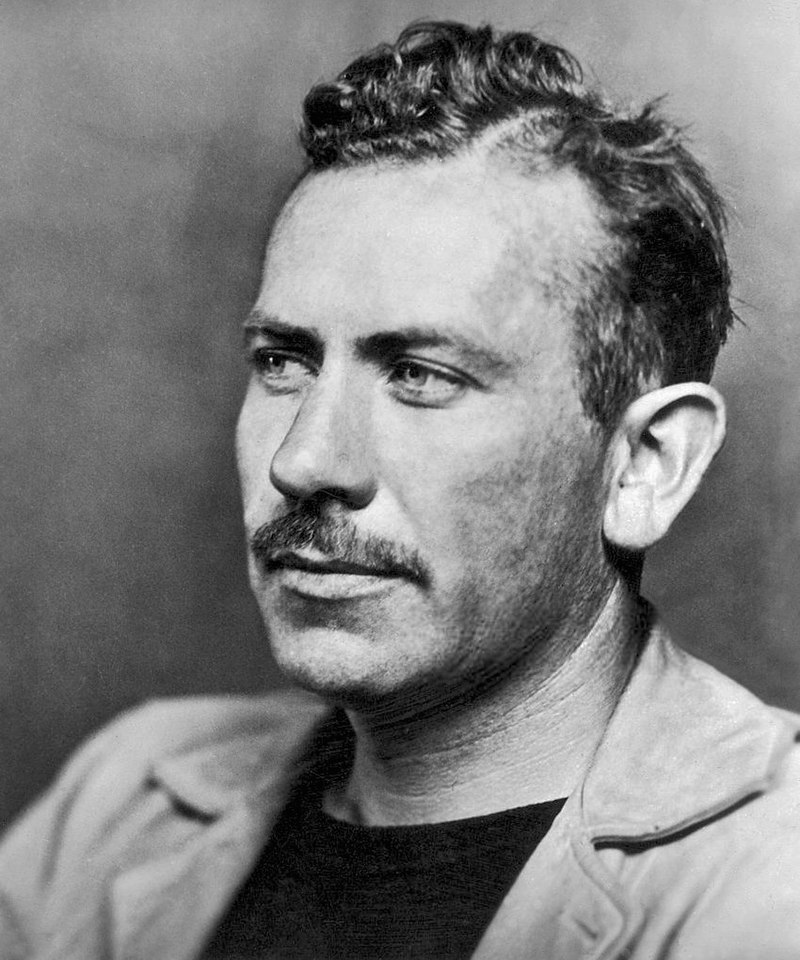
Steinbeck in 1939

Posted in American History, books, General Essays | Tagged , , | Leave a comment

The Answer Is: Power, Love, Self-Control

I belong to a group of men, the Brotherhood of St. Andrew, most of whom are of the Anglican tradition, who meet weekly to discuss Christianity, and to share a meal as well as Eucharist or Morning Prayer from the Book of Common Prayer. Yesterday was my turn to do the scripture lesson, to present my ideas and interpretation of four readings, two from the Old Testament, and two from the New Testament. I discussed Paul’s Second Letter to Timothy.

During the course of the discussion, one man asked how an older person should respond to a young person who has embraced atheism. The following was my answer:

Atheism is a philosophy that is a figment of the imagination. It derives from a lack of satisfaction, from unhappiness, from feeling unfulfilled, from fear of the many tragedies that befall humans. How can God allow, if he exists, the many disasters that we read about, experience, on a daily basis? How can God allow the random deaths of children, cancer coming to a person who is apparently healthy and happy, tornadoes that sweep through neighborhoods, terrorist attacks, random murders of the innocent, civil wars, fires sweeping through apartment buildings, the attacks of 9/11, and so on, and so on? There are too many disasters and tragedies and chance occurrences that kill and dismember to list them all. Think of the hunger that exists, the poverty, the disease, the drug abuse, the crime. One wonders: where is God in all of this? God, why have you forsaken us?

These questions have been asked for thousands of years by thoughtful and despairing people who question God even as they realize He exists. God is so much a part of our existence that to deny Him is to deny Self, to subject oneself to never-ending anxiety about what was, what is, and what will be. Jesus on the Cross quoted Psalm 22, God why have you forsaken me?, rhetorically, for he knew that God, Self, never forsakes.

We live in times of terror, disaster, crime, racial conflict, economic woes—but of course all times are alike, never has there been a time of peace, happiness, love, plenty, unending fair skies and full stomachs. So, because each moment has sufficient cause for worry, humans, indeed all animals, fear.

Fear, timidity, cowardice, one could say, is the natural state of humankind. For how can we confront each moment of uncertainty with certain courage and faith? It is quite impossible, because the next moment of uncertainty comes, followed by the next, and the next, and the next. It doesn’t end until death. The anxiety of each passing moment convinces some people that there is absolute uncertainty in the world, that is, there is no God.

In Paul of Tarsus’s s second letter to his friend Timothy, Paul, in one sentence, summed the human dilemma, summed Christianity, and summed why atheism is a philosophy that is based on fantasy. He told Timothy that God asks us to be fearless: fearlessness derives from power, love, and self-control. The Greek word for power, dynamis, is the same word used in the Gospels to describe Jesus’s power in healing others. It is the power of love. And a person can only use this power of love by means of self-control, that is, self-awareness, to realize that love is found in oneself. And this love is God, for as John truly said, God is Love.

Love is a universal, a constant throughout time and place, found wherever there is hate, despair, tragedy, suffering. Love is the universal, the transcendent, the eternal, the infinite. The atheist proclaims there is no God, then proclaims that love exists, not realizing the inherent contradiction.

To discipline oneself, to channel love toward others, is a work of great power. It is the means by which love combats hate.

There is much noise in our society: television, movies, videos, cell, tablets, pc, iphones, speakers, headphones—the list goes on and on. Humans are constantly talking and listening, though rarely is the communication relevant. If a person retreats to his or her own room, there he or she might find God. A wonderful example of this is the song by Thousand Foot Krutch, “In My Room,” the lyrics for which can be found at this link: http://www.azlyrics.com/lyrics/thousandfootkrutch/inmyroom.html

See also:

Posted in Christianity, God's Providence, Great Commission, Reflections on the Psalms | Tagged , , , , | Leave a comment

In Defense of Great Books

Recently Yale University students asked their professors to stop assigning readings from English poets, as there is a preponderance of White male poets, and the White voice has been dominant for too long.

I teach at a college where the White voice is not dominant, indeed where there is incredible diversity in a variety of racial and ethnic backgrounds. Yet I still have assigned the Great Books, and in one class in particular, an Honors First Year Seminar class, I required students to select a Great Book of their own choosing, write a paper, and give a talk.

This assignment was color and gender blind. Students could pick any Great Book, by a woman or man, by a Black, Indian, White, Asian, Jew. My only requirement was that the book be considered by the intellectual community at large, by librarians and scholars and teachers, as a profound work of literature. Why assign such a book?

Reading a Great Book can engender in students the ability to examine a text, ask questions, seek answers, come up with a creative interpretation of what they have read, and write intelligent, critical essays, and make intelligent, critical comments, based on their reading and thinking.

Bacone College over the course of its 137 years has often sought to create the conditions under which students can achieve an excellent liberal arts education stimulating questioning, seeking, discovery, analysis, and rhetoric, which have always been the core of the Liberal Arts, which focuses on human expression and human experience over time in history, philosophy, religion, science, society, culture, government, and institutions.

The Great Books stimulates the traditional philosophy of the Liberal Arts, which was based in the Trivium (grammar, logic, and rhetoric) and the Quadrivium (arithmetic, geometry, music, and astronomy). These seven objects of inquiry and their modern equivalent form an important foundation for an educated person who pursues lifelong learning, provides an important basis for personal philosophy, and provides tools for success in a variety of careers. Liberal Arts involves the study of those subjects that open the mind and help bring about a free people. The seven objects of inquiry—grammar (English, literature, languages), logic (philosophy, deductive and inductive thinking, theology), rhetoric (history, humanities), arithmetic (numerical reasoning and inductive thinking), geometry (spatial reasoning and deductive thinking), music (arts, studies in culture and human expression), and astronomy (the hard sciences)—form the essence of the liberal arts: to question, to seek, to learn, to know, to accept others and oneself. The medicine wheel, which is the essence of Bacone’s seal, is the orientation of the campus, and has provided a philosophical basis for the college, is reflected in the Trivium and Quadrivium: spiritual seeking, emotional and natural thinking, focus on the intellect and past tradition, finding solutions to the manifold problems of life: in short, self-discovery. Students with such an education are prepared to engage in graduate level work in the humanities, social sciences, arts, and sciences; ready for careers in the public and private sectors; and educated for careers that require thoughtful, analytical, and articulate people.

The Liberal Arts is particularly focused upon a multi-cultural approach, examining cultural expressions, history, religion, society, thought, economics, and politics of Americans and other peoples of the world. Bacone College has a mission to serve American Indians and other historically under-served students in a Christian environment. As a Bacone professor, I reach out to students who are American Indians from dozens of tribes, African-Americans, Hispanic-Americans, Caucasians, and students from around the world, eliciting from them a questioning attitude about their own heritage and those of their classmates, seeking answers amid the cultural variety that helps bring humans together.

The Great Books, an essential component of the Liberal Arts curriculum, helps students to learn to acquire knowledge about the nature of humanity, helping a person to become more reflective about the self, which helps in developing sophisticated forms of thought, such as conceptualizing human experience based on analysis rather than guesswork. Knowing more about humanity over time, students break from human credulity to have a more critical assessment of life’s experiences. Increasingly in the 21st century, human organizations and institutions—corporate, educational, governmental—seek thoughtful, reflective employees who can conceptualize phenomena, understand patterns, analyze problems, form hypotheses, and suggest and implement solutions. These employees, educated people who are engaged in lifelong learning, are literate and articulate communicators.

I cut my teeth as a High School Senior and College Freshman and Sophomore on the Great Books, especially the ancient Greek, Roman, Hebrew, and Christian classics from the first millennium BC and first millennium AD. I seek to inspire students likewise to begin their pursuit of knowledge by means of a thoughtful examination of the great words of a great mind between the covers of a great book.

Posted in books, General Essays | Tagged , , , , | Leave a comment

Narrative History Rescues the Past

“Narrative History Rescues the Past”–You’re not likely to see this headlining the latest news feed, though subtle truth rarely makes the news.

Moreover, narrative history is rarely sensational, rarely fantastic, and is (unfortunately) not imaginary, rather based on real people and real places; reality rarely captivates the way fantasy and the unreal do. Yet fiction is not likely to rescue the past.

Doubtless I appear to be writing nonsense: how can people living in the present, anticipating the future, rescue something that has disappeared, gone, never to be relived? The past can be remembered, recollected, but rescued? Hardly.

Stubbornly, perhaps, I maintain that the past can be rescued, and that narrative history wrought by narrative historians is precisely the means to do it; a good narrative historian is a rescuer of the past.

Take my latest book, The Sea Mark: Captain John Smith’s Voyage to New England. There have been many books written on John Smith, of course, and movies made, and poems written, and caricatures drawn, and monuments dedicated to—and more. Why would he need to be rescued, if by that obscure, if pithy, word rescue I mean to bring to awareness, to make known, in the present?

No, that’s not what I mean by rescue. But I am getting ahead of myself. Let me define terms. First, what is meant by narrative history?

Narrative history is an account of sequence of events over time restricted to actual sources or implied events; it uses the historical imagination to re-create a particular episode (if consistent with sources); it uses quotes from writings as a replacement for dialogue; it does not manufacture or imagine a plot, rather the plot occurs as a matter of course based on what really happened; it re-creates scenes based on actual experiences; events and sources guide the imagination and storytelling (not vice-versa); and it relies on honesty: honest use of sources, honest presentation of past, honest evocation of human experience.

A narrative historian must write about a person or topic for which they wish to re-live, re-create, re-experience. Sources must exist to allow for this mental exercise, as well as the penchant to understand human nature, which is gained by reflection into self. Added to this is a good imagination: to imagine the past, imagine what happened, imagine the people, then conform the imagination to the sources, to what really happened. Empathy unites, organizes, creates the whole portrait of the past: as the historian researches and imagines, visits places, he/she must feel, must sense the past, must empathize with those who once lived.

Empathy is the means by which the past can, as it were, be rescued. Empathy with another, even another long dead, requires a vicarious dialogue to be created in one’s head. This dialogue with the past was perfected by a highly imaginative philosopher of the 14th century: Francesco Petrarca, who conversed by means of his pen and paper with past people, Cicero and Augustine: he asked them questions, and heard, in his mind, a response.

A dialogue with the past: this is how the historian rescues the past. This dialogue is a mixture of the subjective (feeling based on imagination) with the objective (reason based on sources); it is getting to know the past person: their habits, feelings, thoughts, interests, aims, emotions, accomplishments; it is dealing honestly with the past: the honest appraisal of person by not imposing one’s own point of view, one’s own preconceived notions, on the past, which is anachronistic.

To empathize with the past one must feel the past as well as feel the present. To understand the life of a past person, one must understand his/her own life. The historian’s own life helps to write the story of the past: the historian’s own feelings helps to understand past feelings; the historian’s thoughts helps to understand past thoughts; the historian’s experiences helps to understand past experiences.

In short, narrative history/biography is the story of two lives, one life explicitly told (the past person) and one life implicitly told (the historian or biographer). In studying these two lives, the life of the past person is rescued, comes alive in the present, to live again in the historian’s mind and in the words put on paper.

For an example, see

Posted in American History, Biography, books | Tagged , , , , , | 1 Comment