New England Missionaries and the American Indians

We have been broken up and moved six times. We have been despoiled of our property. We thought when we moved across Missouri River and had paid for our home in Kansas we were safe, but in a few years the white man wanted our country. We had good farms, built comfortable houses and big barns. We had schools for our children and churches where we listened to the same gospel the white man listens to. The white man came into our country from Missouri and drove our cattle and horses away and if our people followed them they were killed. We try to forget these things but we could not forget that the white man brought us the blessed gospel, the Christian’s hope. This more than pays for all we have suffered.

                                                              –Charles Journeycake, Chief of the Delawares

Humans are subject to the tyranny of time. At a single moment, a person’s life changes, takes a different direction than that heretofore. Humans try to track such instances, narrow them to a specific date, time of day, hour and minute, to attempt to exert some feeble control over what is uncontrollable. Other instances cannot be dated, are not subject to clocks and calendars. They just happen, vaguely but definitively.

            At such a moment, Daniel Little was walking along the road returning home from the port, where he had journeyed earlier that day to inquire about a shipment of furniture he had been expecting. His business concluded, he departed for the two mile walk along the Port Road back to the parsonage, where he and his wife and children lived in a small village called Kennebunk. Little had lived in Kennebunk for half a dozen years, having accepted the call of the Second Parish in 1751 to minister to their needs. He had in 1752 built a snug two-story dwelling on the outskirts of the village on the road to the port. The Kennebunk River was just north of his home. He had a fine garden, a quiet life, a stable existence, and considered himself happy, blessed by God.

            Little was a native of Newburyport, Massachusetts, and had grown up in nearby Haverhill. He had been well-educated by private tutors and had become a gifted Gospel minister. He arrived in Maine at a time between wars, when there appeared to be a modicum of peace, the previous conflict, King George’s War, having been concluded a few years earlier. The inhabitants of Maine had, unlike some British-American settlements in North America, generally been spared the worst of recent warfare. Rarely did Maine homesteaders fear for their lives from attacking French and, particularly, their Abenaki allies. Indeed the British had been on the offensive against Indian tribes and the French during King George’s War, and the Indians had the worst of it. Likewise when war broke out again in 1755, Maine seacoast communities were largely spared the violence that others further west and south experienced. There was then, during the French-Indian War, a slight sense of security in Maine seacoast communities that previous generations would have hardly felt.

            Daniel Little was walking alone this day on the road from the port, approaching a bridge crossing a tidal inlet, feeling full and satisfied, his thoughts wandering about his favorite themes—the wonderful plenty of the land; the rich fodder, marsh hay, bending in the breeze; the cool, moist air promising much for the farm community; God’s benevolence revealed in nature—when a sudden noise interrupted his solitude. A whistle. Not the whistle of a gull or hawk, or the whistle of the wind blowing through birches and pines. Rather an artificial whistle made by a contrived instrument. Little had heard the pewter and wood whistles used by militiamen on training days, but this one somehow sounded different, ominous. There was no militia training that day. All was quiet save the brief shrill of the whistle. Uncertain, afraid and cautious, Little slipped from the road and hid in the tall marsh grasses next to the bridge support. A whistle implied at least two separate warriors or warrior-bands. Had they seen him? Were they coming even now to capture him? He thought of his family, his widowed wife, his fatherless children. Even if the raiders had not seen him, they would use the road, cross the bridge, as he had. Little, knowing he must depart quickly, crawled on his hands and knees in the shallow, rank water of the marsh, provided by the grace of God to protect him; he moved slowly away from the bridge. He heard soft footsteps. He glimpsed a warrior. Stories from the past descended upon him.

            A child in Haverhill, growing up during Dummer’s War, when there was so much talk of militia hunting scalps, paid for by the Province of Massachusetts according to the age and gender of the deceased; listening to the bravado of the soldiers mixed with the fear in peoples’ voices of the savagery of the enemy, of the barbarism, of how they treated defenseless children and women, though they learned their lesson when they captured the likes of Hannah Duston during King William’s War, who paid them back fully, taking their scalps and bringing the bloody trophies to Haverhill. Indians and French attacked the town again in Queen Ann’s War, just a dozen years before Little’s birth. Other towns besides Haverhill—such as Deerfield, Dover, Oyster River, Salmon Falls, York—in Massachusetts, New Hampshire, and Maine, experienced the silent incursions of the enemy, the killing of the innocent, the capture of women and children. The people of the time considered the Indians worse than dogs. Ministers in the pulpit condemned them as agents of the Enemy. They were a silent, nefarious force of evil, unexpected, merciless.

            The warriors Little saw, if he got a good look, were scantily clad save for a breech-cloth and moccasins and leggings reaching to the upper thigh, but nothing about the stomach and chest. They were strong, tattooed, their head shaved except for a scalp-lock. They were armed with bow and arrow, or a musket, and a war ax with a stone or iron head. The minister crawled along the narrow tidal channels that marked the marshland, which allowed him to go undetected. He made his way in a westerly direction for a long time until he no longer heard the sounds of men, and feeling that he had escaped the immediate danger, quickly rushed back to the parsonage, paralleling the road, fearing the worst, praying for the best.

            Little found that all was well. Indeed the raiders had apparently come and gone without attacking anyone; all in the community were saved. But something had changed in the mind of the pastor. The peace that he had felt before the incident had vanished with the raiders. Little kept his possessions, family, friends, and life, but not his peace. There was now a blot on contentment. The presence of evil, Little knew from the Bible, is constant, ubiquitous—but hitherto he had rarely known it. Evil was theoretical, something to be talked about, a theological concept, like Adam and Eve’s sin, a distant reality that never quite penetrated the body and mind. Evil, like God, transcends the moment, and though Little was aware of its existence, he had never felt it overwhelm the present. Until now. Evil is present, possible at any moment.

            He could never rid himself of the sound of the whistle.

            Daniel Little became, within twenty years, the Apostle of the East—so-called by his contemporaries and admirers for his many journeys along Maine’s eastern frontier to minister to the Indians and English settlers particularly of the Penobscot valley. Little made repeated journeys before and after America’s War for Independence. He was a restless adventurer, a messenger for Christ. So many of his ilk, the hundreds of Protestant clergymen of small New England towns, never ventured forth; they were content to stay put, to battle sin among their own neighbors, to shepherd the flock in the daily cares of life, to administer the sacraments of baptism and communion, to teach and preach, counsel and condole. Little did all of these as well during his long tenure as pastor of the Second Parish of Wells, Maine—what became the first parish of Kennebunk. He served the people for over fifty years. But all of this activity as a pastor, the responsibilities of a large family, the intellectual demands on a Christian minister, were insufficient. Little felt compelled to do more.[1]

            Some few among New England Congregationalists of the seventeenth and eighteenth centuries felt this same call of Daniel Little. His predecessors in time but not in commitment, energy, and spirit, included Eleazar Wheelock, John Sergeant, Experience Mayhew, Thomas Prince, John Eliot, and Roger Williams. Congregationalist Roger Williams, who came to know the Narragansett Indians of Rhode Island, was one of a number of European and American scientists who were fascinated by the Native Americans, their customs, and their origins. Of the many speculations on the origins of the American Indians, one of the more sophisticated were ruminations of Williams published in A Key into the Language of America (1643), in which he argued that the language and customs of the Indians bespoke a heritage not unlike the ancient Hebrews. “First,” he wrote, “others (and my selfe) have conceived some of their words to hold affinities with the Hebrew. Secondly, they constantly annoint their heads as the Jewes did. Thirdly, they give Dowries for their wives, as the Jewes did. Fourthly (and which I have not so observed amongst other Nations as amongst the Jewes, and these🙂 they constantly separate their Women (during the time of their monthly sicknesse) in a little house along by themselves foure or five dayes.”[2]

            Other Congregationalists agreed. John Eliot, minister at Roxbury, Massachusetts, for example, thought some Algonquian dialects so like the Hebrew that it made sense to teach these people the Hebrew Bible. In time he changed his opinion, opting instead to embrace the onerous project of translating the Bible into the indigenous Algonquian language. The problem was that Algonquian had no syllabary, no systematic grammar, was a spoken language, concrete rather than abstract. Eliot became such an expert in Algonquian that his first sermon preached to the natives in 1646 was in their own language. On his missionary visits, Eliot would “offer a short prayer in Indian, . . . recite and explain the Ten Commandments, . . . describe the character, work, and offices of christ as Saviour and Judge, . . . tell his hearers about the creation, fall, and redemption of man, and . . . persuade them to repentance.”[3] Eliot believed like most messengers that embracing Christianity was insufficient without also embracing the civilized accoutrements that accompanied the faith. He believed that the way of Jesuit and Franciscan missionaries, to live among the Indians and adopt their ways as a stimulus to conversion, was inappropriate. “I find it absolutely necessary to carry on civility with religion,” he wrote.[4] He sought true and committed converts, which included “strict observance of the Sabbath, family prayer, grace at meals, Bible-reading, a conviction of their sinful and lost state, spiritual experience of renewal, and a sincere purpose to lead a godly, consistent life.”[5] Eliot followed in the wake of his missionary forebears in journeying to reach distant peoples to bring the message of the Gospel. Hearing of the great sachem of the Penacooks, Passaconaway, a shaman who reputedly had mastered the dark arts (in Eliot’s mind) to convince his people of his great power over nature, Eliot traveled up the Merrimack River, and met with Passaconaway. Some traditions claim that the great leader converted, though perhaps not. The Penacook Confederation was at this time in the mid-seventeenth century caught between expanding English power in Northern New England, expanding French power in the St Lawrence River valley and tributaries to the south, and the power of Mohawks (Iroquois) to the west, south. and east of Lake Ontario. Passaconaway and his son and successor Wannalancet tried to negotiate with all of the competing forces to preserve their power along the Merrimack River. In this they failed, and Wannalancet took his people upriver to the Pemigewasset, and eventually further north of the White Mountains of New Hampshire. Reputedly he was a Christian by this time, converted by John Eliot.[6]

            Eliot was part of a missionary society inspired by Englishmen such as the scientist Robert Boyle and chartered in the 1660s in New England: hence its name, the New England Company, initially called the Society for Propagation of the Gospel in New England. Like most such societies it collected and invested funds, from which it supported and paid missionaries and schoolteachers and supplied them with books, sermons, and Bibles by which to convert and teach the Indians. They believed that conversion was necessarily long and drawn out because of the inability of the Indians to read the Word. One novel idea in this regard was to select intelligent boys and send them to Harvard; five Indian boys learned Latin at Harvard in the 1650s.  A building called the Indian College was built for the purpose, but the experiment in the end failed, and the idea conceived by some members of the New England Company to educate Indians as missionaries to their own kind was abandoned.[7]

               One of Eliot’s great accomplishments was publishing the Indian Bible. He believed that it would be difficult enough for the Indians to learn about Christianity in their own language, much less to learn a new language as well. Eliot learned the language from war captives and his servants. “He secured from time to time what he calls the more ‘nimble-witted’ natives, young or grown, to live with him in Roxbury, and to accompany him on his visits” to the Indians, “to interchange with him words and ideas.”[8] One of his first students, who helped with translating, was a Long Island Indian named Job Nesutan.[9] The New England Company and Commissioners of the United Colonies of New England (New England Confederation) paid to print Eliot’s efforts, such as his Indian Primer or Catechism. His first translation of Genesis was an interlinear English translation. His first attempt at translating the New Testament was the Gospel of Matthew. His complete translation of the New Testament was published in 1661, followed by the Old Testament in 1663. He published a book on logic called The Logic Primer to teach reasoning to the Indians. The Indian Dialogues was to teach missionary work among them.[10]

               The New England Company also supported the work of Eleazar Wheelock, who founded Moor’s Indian Charity School, a boarding school for Indians, in Connecticut. Wheelock had some influential students, such as Samson Occom, a Mohegan convert during the Great Awakening; Occom eventually was a missionary to Long Island Indians and the Oneida Indians of upstate New York. Another was the Mohawk convert Anglican Joseph Brant, who attended Dartmouth, Wheelock’s college founded along the Upper Connecticut River in New Hampshire.[11]

            Congregational messengers to the Algonquians and other Indians during the eighteenth century increasingly believed that the natives should, once they gained the basics of Christianity in their own language, embrace English ways: language, culture, customs, Bible, and worship. This was a lofty aim, especially on the frontier, and particular where Roman Catholic missionaries had come before the Protestant messengers.

            Such was Daniel Little’s experience. Little became a member of the Society for Propagating the Gospel Among the Indians and Others in North America, founded by New England clergy in the 1780s. Like many of the members of this missionary organization, Little tended toward a liberal Protestant theology in which he reached out to others through good works more than theological prescriptions. After the defeat of France in 1763, there was a religious and power vacuum in the Penobscot valley; the native Penobscot tribe, like many Maine Algonquians, had been converted by the French Catholics. Little, impatient with what he considered to be the flimsy theology of the Papists, wanted to bring to the Penobscots a love and devotion for the Gospel. At the same time, English settlers of the eastern frontier generally lacked contact with Gospel ministers, and were hungry for the rich milk of the Word. Both of these groups, Indians and frontier settlers, living in religious limbo, required not just the Gospel but the accoutrements of religious society as well. Little, not a religious theoretician, rather a practical preacher, sought as a pastor and missionary to spread a pastoral Christianity fit for an agrarian people.

            Daniel Little like many of his contemporaries combined the roles of clergyman and scientist; his particular interests were in the physical and life sciences and metallurgy. Little’s simple piety in a God who blesses all of the Creation led him to move increasingly away from New England Calvinism to a more Universalist mindset. Feeling that anyone can be saved spurred Little on to bring the Good News to the ignorant, the wayward, the Catholic, the Indian.

            Little’s interest in natural history encouraged him to keep journals of his travels, in which he recorded his itinerary, those with whom he met, the landscape in which he traveled, and his observations of the remarkable of nature and humankind. He made six extensive journeys, of which he kept detailed diaries of five, which provides a window into a past time when the settlements of the eastern frontier and Penobscot valley were rustic and few and far between. Daniel Little revealed the same jubilation and wonder on his several journeys during the 1770s and 1780s to Penobscot Bay and up the Penobscot River. As a pastor and a missionary Rev. Little focused on the practical means to achieve a happy existence. He knew there were many white settlers along the eastern Maine coast with no religious instruction, and the morals of their communities reflected it. To help, Little journeyed in 1772 to the Penobscot, founding a missionary church at Blue Hill on a peninsula that separates Penobscot Bay and Blue Hill Bay. During the War for Independence, he traveled up the Penobscot to present Bangor, at the confluence of the Penobscot and the Kenduskeag River. Little baptized children and instructed settlers and Indians on Christian morality and the Bible. When preaching to the Abenakis, he read portions from Rev. John Eliot’s Indian Bible, created over a century before. But finding that the natives could not understand the language, Little followed Eliot’s example and transcribed a Penobscot dialect and translated portions of the Bible accordingly.[12]

            One manuscript journal, Minutes of the Progressive Growth, and Maturity of the most useful Vegetables at Penobscot, &c, describes his observations made on a journey in 1785 up the Penobscot River to “Indian Old Town, . . . ten miles above the Head of the Tide” and “70 miles north from the Entrance of Penobscot Bay.” Of the vegetation of the Penobscot region he wrote: “Passing thro corridor adjoining to Penobscot Bay in [the] Month of June I observed a Young Growth of Oaks and maples for Several Acres together which . . . upon Examination found Worms who were just finishing their Harvest. The People say they are hatched from the Eggs of a Caterpillar which are laid on the Smooth Bark of trees in the month of Sept to which they adhere and are hatched by the Heat of the Sun, the May following. They are one Inch in length, of a dark brown Colour. The Leaves of other Trees adjoining and intermixed, remains untouched, in full Verdure.” Of the Penobscot Indians at Old Town, Little wrote: “On an island in the River on the lower Point of which stand the Indian Houses in 2 Ranges, in very exact Order, of the Same Dimensions and Materials, around which they plant their Corn. . . . Their Manure [is] Alewives, of which they cover with Earth. . . . The Children of this Tribe numerous–they appear very easy and contented–no signs of Envy, very grateful and sometimes a little gay.”[13]

            Daniel Little, in short, braved mountains, rivers, foggy bays, isolated islands, barrenness and loneliness, and inhospitable conditions of nature and humans for the sake of the Great Commission, his own personal redemption, and knowledge. What motivates a person to pursue the Great Commission? What led Daniel Little on his restless pursuit into the wilderness of nature and the mind? Perhaps he wished to conform to Christ’s commandment to spread the Word to all nations, as recorded in the Gospel of Matthew. Perhaps he believed in bringing the Word to the whole creation, hence to all places, even the most sparsely inhabited, as recorded in the Gospel of Mark. Perhaps his personal sense of sin and redemption demanded that he show others a similar way to peace and life. Perhaps it was distant memory, a whistle from the past, an urge to return to a time when he had peace of mind, when he knew little fear, when Evil did not taunt him with the possibility of shattered expectations. To bring Christianity to the original source of fear was the means to expiate it, come to terms with foreboding and end the anguish of the spirit.

******************************

The experiences and feelings of Daniel Little—and the other missionaries whose lives and works are evoked and rescued in this book—were akin to the Apostle Paul, the first missionary. Paul’s missionary work was in response to the burden of sin. He was plagued with an “angel of satan,” guilt and the continual need for atonement, which kept Paul dependent upon God’s grace. Even the great Apostle felt  ongoing sin and weakness and he called upon God to release him from the torment. But Paul was not ready to be without that constant spur to his faith and obedience.  Redemption compelled him to tell others, to replay his own experience over and over, so in a way to reassure himself that he was indeed redeemed.

            The experiences of Paul, the psychology of the missionary, are found throughout time, found centuries later in North America among Protestants who were looking for more, were trying to make sense of the Message that they were themselves bringing to others. The messengers to the American Indians were weak, uncertain, and sinful, engaged in a personal journey in the wilderness among unknown peoples, a journey of redemption and atonement. They were responding to Jesus’s commandment, as reported in the Gospel of Mark, to “Go into all the world and preach the gospel to the whole creation,” and the Gospel of Matthew, “Therefore go and make disciples of all nations.” The Great Commission itself engendered confusion and doubt. The world was not entirely known to the Greco-Roman culture in which Jesus and His disciples lived—the Americas, for example, were not known to Old World peoples for centuries. How can the Gospel be taken to places unknown? But Jesus commanded, Mark says, to preach the Gospel to the whole creation. The Greek word, “ktisis,” literally means “creature” or “creation.” How does one preach to all creatures, to the whole creation? Countless individuals responded to the commandment with personal journeys into the unknown of peoples and places. There is already mystery and uncertainty in confronting the everyday, in confronting the newness of experience inherent in the passage of time. But to embrace even further change and uncertainty by exploration into the unknown, bringing the message to unknown others, is to increase anxiety, hence to increase reliance upon God.

            Missionaries, in spreading the Gospel, were doing so in part as a response to their own sin, the awareness of which led them to act. There was restless energy felt by the missionaries to expiate and atone for their own transgressions by trying to remove those of others. They were trying to remove the splinter from the eyes of others notwithstanding the huge plank in their own. Daily the weight of personal sin required movement; the air of the wilderness helped the missionary not to suffocate. What else drives a person to do this but atonement? Like Paul reaching out to the Gentiles, American Protestant missionaries reached out to Indians, humans believed to be in a pre-redeemed state, when sin is rampant and before humans have been saved by Christ, when Satan holds sway—a time and state that can recur again and again when temptation brings a person back to an earlier, pre-redeemed state. This id-like part of us, the savage part, is ubiquitous, and if one is not constantly vigilant it will recur. Missionary work is vigilance for one’s own continual redemption.

            The origins of Indians fascinated sixteenth, seventeenth, and eighteenth century missionaries because discoverers and colonists of America were confronted with the presence of a people that were not touched by the Great Commission. Missionaries had traveled to most countries of the world by the time of Columbus’s voyage, and it was obvious that even those places touched by the Great Commission could easily return to sin. But what about a people never so touched? It is similar to thinking about oneself before and after any great event of education or civilization or conversion. What was humanity like before then after the Incarnation? American Protestant missionaries were as a result historians of the peculiar experience of America; they were fascinated by the past, both distant and not so distant. and by personal history, that is, their own psychology.

            The psychology of the missionary involves the elevated sense of self. How does God appoint a person to be a messenger? For a person to assume such a role is an indication of a measure of self-importance, some hint of self-perceived greatness. Spiritual experience has convinced this person to engage in an arduous, sometimes dangerous role. A sense of selection, or election, which involves a spiritual or mystical experience, exists. What is this but a calling, and what is a calling but a mystical experience—a communication with the divine? This self knowledge, of limitations and possibilities, propels and harbors the messenger going forth in strange lands among strange peoples. Missionaries such as Daniel Little possessed an intuitive strength gained through prayer and religious struggle to know what and who is God and how the messenger relates to God, faith in God’s will, and the continual battle waged against sin and the humility consequent thereon.

            The messengers of the seventeenth, eighteenth, and nineteenth centuries were the intellectuals, the scientists and historians, of their time. They combined a scientific interest in Indians—their origins, history, customs, and culture—with the personal religious zeal of a missionary. The commandment to spread the Gospel to the entire creation implied that missionaries would be students of nature, natural theologians, amateur scientists. The missionaries described in this book knew that God’s providence existed; hence they were students of time, of history, both natural and human. As Edward Young proclaimed:

‘T is elder Scripture, writ by God’s own hand,¾

Scripture authentic! Uncorrupt by man.

            All that the missionary learns of God’s creation, natural and human, serves to increase knowledge, that is, to penetrate a bit of what God is the sum of. Faith in God yields faith in self, which increases faith in God. God is the unyielding source of power and strength, the food that continually feeds, the drive that never ceases, the love that never forsakes. Love of God yields love for all of God’s creation, including love for self, love for nature, love for humankind. Love of self is the propeller for action to move in time according to a set purpose. When one feels God’s love one feels love itself, toward oneself and toward others. Perfect love knows no fear.

            God’s love is really the key to the work of American Protestant missionaries. To spread God’s love is to feel it, to know it in oneself, and to recognize it in all God’s works. This is the essence of the piety of the missionary, to feel overwhelming love for God because of awareness of all God’s gifts of knowledge, life, security, purpose. What God has given is awe-inspiring. The pious scientist studies natural and human history to achieve this awareness. Natural and human history, seeing God’s works over time and the wonderful intricate patterns and consistency of it all, yields continual piety, awe, in God’s plan and God’s creation. The scientist who examines cause and effect, patterns, explanations for phenomena in human and natural history, when finding said patterns, consistency, regularity, and order, senses therefore the origins and reasons behind it all, and discovers the source is God.

            This is what Paul meant in his Epistle to the Romans, chapter two. Our lives in time seem so isolated, disjointed, lonely, purposeless, meaningless, that when we see meaning, purpose, pattern, order, harmony, consistency, in nature, in human existence, being reflected in our own existence, we are looking upon something that appears transcendent, and that which transcends time, movement, the momentary, the isolated, is truth, or at least it appears as a truth beyond our normal experience. Therefore when a person goes outside oneself, examines experience other than oneself, the experience of other humans, the experience of other life in nature, then this willingness to examine what exists outside self is the route to know God. Movement, action, travel, experience, study, history, science—all these tend to a greater awareness of what is, which we call God. We are movement, we are continual becoming, but when we find the still, the unchanging, the final, the ultimate, that which is, being, this is God, this is love.

            Missionaries such as Daniel Little, Jeremy Belknap, Jedidiah Morse, John Ogilvie, John Stuart, Robert Addison, Samuel Andrews, William Case, Peter Jacobs, Peter Jones, Isaac McCoy, Charles Journeycake, Joseph Murrow, Almon Bacone, Robert Hamilton, Mary P. Jayne, George Hicks, and Lucy Hicks were people reaching out to different cultures to come together in peace rather than conflict, to discover common human feelings, experiences, drives, and characteristics such as love, fear, inquisitiveness, the demand to survive, and the common need to discover constancy out of the randomness of the singular moment. These people discovered and evoked common human experiences, and a bond grew, that is, the basics of love, and the more the common bond was formed the more love was fueled. Awareness of common experiences fueled awareness and knowledge of order, harmony, and consistency that yielded piety in the source of all that is unchanging and constant. Missionaries transcended the boundaries of space but in the process found the transcendent truth common to all cultures. These missionaries were messengers of order, harmony, constancy, peace, truth, and love.


[1]     Sources of information for Daniel Little’s life, work, and writings include the Daniel Little Papers, Brickstore Museum, Kennebunk, Maine; Records of the First Parish Church of Kennebunk at the Maine Historical Society; and scattered sources at the Massachusetts Historical Society.

[2]     Williams, A Key into the Language of North America.

[3]     Justin Winsor, The Memorial History of Boston, vol. 1 (Boston: Osgood, 1881), 262.

[4]     Ibid., 263.

[5]     Ibid., 265.

[6]     For more information, see Russell M. Lawson, Passaconaway’s Realm: Captain John Evans and the Exploration of Mount Washington (Hanover: University Press of New England, 2002).

[7]     William Kellaway, The New England Company, 1649-1776: Missionary Society to the American Indians (New York: Barnes & Noble, 1961).

[8]     Winsor, Memorial History, 261.

[9]     Ibid., 271.

[10]   Kellaway, New England Company.

[11]   Ibid.

[12]   Daniel Little Papers, Brickstore Museum.

[13]   Belknap Papers, Massachusetts Historical Society.
For more, see https://www.amazon.com/Apostle-East-Journeys-Daniel-Little-ebook/dp/B07CMF2R5Y?ref_=ast_author_dp_rw&th=1&psc=1&dib=eyJ2IjoiMSJ9.kUZIS5Al0_zKgdrrr5SzCIiJF30vxn6uHcNP6k2N52r2DWHgoEJmJic1Cy_s_3O7DjGJlIiS-MDaEOdx78oBRY_Mpga-vr8P4GNEO3Ng2fJAYMr8A4rfJBtSsaCDx6Of31ApJ_I70Rd9s0k4zerljQWzBD8qNbOgWzzAEw267FnlZ9Rpa6FQHqpqjtZMf3NwW4BWH-dLlhMoVP8HGNGMPLVJfbM2cgirprcTiCc_lVQ.hKVKjxkQjPY4ak8BMDsIrHSTxy1lzy6kcUB2l1K5v-8&dib_tag=AUTHOR

Posted in Biography, books, Christianity | Tagged , , , , , , | Leave a comment

Jesus of Nazareth

Jesus of Nazareth

Who was Jesus?

               Jesus the son of Joseph and Mary was born in the town of Bethlehem in Judaea around four to six B. C., or according to the Roman dating system of the time, 747 to 749 years since the founding of the city of Rome. Herod the Great ruled the Kingdom of Judaea with the acquiescence and support of the dominant empire of the time, Rome. The emperor Octavian Caesar, Augustus, had been princeps of the Roman Empire for over twenty years, and was in the process of establishing a dynasty that would continue decades after his death. The empire was relatively peaceful: Roman institutions, government, and law provided security and continuity. Roman imperial government was not as harsh as other states, before and after. The benefits of Roman citizenship were sought after, and given due respect. No doubt the humble carpenter and his wife who gave birth to their son in Bethlehem knew little of Roman policies, politics, and traditions. Writers who traced the life of Jesus a half-century after the fact of his birth claimed that Joseph and Mary made their home at Nazareth in Galilee, which was a pastoral, maritime community dominated by a farm economy and the freshwater Sea of Galilee. Fish was the staple of many tables. Fishermen walked to the synagogue along with farmers and craftsmen. Nothing is known about the life of Jesus up to his thirtieth year, save that he and his family had some indications of the significance of his life as they fit his birth into the context of Jewish teaching, history, and tradition.

               The Hebrews had for over a thousand years looked for the appearance of an anointed one, a Messiah (Christos) who would champion their cause, who would free them from suffering and political oppression, who would lead them to a new age wherein the chosen people of Yahweh would find redemption and peace–and power and glory as well. The Messiah was to come in a blaze of glory. According to the Book of Daniel in the Old Testament, the Messiah would provide a temporal and secular manifestation of what all people seek, what people of the ancient world in particular sought–wealth, power, glory, revenge, martial success. Hence did the Jews hunger for the anointed one. They looked for such a person. When Jesus began his teaching, according to later writers such as the author of the Gospel of Mark, he was hesitant to proclaim himself the anointed one. But those around him believed that he was. Indeed, during his ministry of several years in and about Judaea, Galilee, and Samaria, Jesus gained a group of followers as well as the reputation as a helper, healer, and teacher of God’s love and redemption. Jesus rarely spoke in any clear terms about who he thought he was. He allowed others to define him as the Son of God, the Messiah, the Holy One. About his own identity he was silent save one simple, mysterious phrase that according to all the Gospel writers he used in self-definition and proclamation. This was the phrase Son of Man. Jesus’s use of the phrase is as mysterious today as it was two thousand years ago. What he meant by the phrase has confused his followers both then and now. And yet it is in his adopted title, his chosen identity, that we see clearly how to measure our own existence in light of the existence of the anointed one, the Son of Man.

Rome

               When Jesus was born at the end of the first century, B. C., the entire Mediterranean world was controlled by the Roman Empire. The city of Rome was founded, according to tradition and legend, in 753 B. C., and was ruled by foreign (Etruscan) kings until 509 B. C., when the Romans revolted, the king was deposed, and Rome established a representative government, the Republic. The Romans were excellent soldiers: the Roman legion consisted of heavily-armed infantry and supporting cavalry. By 300 B. C. Rome was in control of Italy. Opposing the rise of Roman power, however, were a variety of Mediterranean empires. The empire of Carthage in North Africa controlled the western Mediterranean and opposed Roman expansion west of Italy. The kingdom of Macedon in Greece controlled the Balkans and opposed Roman expansion east. Ptolemaic Egypt was rich and powerful, as was the Seleucid Empire in Western Asia.

               The Roman rise to power in the Mediterranean was rapid and ruthless. The Romans conquered Carthage in a series of wars (Punic Wars), and obliterated the city of Carthage itself by 150 B. C. Shortly thereafter the Roman invaded Greece, conquering Macedon and its king Philip V by 180 B. C. The Seleucid Empire, a large Greek empire that was the remnant of the conquests of Alexander the Great, was controlled by Rome late in the second century, B. C. The varied wars that resulted in Roman power led to the decline of the Roman Republic. Powerful generals assumed illegal powers. The most famous Roman general, Julius Caesar, attempted to establish himself as a king in the mid first century, which began the Civil War in 49 B. C. Caesar’s forces defeated the forces of Pompey by 45 B. C.–Caesar declared himself Dictator. Caesar’s rule was short-lived, however, as he was assassinated in 44 B. C., which began another civil war in which Octavian (Augustus) Caesar would conquer Caesar’s friend and ally Mark Antony and Antony’s lover Cleopatra of Egypt. Octavian marched on and occupied Egypt in 31 B. C.

               During this period of Rome’s rise to power the Hebrews had struggled against a series of different kingdoms and empires attempting to control Palestine. The Apocryphal books of Maccabees describe the Jewish struggle against the Seleucid king Antiochus during the mid second century B. C. Meanwhile Roman power continued to expand into Asia; early in the first century B. C. the Roman general Pompey took control of Palestine and established governors and client-kings to rule the region. One of these rulers, after the death of Pompey and assassination of Caesar, was Antipater, from the region of Idumaea. Antipater’s son Herod succeeded him in 37 B. C. and gained the support of Octavian, who ruled Rome from 31 B. C. to 14 A. D. Herod was an energetic ruler who sought to maintain his personal power at all costs. He supported Judaism and lavished money (gained through ruinous taxation of the people) on his own palaces, in the building of cities (such as Caesarea), and on Jerusalem. He was, like many ancient kings, surrounded by flatterers and family members who sought power.

               Soon after the Resurrection and ever since, for almost two thousand years, some have questioned whether the stories of the New Testament are simply that, stories, without a basis in reality. The Gospels were written between thirty and sixty years after Jesus’s death, when the early church was growing and attempting to attract members and to justify its claims. What better way of justification than to base all claims in the teachings and life of a miracle-worker, the Christ, the Son of God, who willingly died for human sin only to live again three days later before ascending into Heaven? But what if early Christians created Christ for their own purposes? A corollary to the question, “How do we know that Jesus actually lived?” is, of course, how do we know that he was the Messiah and Son of God. In other words, even if he did live, is he really all that the Gospels claim he is?

               To answer in the affirmative that Jesus did in fact live, and that what the Gospels claim about him is true, we must rely on contemporary sources, and examine the impact of Jesus’s life on individuals who lived at the same time. Contemporary sources include, of course, the Gospels, but also the writings of a non-Christian, Flavius Josephus (37-100). And there is no better example of the impact of Christ’s life on a contemporary than the life and writings of Paul of Tarsus, author of the New Testament Epistles.

Gospels

               The four Gospels were written in a form of common, spoken Greek, koine, between 60 and 100 A.D., thirty to seventy years after the death of Jesus. Jesus taught by word of mouth; listeners continued to pass along his words for generations until some sayings and stories were recorded. The Gospel of Mark was not the first in order but, according to modern biblical scholarship, the first written, circa 65 A.D., by John Mark, friend of the disciple Peter and associate of the apostle Paul. German scholars of the nineteenth century believed that the reason Matthew and Luke have similar stories to Mark, often more fully rendered, is because Matthew and Luke relied on Mark as a basis for their Gospels. The stories of Jesus in Matthew and Luke not found in Mark, these German scholars reasoned, were based on another source, or common oral tradition, which they labeled quelle (source), or simply Q.

               Written for a Jewish and Gentile audience, the Gospel of Mark introduces Jesus of Nazareth as the Son of Man, which is how Jesus referred to himself. The mystery of this self-proclamation is further heightened by Jesus’s insistence that those whom he heals should not reveal his true nature as the Christ, the Son of God. The reasons for his reticence to be so identified is as unclear as his preference for the designation of Son of Man. The gospel does not provide the birth stories that are found in Luke and Matthew, and indeed does not provide any biographical information except for a vague account of Jesus’s ministry when he is a mature adult and near the end of his life. The Gospel of Mark provides a disjointed chronological narrative, broken into various episodes in the life of Jesus, related in isolated vignettes. The gospel emphasizes Jesus as healer and as Messiah bringing forth the Kingdom of God.

               The Gospel of Mark is the shortest of the gospels, introducing stories and events that the longer gospels of Matthew and Luke explicate in greater detail. the portrayal of Jesus in the Gospel of Mark is more human than the others, notwithstanding the numerous miracles this gospel (as well as the other three) describe. The Jesus of the Gospel of Mark is not always certain (as when he claims no one, not even himself, knows when the Son of Man will return); he is afraid on the night of his betrayal in the Garden of Gethsemane; he is reluctant for word that he is the Messiah to spread throughout the land; and he tells homely, pastoral parables to illustrate his life, message, and purpose. Examples of the latter include the parable of the sower and the parable of the mustard seed. In the former, Jesus says that “A sower went out to saw. And as he sowed, some seed feel along the path, and the birds came and devoured it. Other seed feel on rocky ground, where it had not much soil, and immediately it sprang up, since it had no depth of soil; and when the sun rose it was scorched, and since it had no root it withered away. Other seed fell among thorns and the thorns grew up and choked it, and it yielded no grain. And other seeds feel into good soil and brought forth grain, growing up and increasing and yielding thirtyfold and sixtyfold and a hundredfold.” The meaning of the parable is that the immediacy of conversion rarely takes root and grows, for true conversion is long and difficult. The parable of the mustard seed

               The Gospel of Mark is written in a simple Greek than can mask its power and profundity. For example, Mark 9: 30-37: In this passage Jesus leads the disciples through Galilee, teaching them that “The Son of man will be delivered into the hands of men, and they will kill him; and when he is killed after three days he will rise.” The disciples, however, are blind to the real purpose of Christ: “they did not understand the saying, and they were afraid to ask him.” Uncertainty and secret fears of his words (rhema), which deal with last things (eschatos), lead them to a typical human response to fear, self-centeredness and narcissism. Coming to Capernaum, a port on the Sea of Galilee, the disciples discuss which one among them is greatest; Jesus castigates them for such vanity, and tells them: “If any one would be first, he must be last of all and servant of all.” Jesus knows that to act against fear and uncertainty one must turn to others, become a servant  (diakonos) to others. The last will be first (protos). Then, “he took a child, and put him in the midst of them; and taking him in his arms, he said to them, “Whoever receives one such child in my name receives me; and whoever receives me, receives not me but him who sent me.” In short, to be like the prototype, Christ, one must embrace fear of last things, of death, and by serving others put aside fear.

               The Gospel of Matthew, written (probably) circa 70 A.D., reputedly by a former tax collector and disciple of Christ identified in Luke and Mark as Levi, was directed toward Jewish Christians, to show Jesus was the Hebrew Messiah, fulfilling Hebrew prophecy. The most noteworthy part of Matthew is the section of moral teaching known as the Beatitudes, based on a series of statements by Jesus during the sermon on the mount wherein he indicated who are the blessed ones. “Blessed are the poor in spirit, for theirs is the kingdom of God,” he proclaimed. Jesus teaches that those who realize our poverty in the face of God, who empty themselves before God, are happy. “Blessed are they who mourn, for they will be comforted.” The mournful are those who feel sorrow for themselves, but for others as well. To feel pain and suffering in the human condition is to feel sympathy and empathy, which is the path to love. “Blessed are the meek, for they will inherit the land.” The meek, the humble, the one who knows he is no better than another, rather than the proud and arrogant, the one who thinks he is better, will enjoy true happiness. Competition with others so to justify pride and arrogance will never satisfy, will only spur further competition. “Blessed are they who hunger and thirst for righteousness, for they will be satisfied.” A person who seeks what is right and true will see righteousness and truth in his own life. “Blessed are the merciful, for they will be shown mercy.” To show mercy is to forgive, to feel charity and love toward another; God in turn will show charity and love toward the merciful. “Blessed are the clean of heart, for they will see God.” The person of a pure heart, he who is clean, who eschews sin and evil, will see goodness itself, God. “Blessed are the peacemakers, for they will be called children of God.” He who acts in accordance with God, who is peace and love, becomes the child of God. “Blessed are those who are persecuted for the sake of righteousness, for theirs is the kingdom of Heaven.” One must fight for God’s ways no matter the consequences. “Blessed are you when they insult you and persecute you and utter every kind of evil against you because of me. Rejoice and be glad, for your reward will be great in heaven.” Blessedness, that is happiness, in short, comes to those who live according to God’s ways rather than the ways of the world.

               The Beatitudes are not as absolute as the more rigid moral requirements that follow in Matthew’s gospel. Unlike the Ten Commandments, the Beatitudes praise certain traits and behaviors rather than condemn specific actions. The verses following the Beatitudes are more severe injunctions of correct behavior. Jesus commands his listeners not only against killing, as in the Ten Commandments, but against anger and slander as well. Not only must a person not commit adultery, but also to refrain from looking at another person in lust, which is akin to adultery. Rather than “an eye for an eye, a tooth for a tooth,” Jesus commands his followers to not resist violence with violence. “If any one strikes you on the right cheek, turn to him the other also.” These are moral demands that cannot be met in normal everyday life, just like no one can completely abide by the Ten Commandments. For example, the notion of turning the other cheek requires that the Christian practice complete pacifism, that he does not respond to violence in kind. This is a good principle, and one every person should strive for. But in reality there are times when a person cannot help but defend himself and his family, and he must respond violently. Jesus, no doubt, knew this, but wanted to indicate his interpretation of the Scripture as well as his ethical commandments. However, he knew we would fall short. If we did not fall short, what would be the purpose of the redeemer? Jesus died for our sins, meaning that he took our inevitable sins upon himself to cleanse us. But this does not end sin, for merely by being human we will sin, as the Apostle Paul knew.

               The Gospel of Luke was written circa 70 A.D. by the physician Luke, Paul’s friend, for Gentile Christians. This gospel presents the most full biographical account of Christ’s life. Indeed Luke, who also wrote the Acts of the Apostles, was the first historian of Christianity, narrating the history of Jesus and his followers from Christ’s birth to the activities of Paul throughout the Mediterranean region. Luke’s Gospel, like Matthew and Mark, is often a disjointed series of vignettes. Jesus is the Son of Man who performs miracles and constantly warns that unbelievers and sinners will never see the Kingdom of God. Luke also provides the fullest account of the birth of Jesus, including the story of Joseph and Mary traveling to Bethlehem, finding no room for Mary who soon will give birth, finding a barn and a manger to lay the newborn in, and being visited by shepherds who have heard of the birth from angels. Luke provides the fullest account of the birth of John the Baptist. It is through Luke that we learn the most about the role of Mary in God’s plan of redemption. Luke also provides the only information about Jesus in the years between his birth and ministry, when he is found conversing with scholars of the Jewish Law at the Temple in Jerusalem when he is twelve years old. In Luke, we have some of the most beautiful and most powerful stories and parables in the Gospel literature.

               The first three Gospels of the New Testament are called the Synoptic Gospels because they generally follow the same pattern and provide a similar account of Jesus. The fourth Gospel, John, is quite different. The Gospel of John was written circa 95 A.D. by the disciple whom Jesus loved, John son of Zebedee. Written for Jewish Christians, it is the most mystical of the Gospels, heavily influenced by Greek philosophy. The Gospel of John, unlike the Synoptic Gospels, presents Jesus as the logos, Greek for “word.” The opening lines of the Gospel read: “In the beginning was the word (logos), and the word (logos) was with God, and the word (logos) was God.” Greek philosophers referred to the logos as the spoken truth, a universal concept, a universal truth. John, by referring to Jesus as the logos, claims that Jesus is more than the Son of God and the Messiah: Jesus is eternally present, the light, knowledge itself, God manifested in His word. The Gospel of John presents the first coherent view of the Trinity: God the Father, Jesus the Son, and the Holy Spirit (the paraclete or advocate), of the same substance, the same being, but acting in different ways.

               John’s use of the concept of logos places Christianity firmly in the context of Greek and Roman philosophy. For centuries Greek philosophers had speculated on the character of being, of logos. the Greeks were lovers of grand ideas, and though there were skeptics, and materialists such as the Epicureans, few Greeks doubted that there was some core idea, a spiritual center, a universal and absolute force defined by early philosophers such as Xenophanes as the mind, or the universal soul according to Pythagoras, or to Anaximander of Miletus, the infinite, or to Zeno of Alexandria, the logos. Stoic philosophers conceived of the logos as the “holy spirit” or the “divine fire.”

               Jesus as presented by John is firmly God. He claims as much, as when he says to the Pharisees of Jerusalem (8: 58), “Truly, truly, I say to you, before Abraham was, I am.” Such is the name of Yahweh (“I am Who I am”–Exodus 4: 14). Indeed throughout the Gospel of John, Jesus claims “I am.” “While I am in the world, I am the light of the world.” (9: 5) “I am the gate for the sheep.” (10: 7) “I am the good shepherd.” (10: 11) “I am the resurrection and the life.” (11: 25) “I am in the Father and the Father in me.” (14: 11) “I am the true vine.” (15: 1) “I am the bread of life.” (6: 35) “I am the Way, the Truth, and the Life.” (14: 6)

Josephus

               One could argue, of course, that as the Gospel writers had a stake in what they were writing about, that no one would believe their words unless they believed that Jesus had lived, that they are inherently biased sources. What is required, then, to provide ironclad evidence of Jesus’s existence, is an unbiased source. Such are the writings of the Jewish historian Flavius Josephus (37-100). Josephus was a Pharisee, perhaps an Essene, a military leader in the uprising against the Romans that occurred in the 60s, and eventually a turncoat who abandoned his countrymen for the Roman cause. He spent the last decades of his life in Rome in retirement, writing books in Latin for a Roman audience, in which he justified Rome’s role in destroying Jerusalem and his own role in abandoning the Jewish cause. He changed his name from Joseph ben Matthias to Flavius Josephus, divorced his wife and married a Roman, and otherwise abandoned his heritage to live a luxurious life in Rome. Josephus was a Jew, perhaps even a pagan, but not a Christian. Hence it is significant that he records information about Jesus. He had no reason to write about Jesus save that the incidents surrounding Jesus’s life were intriguing and fascinating, and as a historian Josephus decided to include them in his history. There are many versions of Josephus’s history preserved in different languages. The Rumanian and Russian edition, translated from Greek, includes accounts of John the Baptist and Jesus. The following description of Jesus reveals that much of what is written in the Gospels is a legitimate account of his life:

                  It was at that time that a man appeared–if ‘man’ is the right word–who had all the attributes of a man but seemed to be something greater. His actions, certainly, were superhuman, for he worked such wonderful and amazing miracles that I for one cannot regard him as a man; yet in view of his likeness to ourselves I cannot regard him as an angel either. Everything that some hidden power enabled him to do he did by an authoritative word. Some people said that their first Lawgiver [Moses] had risen from the dead and had effected many marvelous cures; others thought he was a messenger from heaven. However, in many ways he broke the Law–for instance, he did not observe the Sabbath in the traditional manner. At the same time his conduct was above reproach. He did not need to use his hands: a word sufficed to fulfill his every purpose. Many of the common people flocked after him and followed his teaching. There was a wave of excited expectation that he would enable the Jewish tribes to throw off the Roman yoke. As a rule he was to be found opposite the City on the Mount of Olives, where also he healed the sick. He gathered round him 150 assistants and masses of followers. When they saw his ability to do whatever he wished by a word, they told him that they wanted him to enter the city, destroy the Roman troops, and make himself king; but he took no notice. When the suggestion came to the ears of the Jewish authorities, they met under the chairmanship of the high priest and exclaimed: ‘We are utterly incapable of resisting the Romans; but as the blow is about to fall we’d better go and tell Pilate what we’ve heard, and steer clear of trouble, in case he gets to know from someone else and confiscates our property, puts us to death, and turns our children adrift.’ So they went and told Pilate, who sent troops and butchered many of the common people. He then had the Miracle-worker brought before him, held an inquiry, and expressed the opinion that he was a benefactor, not a criminal or agitator or a would-be king. Then he let him go, as he had cured Pilate’s wife when she was at the point of death. Returning to his usual haunts he resumed his normal work. When the crowds grew bigger than ever, he earned by his actions an incomparable reputation. The exponents of the Law were mad with jealousy, and gave Pilate 30 talents to have him executed. Accepting the bribe, he gave them permission to carry out their wishes themselves. So they seized him and crucified him in defiance of all Jewish tradition.

               Josephus therefore had learned enough about the life of Jesus to know that he someone with a reputation for divine or superhuman qualities; that he performed miracles and was a healer; that he had followers who expected him to overthrow the Roman occupation of Palestine; that the Jewish authorities considered him a liability in their relations with Rome; that he met with Pilate, who found him innocent but ultimately caved into Jewish pressure; that he was crucified.

Nag Hammadi Scrolls

               Another important source giving evidence of the life and teachings of Jesus is the Nag Hammadi Scrolls. These papyrus and parchment scrolls were discovered at Nag Hammadi, Egypt, in 1947. They contain a collection of writings from a sect of Christians heavily influenced by the Greek philosophy of Gnosticism, which assumed that truth involved the search for gnosis, inner knowledge, which is found within each person. Gnostic Christians believed that truth is spiritual rather than bodily, hence the search for God must involve an approach that transcends bodily experiences. Gnostic Christians such as Valentinus did not accept the orthodox interpretation of Christ’s life that included the Incarnation, where God chose to take on human flesh and become man; the Crucifixion, where God chose to suffer and die; and the Resurrection, where God rose again in the flesh. Gnostics believed that flesh was evil, and that Jesus was not a bodily human, rather a spiritual presence, even on the Cross. This interpretation of Christ robbed Christianity of the central tenet that Christ must experience humanity to die for human sins, and was condemned as a heresy by the emerging Catholic Church of the first few centuries, anno domini.

               The Nag Hammadi corpus is a diverse collection of works written between the first and fourth centuries, A. D. It includes new gospels, such as the Gospel of Thomas, Gospel of Philip, and Gospel of Mary; supposed works of other disciples, such as the Apocryphon of James, the Apocryphon of John, the Apocalypse of James, the Apocalypse of Peter, the Letter of Peter to Philip, and the Act of Peter; and other works of Christians, such as the Prayer of the Apostle Paul and the Apocalypse of Paul. Most of these works were known to the early Church, but were branded as heretical by early Church Fathers, and not included in the corpus that made up the New Testament. Modern scholars consider most of them to have been written several centuries after Christ’s death, and reflect the thinking of second and third century Gnostic Christians, rather than the actual writings of the disciples and followers of Christ of the first century. There are, however, a few exceptions. The most important is the Gospel of Thomas

The Gospel of Thomas

               The Gospel of Thomas is a Coptic translation of original Greek, with some indication that the sayings were originally in Aramaic, the spoken language of the Near East, hence of Jesus and His disciples. The gospel is a sayings gospel, that is, there are no biographical details, rather just the sayings of Jesus, most beginning with the statement, “Jesus said…” Modern scholarship places many of the sayings in the first century A. D., hence as old as the original four gospels. Some of the sayings are found in the four gospels, but others are completely new, and apparently authentic–that is, part of an oral tradition of the mid-first century that circulated the sayings of Jesus. The Gospel of Thomas is therefore an extremely important source in our understanding of Jesus and his teachings.

               The gospel opens with the statement: “These are the secret sayings which the living Jesus spoke and which Didymos Judas Thomas wrote down.” Thomas was the disciple known as the twin, in some traditions Jesus’s twin; he was the “doubting” Thomas of the Gospel of John. The Gospel of Thomas confidently declares that “Whoever finds the interpretation of these sayings will not experience death.” The Gospel of Thomas was doubtless included in the Gnostic corpus of the Nag Hammadi Scrolls because it has Gnostic overtones, such as the following: “The kingdom is inside you,” Jesus said, “and it is outside of you. When you come to know yourselves, then you will become known, and you will realize that it is you who are the sons of the living father. But if you will not know yourselves, you dwell in poverty and it is you who are that poverty.” Self-knowledge, Gnosis, is the key, therefore, to the wealth of the Kingdom of Heaven. Many of the statements Jesus makes in the Gospel of Thomas are similar to those of the four Gospels, but others are quite different, such as: “Jesus said, ‘When you see one who was not born of woman, prostrate yourselves on your faces and worship him. That one is your father’.” A Gnostic would not believe in the Virgin birth of Christ. Another Gnostic saying Jesus makes in the Gospel of Thomas is: “I shall give you what no eye has seen and what no ear has heard and what no hand has touched and what has never occurred to the human mind.” Still another: “When you make the two one, and when you make the inside like the outside and the outside like the inside, and the above like the below, and when you make the male and the female one and the same, so that the male not be male nor the female female; . . . then will you enter [Heaven]. The Gospel of Thomas repeats some of the sayings of the Beatitudes, but adds a few new ones, such as: “Blessed is the man who has suffered and found life’; and, “Blessed are the hungry, for the belly of him who desires will be filled.” Echoing the Gospel of John, Jesus says: “It is I who am the light which is above them all. It is I who am the all. From me did the all come forth, and unto me did the all extend.”

For more on Jesus, see my biographical study of Jesus: https://www.amazon.com/Metamorphosis-Jesus-Nazareth-Vanquished-Legion-ebook/dp/B07N9B75YF?ref_=ast_author_dp_rw&th=1&psc=1&dib=eyJ2IjoiMSJ9.kUZIS5Al0_zKgdrrr5SzCIiJF30vxn6uHcNP6k2N52r2DWHgoEJmJic1Cy_s_3O7DjGJlIiS-MDaEOdx78oBRY_Mpga-vr8P4GNEO3Ng2fJAYMr8A4rfJBtSsaCDx6Of31ApJ_I70Rd9s0k4zerljQWzBD8qNbOgWzzAEw267FnlZ9Rpa6FQHqpqjtZMf3NwW4BWH-dLlhMoVP8HGNGMPLVJfbM2cgirprcTiCc_lVQ.hKVKjxkQjPY4ak8BMDsIrHSTxy1lzy6kcUB2l1K5v-8&dib_tag=AUTHOR

Posted in books, Christianity | Tagged , , , , | Leave a comment

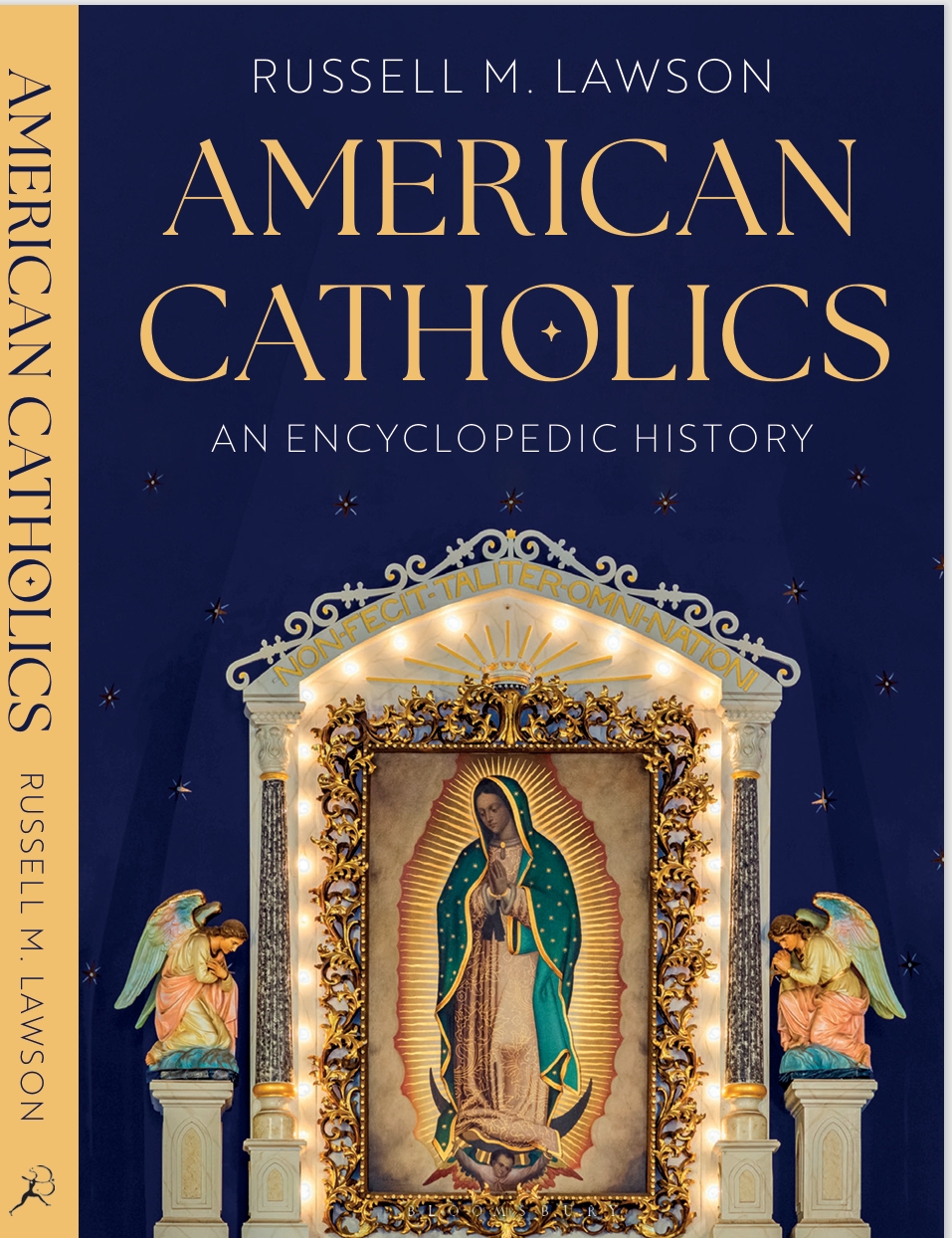
American Catholics

Understand the role, impact, and lasting legacy that Catholicism has had in North America from European contact to today.

Beginning with North America’s contact with three imperialist powers (Spain, France, and England), this narrative account tells the story of how Catholicism became and continues to be part of the basic religious and cultural fiber of North America. The book follows a narrative chronological and thematic format, focusing on people, events, practices, social and cultural phenomena, and institutions. People discussed include the well-known, such as Christopher Columbus and Junipero Serra, and the not-so-well-known, such as Juniper Berthiaume and Jean Louis Berlandier.

With 33 chapter divided into 7 parts and all drawing on primary sources, this book engages with topics such as the overwhelming violence against Indigenous people and the religion’s role in wars, politics, and modern-day culture.

American Catholics: An Encyclopedic History: Russell M. Lawson: Bloomsbury Academic – Bloomsbury

Posted in American History, books, Christianity, God's Providence, Great Commission | Tagged , , , , | Leave a comment

The Christmas Miracle

For Christmas, this novella is a fictional account of one person’s search for God, for love, as he arrives at the final moment of his life. Calvin is a middle aged husband and father dying of cancer. He is spending his last days in a hospice. The book examines his last day of life, Christmas Eve into Christmas Day. Amid the pain and suffering, Calvin experiences a recurring dream in which he is searching for truth, attempting to fill in a scroll with words of truth. In an imaginary dream town, he tries various means to uncover the truth, without success. Finally, in the late afternoon of Christmas Eve, he finds himself standing in line in an alley of the town. He converses with several people–a smoker, a knitter, a professor, and a little bald man. As they wait for the end of the line, they try to figure out what the line is for. Their conversation takes a religious turn, and the professor tries to convince everyone that Christianity is nonsense. He is skeptical and secular. The little bald man tries to counter the professor’s arguments, generally without success. As the line proceeds outside of town into a hilly environment, and as darkness falls and fog envelops them, they cease their conversations. Calvin is alone with his thoughts. He is not sure why he is in the line, where it is taking him. Eventually, at dawn, he comes to a hill on which is a ladder. Unsure why, for what purpose, he scales it anyway, and arrives at a long wooden horizontal post with a hammer and nails. There are notes hammered to the wood. Calvin reads them. They are confessions of error, pain, suffering, and sin–to whom is unclear. Meanwhile Calvin, in the hospice, goes in and out of sleep. He is experiencing horrible pain, and knows he is close to death. The dream intrigues him. As he grows closer and closer to the end, the dream reaches a culmination as well.

The book is available on Amazon:

Posted in books, Christianity | Tagged , , , , , , | Leave a comment

Image of God

Many years ago I wrote this poem after the birth of my third son. It is particularly appropriate during this season of advent; the poem can easily be applied to the Christ child.

Image of God

Sheltered in warmth,

Cocooned in love,

Peaceful slumber undisturbed.

Profile of grace,

Distance between

Human and divine is blurred.

Image of God,

Where evil flees,

Sweet purity unperturbed.

Body and soul,

Unite as one,

Eternal blessings ensured.

Life fresh and new,

Content in sleep,

By angelic care secured.

Wee little babe,

Life ever new,

By this gift God’s eternal will is served.

Posted in Christianity, God's Providence | Tagged , , , , | Leave a comment

Being a Christian Scholar in a Secular Academic World

The culture wars of our times have been centered in universities since the emergence of the Counter Culture in the 1960s. University scholars have often taken the lead in progressive stances on ethical, cultural, and religious issues. For many years I have taught at a variety of colleges and universities, including Christian-based Liberal Arts colleges. I went to universities for my undergraduate and graduate education and witnessed firsthand the growing secularism in the academic world.

My philosophy of teaching is based on my faith that God’s will, Providence, is constantly present in human events. The temptations in our materialistic, secular world not to believe in the presence of God’s will are great. In higher education, a belief in the presence of God’s will is considered foolhardy and simplistic. And yet my understanding of human history, as well as my own personal experience, tell me that God’s will is and always has been active in human affairs. One thinks of St. Paul’s statement that he is a fool for Christ. Indeed, Paul faced criticism and derision for his simple belief in God’s will. Such a belief contradicted Greek and Roman philosophy of the first century just as it contradicts science and philosophy today.

In bringing my belief in Providence to students I don’t browbeat nor proselytize, or ever state it specifically; many students would be surprised to know this is what I believe. Indeed, I encourage questioning and doubt. If God’s will is present, which I believe it is, awareness of His will in our lives will shine clearly through doubt and confusion. This happened in my own life, and I believe it will happen in the lives of students as well.

I bring my philosophy of Christian liberal arts education to bear not only in the classroom but in the conference room and world of scholarship as well. I teach courses in religion from a historical perspective and courses in history from a subtle religious perspective. Even at ostensibly Christian schools, I have discovered that it has not always been easy to promote Christian learning in the academy. As Chair of the Task Force on General Education at one college, I worked against much opposition to institute a required Christianity course in the core curriculum. Moreover, in my many books on explorers and scientists, I recognize, though never state explicitly, the role of Providence in their lives.

Thoreau advised people to march to a different drummer. The standards and philosophy of leading centers of higher education, and in academic journals and conferences and publishing, is secular. Christianity has long been removed from the halls of academe. Yet if the tradition of the liberal arts has long been associated with Christian learning, if American education was overwhelmingly Christian for centuries, why should we abandon it based on the spur of the moment, which, in terms of the history of humankind, is marked in decades and centuries, not seconds, minutes, and hours. What is popular and accepted today will not be tomorrow. One must be true to oneself, and not follow along in the arbitrary directions of the winds of change. There is an anchor to truth in the world. And, in my opinion, a person who is supposed to be involved in pursing the truth and helping others to do so as well—a professor in a liberal arts college—should not abandon this responsibility. For as Jesus said, “You shall know the truth, and the truth shall set you free.”

I have often been asked how an older person or teacher should respond to a younger person who has embraced atheism or agnosticism. As a Christian scholar in a secular academic world, this is my response:

Atheism is a philosophy that is a figment of the imagination. It derives from a lack of satisfaction, from unhappiness, from feeling unfulfilled, from fear of the many tragedies that befall humans. How can God, if he exists, allow the many disasters that we read about, experience, on a daily basis? How can God allow the random deaths of children, cancer coming to a person who is apparently healthy and happy, tornadoes that sweep through neighborhoods, terrorist attacks, random murders of the innocent, civil wars, fires sweeping through apartment buildings, the attacks of 9/11, and so on, and so on? There are too many disasters and tragedies and chance occurrences that kill and dismember to list them all. Think of the hunger that exists, the poverty, the disease, the drug abuse, the crime. One wonders: where is God in all of this? God, why have you forsaken us?

These questions have been asked for thousands of years by thoughtful and despairing people who question God even as they realize He exists. God is so much a part of our existence that to deny Him is to deny Self, to subject oneself to never-ending anxiety about what was, what is, and what will be. Jesus on the Cross quoted Psalm 22, God why have you forsaken me?, rhetorically, for he knew that God, Self, never forsakes.

We live in times of terror, disaster, crime, racial conflict, economic woes—but of course all times are alike, never has there been a time of peace, happiness, love, plenty, unending fair skies and full stomachs. So, because each moment has sufficient cause for worry, humans–indeed all animals–fear.

Fear, timidity, cowardice, one could say, are the natural state of humankind. For how can we confront each moment of uncertainty with certain courage and faith? It is quite impossible, because the next moment of uncertainty comes, followed by the next, and the next, and the next. It doesn’t end until death. The anxiety of each passing moment convinces some people that there is absolute uncertainty in the world, that is, there is no God.

In Paul of Tarsus’s s second letter to his friend Timothy, Paul, in one sentence, summed the human dilemma, summed Christianity, and summed why atheism is a philosophy that is based on fantasy. He told Timothy that God asks us to be fearless: fearlessness derives from power, love, and self-control. The Greek word for power, dynamis, is the same word used in the Gospels to describe Jesus’ power in healing others. It is the power of love. And a person can only use this power of love by means of self-control, that is, self-awareness, to realize that love is found in oneself. And this love is God, for as John truly said, God is Love.

Love is a universal, a constant throughout time and place, found wherever there is hate, despair, tragedy, suffering. Love is the universal, the transcendent, the eternal, the infinite. The atheist proclaims there is no God, then proclaims that love exists, not realizing the inherent contradiction.

To discipline oneself, to channel love toward others, is a work of great power. It is the means by which love combats hate.

There is much noise in our society: television, movies, videos, cells, tablets, pcs, iphones, speakers, headphones—the list goes on and on. Humans are constantly talking and listening, though rarely is the communication relevant. If a person retreats to his or her own room, there he or she might find God.

Posted in Christianity, General Essays | Tagged , , , , , , , | Leave a comment

Understanding Divine Providence: Montaigne and the Fear of Death

The life and Essays of Michel de Montaigne, the sixteenth-century French Catholic philosopher, reveals how accepting the will of God helps a person face the overwhelming fear of mortality–in other words, to embrace death. 

Montaigne was neither saint, priest, nor monk, rather a worldly man who lived in a secular time of conflict between Protestants and Catholics. Montaigne was a landowner, a government official, and soldier. He was as well a Catholic layman who preserved his faith in light of the Protestant challenge during the sixteenth century. He struggled with the new ideas of the Renaissance, such as humanism, which placed humans as near equals to God. He questioned new scientific ideas that seemed to challenge Biblical authority. Montaigne was a thinker who penetrated self in search of answers for his faith, his heritage, and his relationship with God. His response, the Essays, have been variously interpreted as the work of a humanist, a skeptic, perhaps an atheist. Rarely are Montaigne’s Essays considered for what they are in fact, the ruminations of a Catholic layman searching for answers that are in response to his understanding of divine providence.

Montaigne faced many serious challenges in his life; the most recurrent, terrifying challenge he faced was with death. The fear of death defined him. How could it not? Montaigne and his wife Francoise de La Chassaigne had six children, all girls; all of the babies save one died within three months; the lone survivor died in childhood. Besides the melancholy of burying his six children, Montaigne lost his father to kidney stones. Michel watched his father Pierre suffer and die, anticipating his own disease and death. 

These years of anticipation were filled with self-induced trauma. Montaigne was a ruminator. He could not keep his mind from obsessing about illness and death. Each moment was potentially a singular experience of joy and wonder if it were not that the passing seconds moved one closer to the end. At the same time that he counseled himself to accept God’s “divine and inscrutable wisdom,” he was descending deeper into the unforgiving world of thought. He ironically thanked God for the constant “brooding over my own thoughts” so that “death, whenever he shall come, can bring nothing along with him I did not expect long before.” 

Montaigne wrote the course of his life into his book. He wrote Essays about his varying emotions, need for solitude, vanity, fear, and cowardice; his friendship and suffering; the importance of conquering the fear of death; about his inconsistency and contradictions; his intellectual influences; and, in his longest essay, the Apology for Raymond Sebond, he challenged the human presumption of reason, questioned what can be known, and explored the dependence of humans upon God. The thirteen essays of Book Three are introspective, intuitive essays in which Montaigne discovered the universality of his own experiences, confronted his own mortality, and discovered the means of achieving contentment. 

During this time in which Montaigne awaited the onset of disease, he began his Essays. He wanted to know why he feared death. Why did this feeling about an as yet unknown future so dominate his existence? The imagination, if not put to good use, restricted from idleness, will “run into a thousand extravagances”–fear. Yearning to understand his images of doom, “to contemplate their strangeness and absurdity, I have begun to commit them in writing, hoping in time to make [my mind] ashamed of itself.” Montaigne feared fear, which was his constant companion. The abstractions of his mind took off “like a  horse that has broke from his rider.” Death appeared to Montaigne as “so many chimaeras and fantastic monsters, one upon another, without order or design.”

Daily Montaigne reasoned with himself, preached to himself, trying to make an apparent evil good, trying to bring pleasure out of suffering. He worked to convince himself that the stone was an ultimate good that was slowly preparing him for mortality. He would not have wished it, yet it was a benefit that he acquired it. He convinced himself that he was joining the company of the ancient Stoics, through God’s will, controlling the body, elevating the mind. He rationalized his ailment. “But thou dost not die because though art sick, thou diest because thou art living. Death kills thee without the help of sickness.” His illness granted him a unique personal experience: in a single moment he could experience the joys and horrors of life: “Is there anything delightful in comparison of this sudden change, when from excessive pain, I come, by the voiding of a stone, to recover, as by a flash of lightning, the beautiful light of health, so free and full?” Montaigne discovered death’s irony that amid its universality is the uniqueness of the particular experience in countless moments of time, never again to be repeated. Human death mirrors human life, human existence, human history, as infinite unique events become the past moving toward the future. The oneness yet individual uniqueness of humans is seen most clearly through death. And if one feels terror because of death one also feels beauty and love, for without death life itself would be meaningless. Montaigne sensed that though his ruminations were beneficial, and helped him to endure uncertainty and crippling fear, that ultimately some other tactic must be relied upon. Such is the route to faith. “What is it we do not lay the fault to, right or wrong?” Some even “exceed all folly, forasmuch as impiety is joined therewith,” blaming “God Himself.” That was an option of course. God is behind all things, and Montaigne knew it. God is the ultimate source of disease, of suffering, of fear. Many have occupied their minds blaming Providence. Not Montaigne. 

“Of Prayers” reveals Montaigne’s belief that God orders reality. God is inscrutable; divine wisdom, justice, and order are unchanging. Montaigne felt total awe toward this Being, so much so that he did not agree with the common person praying to God, for prayer must be completely pious, pure, uncorrupted by human motives and desires. One must have a certain basis in religious knowledge to approach God. In the Apology for Raimond Sebond Montaigne shows how much we do not know, just how unstable human reason is. If there is absolute knowledge, and if we are so distant in our relation to knowledge, if we realize that in our instability we can rarely penetrate the inscrutability of God, yet as humans we cannot help but seek this knowledge, then we must go to that single source, knowledge of self, as the only real means of ever hoping to approach knowledge of something more than just passing temporal affairs. Who am I to know God?, Montaigne asks. How can I truly know God? By examining the self. Examine each moment, he told himself, each event in life brought about by the will of God, and his response to the challenge of time. In dying, what is the response? In suffering and death, what is the response? To live life: it “is not only the fundamental, but the most illustrious, of your occupations.” Montaigne anticipated the eighteenth-century Jesuit philosopher Jean-Pierre de Caussade’s Abandonment to Divine Providence in his comments about the simplicity of God’s providence, the simplicity of life: “We are great fools. ‘He has passed his life in idleness,’ say we: ‘I have done nothing today.’: “What! have you not lived? . . . “Have you known how to regulate your conduct, you have done a great deal more than he who has composed books.” In short, “the glorious masterpiece of man is to know how to live to purpose.” And what is it to live to purpose? To live in conformity to God’s will.

The time spent reading, contemplating, ruminating, searching, seeking the path to happiness, to knowledge, eventually appeared, Montaigne concluded at the end of his life, impious. Why should humans, should he, seek, question, ask, decide, move, plan, force, act upon those matters reserved for the will of God? What is the point to all of the rules of objective scholarship and scientific detachment if what we know or do not know, do or do not do, are in God’s hands anyway? One must accept. “I have let myself go as I came,” Montaigne confessed in Of Physiognomy; “I contend not.” Balancing knowledge is ignorance; next to will is passivity. Though reason calls, one must learn the value of faith. Mystery and miracles contradicted the well-trained philosopher’s mind of Montaigne. And yet the so-called stoic, skeptic, rationalist, atheist Montaigne, the Montaigne of the modern scholar, learned “that to condemn anything for false and impossible, is arrogantly and impiously to circumscribe and limit the will of God.” Carved in the ceiling of his library was the line from the Psalmist, “Thy judgments are like a great deep.”

Montaigne’s battle to accept himself in light of his understanding of God’s will is the story of his life’s work. The closing theme of the Essays is faith. Montaigne believed his life’s struggle with death and his duty to accept God’s providence were common to all humanity. Ultimately, as St. Augustine showed, and as other thinkers who came after Montaigne, such as Jean-Pierre Caussade, would continue to emphasize, to relinquish control to God in death is in the end a very simple act–an act of faith.

(Quotes from The Works of Montaigne, ed. W. Hazlitt, 1856)

Posted in Christianity, God's Providence, Michel de Montaigne | Tagged , , , , , , , | Leave a comment

Modernity and Martyrdom: Dying for Providence

One of the great challenges to a person who believes that God’s will is always present is that Providence orders a world of growing irreligiosity, violence, terrorism, and atheistic ideologies. The divine plan is clearly beyond the human ability to comprehend. For many years God demands of us belief when the majority of the population, educators, government leaders, and law enforcement disbelieve, refuse to accommodate, even fear, Divine Providence. The belief that God is in control of all things challenges the rationality and secularism of our world, and seems in social media, the academic world, modern science, and popular culture, ludicrous. Throughout most of the past five hundred years of American history Roman Catholics have faced anger, resistance, violence, discrimination, and loss of inherent rights. The most courageous, the most convinced of God’s will, were those willing to die for their beliefs—the martyrs.

Martyrs are “witnesses” to God’s Providence, so much so that they often intuitively anticipate their own death at the hands of disbelievers and oppressors. A martyr is typically a normal person, not more intelligent, not more courageous, not “better,” just more faithful, knowing that God’s will orders all things, including in their own lives.

For the first three centuries of American history after the arrival of Columbus martyrs were typically missionaries bringing the Good News to indigenous peoples, who were often receptive but sometimes not, and violence was the result. During the past two centuries, the modernity of American society, culture, and technology has resulted in a modern mentality that eschews God and His Providence in the belief that humans are the ultimate expression of the evolution of life. Modern ideologies besides Darwinism include Marxism, the belief that material forces dominate a godless world; behavioralism, that humans are inherently irrational, dominated by the subconscious mind; and relativism, that truth depends on the whims of the individual: with such secular ideologies holding sway over most of the world’s peoples, it is an easy task for government to assume the role of God and demand obedience and worship from the masses. Since such governments are often oppressive to opposition and in control of powerful armies, those who stand up for God oftentimes accept God’s will that their lives will be a witness to Providence.

What happened to Mexico during the nineteenth century in the wake of independence from Spain is illustrative. The Mexicans identified the Roman Catholic church with imperialist Spain, and the decades following independence saw increasing restrictions on the influence of the Church. Constant political conflict between liberals and conservatives in Mexico led to economic, social, and cultural instability—one of the casualties was Christian morality. Benito Juárez, leader of the Liberal faction, fought against the power and influence of the Catholic Church. Liberals had the wealthy and educated backing them against the vast numbers of uneducated peasants who retained their faith, not giving into modern ideologies. Oppression of Roman Catholics erupted into the Cristero War in the early twentieth century. Mexico’s 1917 Constitution upheld earlier governmental acts seeking to bring secularism to the Mexican people.

The Catholic Church was not silent during these years when modernity was taking over the world. Vatican I, for example, proclaimed: “Everything that God has brought into being he protects and governs by his providence, which reaches from one end of the earth to the other and orders all things well. All things are open and laid bare to his eyes, even those which will be brought about by the free activity of creatures.” Vatican II almost a century later provided an incisive assessment of modernity: “Never before has man had so keen an understanding of freedom, yet at the same time new forms of social and psychological slavery make their appearance.” The Encyclical of Pope Pius XI on the Persecution of the Church in Mexico accused the Mexican government of trying to rid the Church from Mexico, depriving it and its people of basic rights, such as the right to worship freely.

A wonderful, insightful portrayal of the conflict between government and religion in twentieth-century Mexico is Graham Greene’s The Power and the Glory. The book evokes the life of an unsuspected martyr, known only as the “whiskey priest,” who is a drunkard and scoundrel who accepts a hitherto unanticipated role of supporting God’s will in providing the sacraments, especially the Eucharist, for oppressed people while continually fighting against his own sense of unworthiness and his terror at being caught and executed. Facing him is the Lieutenant, a fervent atheist who supports government repression, and who is infuriated “to think that there were still people in the state who believed in a loving and merciful God. There are mystics who are said to have experienced God directly. He was a mystic, too, and what he had experienced was vacancy–a complete certainty in the existence of a dying, cooling world, of human beings who had evolved from animals for no purpose at all. He knew.” The Lieutenant stops at nothing to capture the whiskey priest and halt the sacraments from providing the Mexican people with a hope beyond the secular power of the government. The priest’s terrified acquiescence to God’s will in performing the sacraments finally leads to his capture and martyrdom. The book wonderfully assesses what happens to a society in which the rational, secular state forbids religious beliefs and functions, and the people become numb and dead inside. To prevent this martyrs sacrifice themselves.

A historical example to support’s Greene’s fictional portrayal is Jose Sabás Reyes Salazar (1883-1927). A native of Jalisco, Mexico, Sabás was ordained in Tamaulipas, a barren, harsh land where he served until government persecution forced him to flee to Tototlán, Jalisco, where he again faced persecution in delivering the sacraments to the faithful. He was priest during the presidency of Plutarcho Calles, whose administration featured oppression of Catholic worship on pain of imprisonment and death. Father Sabás realized that continuing to deliver the sacraments in secret would result in personal disaster, but he could not resist God’s call. Federal troops in 1827 entered the town searching for Catholics; Father Sabás took shelter in the home of one of the families he served. When the troops entered the home, Sabás, to prevent the family from suffering, as he was the one they were searching for, came out of hiding and made himself known—he knew that the result would be torture and death. He conformed to the will of God, praising God as the torturers and executioners slowly took his life away.

Another example of martyrdom by a priest seeking to defend the rights of the people to worship occurred in Guatemala almost half century ago. Stanley Rother (1935-1981) was a small-town Oklahoma boy turned priest and missionary to Guatemalans in a small village in the late 1960s. He served for over a decade as violence increased during the Guatemalan Civil War. He knew that his life was in danger, writing his bishop in 1980: “The reality is that we are in danger. But we don’t know when or what form the government will use to further repress the Church. . . . Given the situation, I am not ready to leave here just yet. There is a chance that the government will back off. If I get a direct threat or am told to leave, then I will go. But if it is my destiny that I should give my life here, then so be it. . . . I don’t want to desert these people.”

There is no more compelling proof of the power of faith and belief in God’s goodness and the rightness in conforming to His will than Rother’s simple statement, “so be it.” God, the supreme Being, gives life, being, and demands life, being. Who are we to deny our being to God when He calls for it?

Posted in Christianity, God's Providence | Tagged , , , , , , | Leave a comment

The Virgin of Guadalupe

In 1759 in the coolness of an October morning just before dawn in the forest of southern Quebec, English soldiers stealthily crept up to a sleeping Algonquin village. On a signal from their commander, Robert Rogers, his men, the Rangers, attacked the sleepers in their wigwams. The Rangers descended upon one hut, servicing as a Roman Catholic Church, with an altar decorated with silver candlesticks and a silver image of the Virgin Mary. They stole the silver and set the church on fire; the missionary serving the Algonquins was martyred, perishing in the flames. The Rangers took their loot and fled. Algonquin warriors soon pursued the fleeing Rangers, who were weighed down by the silver, so buried it. The Silver Virgin has never been found.

One might question why a silver statue of the Virgin Mary was gracing an altar of a primitive wigwam church in the forest of southern Quebec. In fact, throughout North America there were similar primitive churches in Indian villages with images of the Virgin, dedicated to the Immaculate Conception, where Indians, led by a missionary priest, said Mass, and venerated the Mother and Child. How did this come to be?

Beginning with Columbus’ first voyage in 1492, the Spanish brought with them to America a belief in the Virgin Mary. Columbus named his flagship Santa Maria de la Inmaculada Concepción. Columbus’ favorite prayer was Jesus cum Maria sit nobis in via, “may Jesus with Mary be with us on the way.” Subsequent missionaries brought Christ as well as His Mother to the indigenous people, converting them, teaching them how to pray, bringing the Sacraments to these neophytes.

Then, in December, 1531, something miraculous happened. The Virgin Mary appeared to a simple Aztec Indian named Cuauhtlatohuac.

We have all been there. It is a situation in which something occurs, some feeling or intuition or thought, some presence. We are taught to be incredulous, to doubt, to not allow the mind to see something, or hear something, or feel something out of the ordinary. Juan de Zumárraga, an educated Franciscan and bishop of Mexico in 1531, was like this. He believed in the Trinity, in the Sacraments, and had faith, but he was impatient with superstition, with storytelling of this or that miracle. Such is the reason that he was skeptical when an Aztec Indian named Juan Diego approached him with a story of an apparition that he had witnessed, a young woman dressed as an Aztec maiden speaking the indigenous language, Nahuatl, who told him: “Know, know for sure, my dearest and youngest son, that I am the perfect ever Virgin Holy Mary, mother of the one great God of truth who gives us life, the Inventor and Creator of people. . . . I want very much that they build my sacred little house here. In which I will show Him, I will exalt Him, and make Him manifest: I will give Him to the people in all my personal love, in my compassionate gaze, in my help, in my salvation.”

It is not that Bishop Zumárraga doubted the existence of the Virgin Mother of God, or that she might appear or speak to a human, but to appear on a hill outside of Mexico City dressed as an Aztec maiden speaking the indigenous language to a peasant, albeit a Roman Catholic Indian convert, was a bit too much to swallow.

Likewise we might have the same approach to a calling, a feeling, a thought that seems to be from God, and we might doubt that Christ or His Mother would approach us, an individual alone, that the divine is present now, in this moment, reaching out to you, that His will is touching you, asking you to listen and obey.

Bishop Zumárraga naturally told Juan Diego to be a bit more specific and precise, and bring some evidence besides his apparent oversized imagination, before he could seriously give credence to the story, and consider building of all things, a church on a hill.

Juan Diego obediently returned and again saw the apparition of the Virgin. He told her of the Bishop’s incredulity. He suggested that a more important person than a humble peasant approach the Bishop. She responded: “Listen, my youngest and dearest son, know for sure that I have no lack of servants, of messengers, to whom I can give the task of carrying my breath, my word, so that they carry out my will; but it is very necessary that you, personally, go and plead, that my wish, my will, become a reality, be carried out through your intercession.”

God’s providence is the great equalizer. Even a nobody might be given a divine task. Juan Diego could not but obey, so he returned to the bishop, and made the request again. The bishop was unmoved. There must be something concrete, something that Juan Diego could show, to convince the skeptical Zumárraga.

Juan Diego, embarrassed, tried to avoid the Virgin, but she found him, and realizing that her word was insufficient, that there must be had concrete proof, she asked him to gather flowers in bloom, even in December, put them inside his cloak, his tilma, and take them to the bishop. Juan Diego did, and when he opened his tilma to the bishop, replacing the flowers was the beautiful image of the Virgin of Guadalupe that still exists in Mexico City. With such proof the bishop believed.

Blessed are those who have not seen yet still believe. The Virgin had informed Juan Diego that “I am truly your compassionate mother, yours and of all the people who live together in this land.” Recognizing this proclamation regarding the Americas, bishops in the United States in 1846 proclaimed Mary as the Immaculate Conception the Patroness of America. Reading her words to Juan Diego literally, she informs us that she represents her Son, her actions in time makes Him “manifest,” a word that has a sense of urgency and truth, that calls out to us to look here and see the Lord, see the Truth, see He through Whom all things are made. Mary informed us, just thirty-nine years after the coming of Columbus to America, that this continent is Christ’s, and through Him, Her’s as well, that knowledge and worship of Him will be spread, initially in Her church on Tepeyac Hill, subsequently throughout the continents to north and south, and people will come to know the presence of God, His will, and that He reigns.

After the appearance of Our Lady of Guadalupe, the veneration for Mary proliferated. A cult dedicated to Our Lady developed soon after. Seventeenth-century historian Fernando de Alba Ixtlilxochitl wrote that when the indigenous people “heard that the Holy Mother of Our Lord Jesus Christ had appeared, and since they saw and admired her most perfect Image, which has no human art, their eyes were opened as if suddenly day had dawned for them.” An early Franciscan missionary in Texas, Fray Marcos de Niza, approached the Tejas Indians “singing the Litany of Our Lady” carrying “in front a picture on linen of the Blessed Virgin.” Seventeenth-century French missionary Gabriel Druillettes experienced a miracle when the Virgin healed his blindness. The first Ursulines arrived in America after St. Marie de L’Incarnation had a dream of the Virgin telling her, to Canada “thou must go and build there a house to Jesus and Mary.”

One of the impediments to the conversion of the first ordained priest in the United States, John Thayer, had been the veneration of the Virgin, which Protestants derided as fantastic, comparable to children believing in ghosts. But Thayer came to realize “that it was profitable to employ with the Son, the intercession of his holy Mother, and that far from doing an injury by honoring and loving her whom he had so tenderly loved himself, it was the mean[s] of honoring him the more.”

The presence of the Mother of God is now, in the moment, interceding with and for the Son, but more, enacting the will of God, an instrument of Providence—indeed, the Mother of Providence.

Posted in Christianity, God's Providence | Tagged , , , , , | Leave a comment

Joseph Ratzinger and Providence

Joseph Ratzinger, Pope Benedict XVI, was a theologian, academic, writer, and historian of Christianity who believed in Providence, that God’s will is present throughout time and place. Providence is the theme of the Psalms, indeed the entirety of the Bible; it was the theme in St. Augustine’s historical works, Confessions and City of God; it was stubbornly recognized by the Renaissance humanist Montaigne; it became the life’s work of Jean-Pierre Caussade; it was recognized by American theologians and martyrs such as Michael Portier and Stanley Rother; it is revealed to us in the Marian apparitions such as Our Lady of Guadalupe; and even so brilliant a historian and scholar as Joseph Ratzinger never doubted God’s presence among us.

Ratzinger’s faith took him through many trying times, such as the decades in which Nazi totalitarianism dominated Europe and Ratzinger was forced to serve in the German military, and afterwards, during the terror of the Cold War and the emergence of the skeptical atheism in the European academic world. He was one of the intellectuals behind Vatican II, when the Church successfully met the challenges of the modern world and stuck to the basic beliefs of Christianity, such as the presence of God’s will even in a harrowing and confusing world. One of Ratzinger’s most succinct expressions of his historical philosophy, which includes his faith in Providence, is the book Eschatology: Death and Eternal Life, published in English in 1988.

Eschatology is a book that deals with the most terrifying aspect of life and most confusing teachings of Christianity. Death is ever present among us, and although one would expect Christians to be comfortable with the idea of death, it is precisely the opposite: death continues to terrify, and in our world increasingly focused on medicine, notwithstanding that God’s will is present, people try to stave off death as long as they can. But why? Because of what death represents. For some, it is simple nothingness. For Christians, theoretically, it is either heaven or hell, or if Catholic, purgatory. But how and why? In death, does a person go straight to heaven or hell? Or does the person fall asleep awaiting Christ’s return in the Judgment? What can an understanding of providence inform us about these questions?

Ratzinger opens the book with a powerful statement of his theme: “We live because we are inscribed into God’s memory. In God’s memory we are not a shadow, a mere recollection.” Ratzinger argues that this life in God’s memory is one throughout time, not just during the waking and breathing of a human during circumscribed years. God’s will is with us throughout all time. For some, providence means right now, that God is holding our hand in each moment by moment. But Ratzinger argues that providence means an eternity of moments in which we experience the kingdom of God. Human existence in time with Christ the Son of Man, the Logos, brings us into God’s scheme of history in which “the walls separating heaven and earth, and past, present, and future, are now as glass.” In other words, the dead are not asleep, the dead are not no longer in time, not no longer in history, but the dead are still a part of time, a part of history, hence subject to divine providence. Christ is “the Son in whom the unbridgeable between already and not yet is spanned.”

Moreover, “eternity is not commensurable with time, being of a wholly other order.” Eschatology does not refer to time, rather to existence. Life eternal is life indestructible. Christianity is therefore “an ever renewed act of encounter” in a timeless moment. Life eternal is authentic, “purifying and transforming.” As so many of the ancient philosophers taught, death is an opening, suffering is an acceptance of what is to come, otherwise “man’s own truth is that he passes away, having no abiding existence in his own right. The more he takes a stand on himself, the more he finds himself suspended over nothing.”

Christ represents all time, all history, the entire Creation, the unification of body and soul. “Dying in Christ” is to be alive, a part of the whole, the entire cosmos, a part of all history, all time. Jesus, God is with us: “if the human capacity for truth and for love is the place where eternal life can break forth, then eternal life can be consciously experienced in the present.” Further, “eternal life does not isolate a person, but leads him out of isolation into true unity with his brothers and sisters and the whole of God’s creation.” What this means is that “an eternity with a beginning is no eternity at all. Someone who has lived during a definite period of time, and died at a definite point in time, cannot simply move across from the condition ‘time’ into the condition ‘eternity,’ timelessness.”

Ratzinger was heavily influenced by Augustine’s theory of time, of memory of the past, awareness of the present, and expectation of the future. Augustine, he argued, believed that our memory continues after death, hence our connection to ongoing movement of time continues, which for Ratzinger is clarified by the idea of purgatory. “The guilt which goes on because of me is a part of me. Reaching as it does deep into me, it is part of my permanent abandonment to time, whereby human beings really do continue to suffer on my account, and which, therefore, still affects me.” In addition, “love cannot . . . close itself against others or be without them so long as time, and with it suffering, is real”—hence love ties us to the present suffering of humans even after death. Purgatory then is “unresolved guilt, a suffering which continues to radiate out because of guilt. Purgatory means, then, suffering to the end what one has left behind on earth—in the certainty of being definitively accepted, yet having to bear the infinite burden of the withdrawn presence of the Beloved.”

The Body of Christ means that “every human being exists in himself and outside himself: everyone exists simultaneously in other people. What happens in one individual has an effect upon the whole of humanity, and what happens in humanity happens in the individual.”

Why pray for the dead, or ask for the prayers of the Saints, Ratzinger asked, if the dead including the Saints are asleep awaiting the Judgment? Rather, “even when they have crossed over the threshold of the world beyond, human beings can still carry each other and bear each others’ burdens.”

Ratzinger argued that after Vatican II the tendency has been to discount the soul and assume that resurrection occurs in the moment of death. But he believes that there is no interruption in life between death and the end of the world. This is because humans are anima forma corporis, an essence, an indestructible life form; human is “the creature . . . for whom the vision of God is part and parcel of his very being.”  Providence is this vision of God. Under God’s providence the dead continue to be connected with the passage of time toward the Judgment; the transition from life to death still waits upon God’s will.

Posted in Biography, Christianity, God's Providence | Tagged , , , , , , | Leave a comment