Junipero Serra: Work and Prayer

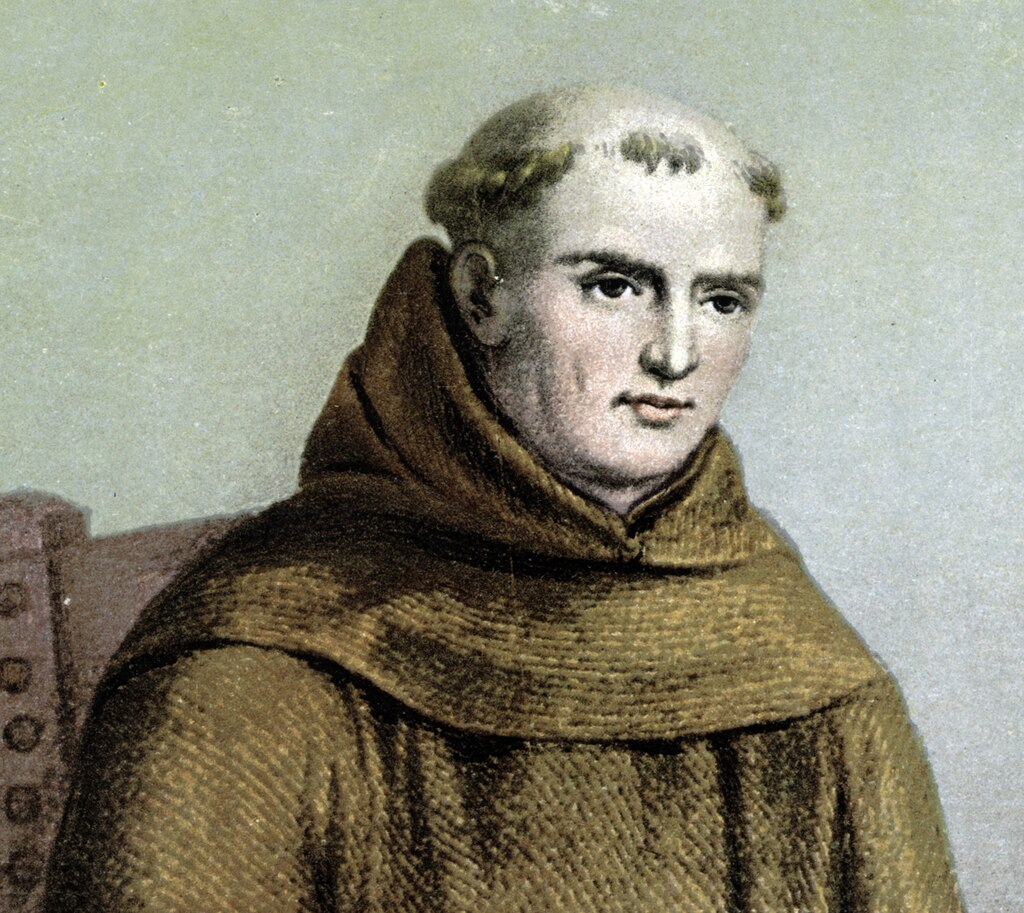
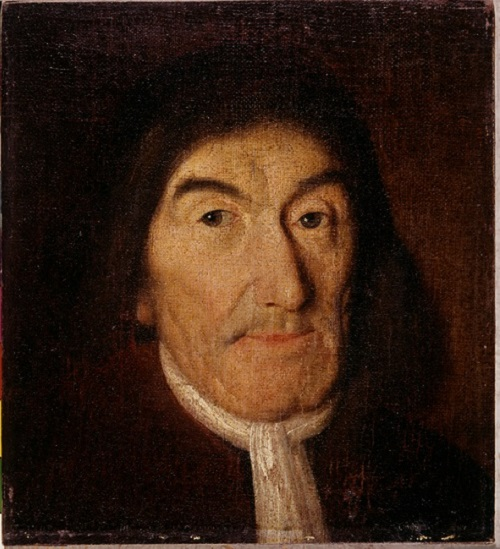
Franciscan Junipero Serra (1713-1784), one of the founders of Catholicism in California, should he miraculously walk the paths of California today (on tired, sore, bare feet, for he believed in the practice of mortification), he would be astonished at the vitriol and condemnations of his efforts at bringing the Great Commission among the native people of California.

In recent years the Left has joined on the bandwagon of hating Franciscan missionaries such as Fray Serra, who has become a symbol of the evils of the Spanish missionary experience in colonial California. Serra has been accused of outrageous actions by the Left in books such as Bad Indians by Deborah Miranda (2013) and in petitions to condemn his memory in such as the following: “Serra is not the historical hero people thought when this landmark statue to him was erected [in Ventura], one of many throughout California, as a historical emblem, he is toxic and should be removed. As a community we cannot and will not support the dehumanization of the Native American community any longer. We are calling for restorative justice and are petitioning for his statue to be removed immediately.” (https://www.change.org/p/ventura-city-council-removal-of-father-serra-statues-name-change-of-schools)

In response, Archbishop of Los Angeles Jose Gomez declared: “The real St. Junipero fought a colonial system where natives were regarded as ‘barbarians’ and ‘savages,’ whose only value was to serve the appetites of the white man. For St. Junipero, this colonial ideology was a blasphemy against the God who has ‘created (all men and women) and redeemed them with the most precious blood of his Son’.” Fray Serra “lived and worked alongside native peoples and spent his whole career defending their humanity and protesting crimes and indignities committed against them.” (https://www.catholicnewsagency.com/news/45029/st-junipero-serra-protested-colonial-oppression-and-abuses-archbishop-gomez-says)

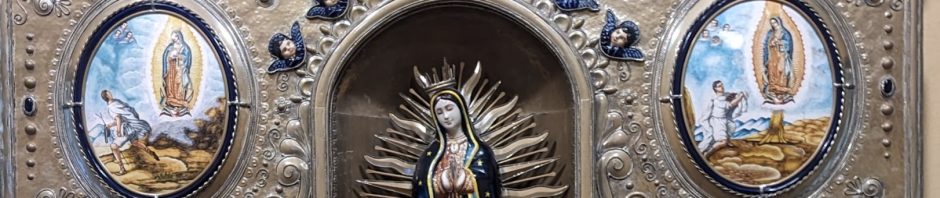
Yes, Junipero Serra sacrificed his life for others. A native of Majorca, he was an intellectual and expert on the Medieval philosopher John Duns Scotus. A Franciscan devoted to the Great Commission, Fray Serra responded to Jesus’ commandment to leave family and friends and, in 1749, journeyed to America. Upon landing at Veracruz, he traveled to Mexico City by foot in an act of humility and mortification. Arriving, he stopped to pray at the shrine of Our Lady of Guadalupe, then joined the faculty of the College of San Fernando, where he often spent years working as a missionary to the people of the Querétaro region northwest of Mexico City. In 1767, Fray Serra was appointed presidente of Franciscan missions in California, to which he journeyed.

Fray Serra traveled to Baja California, where the Spanish had established numerous missions, before turning his attention to the north, Alta California, in 1769. He journeyed overland through Baja California, halting on his journey in April, 1769, between Mission Purisima Concepción and Mission Guadalupe, where he found the local Indian tribe, the Cochimi, suffering from lack of food. “When night came on I tarried on the ground,” he wrote in his diary. “There I talked with some ten families of Indians, and when I asked them for the reason of their being there, they told me with much sorrow that they were of the mission of Guadalupe; and that the Father, for want of provisions, had found himself obliged to send them out to the mountains to seek their food; and that as they were not accustomed to this, their hardship was great, particularly in seeing their babies suffer and hearing them cry. I felt sorry enough, and though it was somewhat unfortunate that the pack-train was behind and could not arrive that night, they were not left without some alleviation; for with a portion of pinole which I carried they made themselves a dish of good atole, which was for the women and children. Afterwards the process was repeated for the men. At this they were consoled, the more so, when I told them that they should go to their mission; that already corn was on the way to the Father by sea from Mulegé by order of the most illustrious inspector. I took my rest, and had them pray together. They concluded by singing a very tender song of the love of God; and as those of that mission have justly the fame of singing with especial sweetness, I had a good deal of consolation in hearing them.” (Quoted in Zephyrin Engelhardt, The Missions and Missionaries of California (San Francisco: James Barry, 1908), 1: 349-50.)

A month later on May 15th, still on the road in northern Baja California, Fray Serra encountered many Indians whom he called “gentiles,” meaning they had not yet heard the Good News. “And I praised God,” Serra wrote, “for allowing me to encounter such humble creatures for whom there appear to be no obstacles that would prevent them from receiving the light of the Holy Gospel.” In June Serra wrote: “The time we have spent with them has been most pleasurable. Their beautiful physique, comportment, friendliness, and happiness have won all our hearts.” June 26, “one of the women wanted me to hold the infant she was nursing. I held him in my arms for a while, so wishing that I could baptize him.” (Quoted in Beebe and Senkewicz, Junipero Serra: California, Indians, and the Transformation of a Missionary (Norman: University of Oklahoma Press, 2015,)186, 194, 197.)

On his many journeys, usually on foot, Fray Serra often incurred leg sores that became chronic, so that his friends were worried for his health. He had such sores on his journey through Baja California. Arriving at San Diego in July 1769, Serra’s leg unexpectedly began to heal–and so too did the people under his charge at the new mission he founded, Mission San Diego de Alcalá, where he halted to take time (about nine months) to tend to the many sick. In July, 1770, he moved north, founding Mission San Carlos de Monterey on the Carmel River (renamed Mission San Carlos Borroméo de Carmelo), a place from where Fray Serra would direct his missionary activities in Alta California. He founded Mission San Antonio de Padua, near Monterey in the Santa Lucia Mountains, in July 1771. Two months later Fray Serra founded Mission San Gabriel, named for the archangel. In 1772 he founded Mission San Luis Obispo de Toloso.

In November, 1776, Fray Fermin Francisco de Lasuén founded Mission San Juan Capistrano on the San Juan Creek. A month later, Fray Serra was journeying with Fray Lasuén on the path from Mission San Carlos on the Carmel River to the new Mission San Juan Capistrano. Caught in a terrible rainstorm, the two Franciscans and their military escort were confronted by warriors from the Chumush tribe, who were often aggressive toward the Spanish; indeed, Fray Lasuén the previous year had narrowly escaped death at their hands. But this time, the Chumush came to the aid of the Franciscans, carrying Fray Serra through a difficult, muddy passage. In return Fray Serra stayed with the people, getting to know them, praying and singing with them. “And for me,” he wrote in his diary, “this served to deepen the compassion I have felt for them for quite some time.” (Quoted in Beebe and Senkewicz, Junipero Serra, 19)

At some of the many missions founded by Fray Serra, such as at San Diego, the local Indians, the Kumeyaay, rebelled against the Spanish presence, especially of the soldiers at the local presidio. On several occasions the Indians attacked the mission. The 1773 attack killed the resident Franciscan missionary, Fray Luis Jayme, who ironically had been a champion of Indian rights against the presidio soldiers. Fray Serra made the decision not to avenge his death, rather to capture, briefly imprison, and set free the Kumeyaay warriors, hoping by such generosity to bring them closer to the faith.

Fray Serra followed the dictates of the Franciscans and other missionaries in America, who believed that Christianity and civilization were linked, that converts must be catechized and learn the sign of the cross before baptism, must learn to farm, and must live in missions to be directed by the missionaries, who thought of the Indians as spiritual children, and believed that often the body must be mortified to embrace the spirit; hence corporeal punishment was often necessary, even if self-inflicted. As he wrote in 1778, “I maintain that settlements populated by fine Spanish citizens who are models of good behavior can be established only after the gentiles who are scattered across the territory have become Christians and have been brought together in their respective . . . missions.” (Quoted in Beebe and Senkewicz, Junipero Serra, 357.)

In Fray Serra’s missions, every day the people of the mission came together for morning mass, which involved the homily and hymns of praise to God. “Then they go to breakfast on the mush (atole) which is made for all, and before partaking of it they cross themselves and sing the Bendito [hymn of praise]; then they go to work at whatever can be done, the padres inclining them and applying them to the work by setting an example themselves; at noon they eat their soup (pozole), which is made for all alike (de comunidad); then they work another stint; and at sunset they return to recite doctrine and end by singing the Alabado,” an evening hymn of praise. (Quoted in Elliott Coues, ed. and trans., On the Trail of a Spanish Pioneer: The Diary and itinerary of Francisco Garcés (Missionary Priest) in His Travels through Sonora, Arizona, and California, 1775-1776, vol. 1 (New York: Francis P. Harper, 1900), 262.)

Junipero Serra was a teacher, a man who gave his life to Christ in obedience to the Great Commission. He believed in establishing missions for the Indians to follow the examples of St. Benedict and St. Francis, who, according to Pope Francis, believed in “combining prayer and spiritual reading with manual labor (ora et labora). Seeing manual labour as spiritually meaningful proved revolutionary. Personal growth and sanctification came to be sought in the interplay of recollection and work. This way of experiencing work makes us more protective and respectful of the environment; it imbues our relationship to the world with a healthy sobriety.” (Pope Francis, On the Care for Our Common Home, section 126: https://www.vatican.va/content/francesco/en/encyclicals/documents/papa-francesco_20150524_enciclica-laudato-si.html)

Work and prayer: Junipero Serra taught others to believe what he believed, that these are the keys to a successful life.

A version of this essay appeared in Catholic Exchange
Posted in Biography, Christianity, God's Providence, Great Commission | Tagged , , , , , , | Leave a comment

Louis Hennepin (1626-1704), Missionary of Hope

When a person thinks back to the colonial American past imagining what the first Catholic missionaries who braved the elements, journeyed into the forests, and canoed down American rivers, must have been like, they are thinking of such a person as Frère Louis Hennepin, the epitome of the Catholic missionary in America. Frère Hennepin was a Récollect Franciscan, the Récollects being one of the reform movements of sixteenth century France that emphasized austerity, penance, prayer as well as being devoted to the Great Commission. Frère Hennepin was not only a missionary explorer but a writer as well, penning one of the great accounts of missionary adventure and a lively description of the French colony of Louisiana in his book, Description of Louisiana.

Louis Hennepin was Flemish, born in Belgium, educated in Belgium and France. Early on in life realized his desire to remove himself from the concerns of the world and devote himself to his relationship with God. Hence, after traveling throughout Europe, gaining a lust for adventure and exploration, serving as a chaplain in war, working in the fisheries of Calais, listening to the stories of seamen who had crossed the Atlantic to New France, imagining what the new lands in American must be like, he joined the Récollect Franciscans. Assigned to New France, he sailed in 1675, arriving to Quebec, where he served at Hotel Dieu, the first hospital for the needy and ill in Quebec, before being assigned as chaplain at Fort Frontenac, situated in what is today Kingston where Lake Ontario is the source of the St. Lawrence River; he also served as missionary to the Iroquois at the Quinte Mission on the north shore of Lake Ontario. During these initial years in New France Frère Hennepin, when he was not praying, catechizing Indian children (often in their own languages), teaching Indian children French, caring for the sick, and saying mass, on his off time he traveled about Quebec and Lake Ontario hiking (often alone) into the interior on snowshoes with sled dogs and canoeing wild rivers and streams in search of adventure.

In 1679, Hennepin and other Franciscans joined René-Robert Cavelier, Sieur de La Salle, on a voyage of exploration setting forth from Fort Frontenac across Lake Ontario. They arrived at the mouth of Niagara River, ascended the river to the falls, took portage around the falls, then halted to construct a three-masted small ship, a bark, on which they crossed Lake Erie from east to west. Arriving at around present-day Detroit, they ascended the Detroit River, traveled through Lake St. Claire, then entered Lake Huron. The journey north and west through Lake Huron was harrowing. The storms on Lake Huron were notoriously dangerous, especially for a small wooden ship driven only by sails catching the wind. The Franciscans led the crew in prayers and dedicated the voyage to the care of St. Anthony of Padua. By the end of August they were glad to reach the strait between Lake Huron and Lake Michigan, which the French called Michilimackinac. From here they sailed into Lake Michigan. At Green Bay La Salle ordered the bark to return to Niagara while he and fourteen men in four birch bark canoes made the treacherous way south along the shores of Lake Michigan, trying to avoid conflict with the inhabitants, the Pottawattamie Indians. For any of the hundreds of missionaries who traveled the North American wilderness, food was always an issue. The missionary explorers with La Salle faced the possibility of starvation dozens of times. Faith, hope, and commitment to the Great Commission drove them forth. Hunger led them from Lake Michigan to the Illinois River, down which they went until they came upon an Illinois village, the warriors of which threatened to attack. Hennepin recalled in Description of Louisiana that he and the two other Franciscans, Frère Zenobius and Frère Gabriel, approached the Indians, took “their children by the hand, who were all trembling with fear; we manifested much affection for them, entering with the old men and the mothers into the cabins, taking compassion on these souls, which are going to destruction, being deprived of the word of God and lacking missionaries.” Love averted conflict.

               Nearby La Salle established a fort; the men were still desperate for food; their ultimate goals, the Mississippi River and the Gulf of Mexico, were still far away. La Salle sent Hennepin and two French voyageurs to reconnoiter the way to the Mississippi. Upon reaching the great river, they did an exploratory descent; they felt much fear. Hennepin led the French canoers in prayer, especially calling upon the aid of St. Anthony, hoping that they would survive if and when they met Indian warriors. Their prayers were answered, as upon meeting with a Sioux war party who threatened death, Hennepin approached them and prostrated himself on bended knee with presents; the warriors spared their lives but made them captives. Forced to ascend the Mississippi to the Sioux village, for nineteen days the war party paddled upriver. Hennepin repeated time and again the Litany of the Blessed Virgin Mary to gain patience and strength. Soon they reached the path to the village, but the challenges of the forced journey were just beginning. Prayers helped Hennepin endure forced marches from dawn to dusk, crossing icy streams in which Hennepin, who was able to swim, exhausted himself in rushing water with ice shards cutting his skin. He could barely walk at times, but he could not halt, or the penalty would be death.

The Sioux village was at the Falls of St. Anthony on the upper Mississippi River. Here Hennepin was adopted by a Sioux family. His life was hard, with much work and little food, but Hennepin never lost his faith in God. He never lost his purpose for the journey, attempting to impart the Christian message by words and actions to the warriors, their wives, and the little children of the tribe. How does one go from being a captive to a teacher? Challenges faced by all missionaries in North America were the difficulty in communicating their message and the apathy of their listeners, who were engaged in the struggle to survive. Hennepin, like Franciscan missionaries before and since, taught the people of the village to cross themselves, to repeat basic prayers, to kneel, to do homage to the Virgin Mary. He used pictures, prayer beads, crucifixes, all of which the Sioux enjoyed. But often after catechism and prayers they seemed to forget, and the lessons would have to start again. To gain their trust, Hennepin practiced healing arts. He had brought herbal healing aids with him and applied them to the sick along with prayers to Christ and the Virgin for healing. Hennepin was also genuinely fascinated by the people, their culture and customs, their language and beliefs. The Indians, he thought, were amazingly superstitious, but his knowledge was not that much better—Hennepin believed like other seventeenth-century Europeans that the tribes of America were descended from the Lost Tribes of the ancient Hebrews. Indeed, the knowledge of America of the greatest thinkers in Europe was primitive. Knowing this, Hennepin kept track of where he went and what he learned, planning to tell the story of his travels in this massive land that the French had christened Louisiana.

During the summer of 1680, Sieur Du Luth (Dulhut) arrived with a small French contingent, convincing the Sioux to release Hennepin and the two voyageurs. After the grueling trip back to Lake Michigan, where he was able to bivouac for several days to collect himself and rest, he celebrated mass, for he had not had wine for the Eucharist for nine months. “All our Frenchmen went to confession and communion,” he wrote in Description of Louisiana, “to thank God for having preserved us amid so many wanderings and perils.” From here he traveled back to Quebec, and eventually returned to France, where he published his Description of Louisiana in 1697, recounting his many adventures. He concluded the book restating his original aim in going to America —obedience to the Great Commission.

Father Hennepin had been a stranger in a strange land, a Frenchman lost somewhere in North America. Prayer and faith were the foundations to keep himself from the shifting sands of doubt and despair. Another man of God many years later who experienced the challenges of coming to America, an Italian immigrant, Jorge Mario Bergoglio, learned that “hope is an anchor.” In America, Hennepin realized through hunger, fear, and despair that, in Pope Francis’ words, “God has made hope for us.”

Pope Francis, Hope: The Autobiography (NY: Random House, 2025).

Louis Hennepin. A Description of Louisiana. Translated by John Shea. New York: 1880.

A version of this essay appeared in Catholic Exchange
Posted in American History, Biography, Christianity, God's Providence, Great Commission | Tagged , , , , , | Leave a comment

God’s Shadow over History

Jean-Pierre Caussade in Abandonment to Divine Providence writes truthfully that God is behind all historical events. If so, then it is God’s will that the United States is in 2025 exactly where He wills it to be. And further, that each person is alive and living their lives according to the divine will. This presents each of us with an enviable but problematic position. Enviable, that we are so blessed by God. Problematic, in that we are responsible to our God to make this life as godly and worthwhile as possible. As Caussade tells us, God is with us, working with us. The metaphor Caussade uses is the shadow. Mary was overshadowed by the divine will, and so are we all, he argues. The shadow is “like a veil” covering “sensible objects,” hiding “them from us.” God’s shadow is near us, even merging with our shadows in the bright sunlight. The shadow, the reality of God’s will, is typically concealed from us. How often do we see it, are we aware of the presence of the Lord?

Working backward in time, what are the signs in our lives, individually and collectively, of God’s shadow? History is a collective story of individual lives. God’s interaction with each person, God’s shadow in the lives of hundreds of millions, becomes one great multifaceted shadow that we call American history. How is it possible to make sense of such a complex interaction? How can 350,000,000 stories come together into one? How can 350,000,000 shadows of God’s will be cast into a remarkable yet incomprehensible single shadow?

More mind-boggling is the population of the earth, over eight billion, each human a part of God’s will. Incredibly, there are millions of species of animal types sharing Earth. The numbers of individual animals are in the hundreds if not thousands or millions of trillions– researchers with a great capacity for counting at the National Science Foundation have estimated that there are at least one trillion species of microbial, plant, and animal life residing on Earth.

To make this assessment of the vast wonder of God’s will even more mystifying, consider the infinite layers of time, of births and deaths, even on a single day, and how these wonderful and tragic events, reflecting God’s will, inform us individually of our own lives in the shadow of His will as well as collectively of a single story of the American people in the vast shadow of His will. But more, what of the dead, and their past lives still impacting the present, the memory, the consequences of their actions, all a part of the collective shadow of God’s will? Proceeding further, what of the angels and their actions on behalf of God’s will interacting with humans as they move hither and yon under the eternal shadow of the will of God?

We love to focus on specific instances to reveal for us the significance of time’s passing, God’s will. Some events are incomprehensible. Each individual death appears a tragedy, and collective deaths even more so. How can we make sense of the 9/11 terror attacks, the deaths so apparently random, the impact on other lives so confusing and terrifying? War is like this. It appears so random. Why is one person destroyed when the next person is spared? Often our greatest leaders at such time of war and disaster are those who accept the will of God. George Washington, for example, was praised for this. A minister wrote during the Revolutionary War that “A man is never more truly noble than when he is sensible that he is only a secondary instrument of bringing to pass God’s great designs.” This was in reference to Washington, whose characteristics included humility before God, his realization that Divine Providence, the will of God, was the ultimate reason for American success during the American Revolution. Abraham Lincoln likewise could not understand why America was being destroyed during the Civil War, but he accepted it as God’s will and put himself, as President, in God’s hands. The Gettysburg Address was his most profound statement in this regard. In other revolutionary events, such as the discovery and colonization of America, the one who relies on God’s will and serves as an instrument of that will—people such as Columbus—are most remembered. Pope Leo XIII praised Christopher Columbus for his devotion to God’s will, quoting the explorer as saying “‘I trust that, by God’s help, I may spread the Holy Name and Gospel of Jesus Christ as widely as may be’.”

There is overwhelming evidence in the affirmative to the debate in recent years as to whether or not the United States was formed by Christians who were sure that God’s will was behind the discovery of America by the Europeans, the colonization of the east coast of North America by the British, and the emergence of an independent United States of America in the 1770s and 1780s. Today, this idea is often derided with the sneer that conservatives believe in “American exceptionalism,” yet like it or not, the founders of this country did believe in American exceptionalism because they believed that God was behind the founding and success of the United States of America. And over the course of the past two hundred and fifty years, there continue to be huge numbers of Americans who believe that God has destined America for greatness, past, present, and future, conforming to the will of God.  

Of this greatness, this conformity, no single mind can comprehend the infinite thoughts, actions, hesitations, mistakes, influences, accidents, layers and layers of interactions of humans, animals, supernatural presences, all foreseen, all known, all willed in a mysterious shadowy form, like mist on a foggy day, or rays of sunlight filtering through cloudy skies. Trying to conceive of it all just in a moment much less to consider scores of years appears impossible, fruitless, defeating. And yet God wills us to contemplate it, to trace our individual and collective pasts, for Jesus Himself lived in time, moment by moment in the shadow of God’s will. Salvation is accomplished in time. Miracles occur in time. Sin shackles and redemption releases in time. The Eucharistic miracle occurs in time. When Jesus was overwhelmed by time’s passing, by the demands of so many souls, so many people acting in the shadow of God’s will, he sought refuge in quiet and prayer. This was His way of making sense. Prayer is the only way we can make sense of time, of the past, the present, and the future, and God’s will guiding us along the path to Himself.

Posted in Christianity, God's Providence | Tagged , , , , , , | Leave a comment

God is with Us in Each and Every Moment: The Teaching of Jean-Pierre de Caussade (1675-1751)

Jean-Pierre de Caussade, an eighteenth-century French Jesuittheologian, provided a seminal study of God’s will in Abandonment to Divine Providence. Caussade writes that to sense God in each present moment that connects the past and future moments sets the mind to work to know that each moment is an entrance into a knowledge and awareness of God, by which to act accordingly.

Caussade was born but a century after Michel de Montaigne; interestingly, the philosophy of the presence of divine providence suggested in Montaigne’s Essays is found in Caussade’s thought; or rather, Montaigne’s Essays reflect Catholic teachings on providence that Caussade elucidates so brilliantly. In Montaigne’s last essay, “Of Experience,” he anticipates Caussade when he has a person worry that they have not done great deeds, to which Montaigne responds, “What, have you not lived?” The act of living, and the act of living appropriately according to God’s will, is the great task of life, Montaigne argued, as did Caussade.

It is easy today, at a time of “influencers” in social media, of people who hunger for instant fame and fortune, to feel oppressed by time and its passing, that life is going by without any great, noteworthy accomplishments that are news headlines. The love for the future, when a person cannot wait for the moments to pass to get to another time, another day, another week, which Montaigne argued was a disease in his time, as it is in ours, prevents people from actually experiencing the present moment. Each moment is a gift from God and should be savored—one doesn’t know how many such moments one has in life, how many are left.

Caussade argues that each moment is an entrance into the divine, into God’s singular moment. How? Imagine the following: To accept God’s will, accept the presence of God’s will in each and every moment, is to accept the moment, and to accept is to find peace. If each moment is up to me then I resist because of my uncertainty and powerlessness. But if each moment is God’s will, and I don’t resist it but accept it, then the moment, now, as well as what will happen, as well as what has happened, is not up to me. To surrender to God’s will is to surrender to the moment, and to embrace the infinite and the eternal. Caussade teaches that God’s will and my will can be simultaneous in operation. God gives us free will to accept His will. I can use free will and resist, but that is when anxiety and confusion take over. To allow fear and anxiety to control in the moment is to resist, to not accept, because of the assumption that my will, or another’s, is in control, and not God. Such is sin.

Jean-Pierre de Caussade was a spiritual director to the Nuns of the Visitation at Nancy, France; he was a priest and college professor and rector, a director of theological study for Jesuits. His surviving works are his short book Abandonment to Divine Providence as well as letters to the Sisters at Nancy. Caussade’s Abandonment reads like a manual for students, for those engaging the religious life as members of a religious order, but his book also is addressed to everyday people living in a secular world. One can sense in reading his work that he experienced the failures and successes that he describes, and that his understanding of divine providence came about from a life of intense devotion and prayer.

Abandonment to divine providence is the “Sacrament of the present moment.” To abandon oneself can be by the active duty of embracing God’s will in the church sacraments, or it can be by the passive duty of accepting in each moment what one discerns as God’s will. It might involve pain and suffering, but in acceptance one is doing one’s duty. Here saintliness is not in great deeds, rather in willingness to accept God’s will. To accept God’s will is to discover an inner contentment; but the exact opposite is true: to deny God’s will is to find the ultimate punishment of anger, frustration, discontent, self-persecution. To be focused on self is “to prevent God from finding an entrance.”

Faith and love are the tools for discovering God’s will, Caussade writes. Faith provides us with the intuitive knowledge of God’s will and of the mysteries of the universe. Those with faith have a different source of information, a different knowledge, from those who examine the world by the senses alone. “To consider God equally good in things that are petty and ordinary as in those that are great and uncommon is to have a faith that is not ordinary, but great and extraordinary.”

God’s will encompasses all things. Caussade provides a fascinating argument that echoes the writings of Pope Francis on “Our Common Home” that “the divine activity permeates the whole universe, it pervades every creature; wherever they are it is there; it goes before them, with them, and it follows them; all they have to do is to let the waves bear them on.” The key to life (which all creatures know, but do humans?) is “to submit with faith and love to the designs of Providence in all those things that have to be done or suffered without going out of their way to seek occasions for themselves.” To do God’s will, no matter if animal or human, is to be sanctified.

Pope Francis could have easily written these words from Abandonment to Divine Providence: “All creatures that exist are in the hands of God.” “The action of the creature is a veil which covers the profound mysteries of the divine operation.” “If only we had faith we should show good-will to all creatures; we should cherish them and be interiorly grateful to them as serving, by God’s will, for our perfection.”

Another welcome and astonishing argument that Caussade provides regards history. His arguments reflect the writings of Pope Benedict XVI. “The sacred Scripture,” Caussade writes, “is the mysterious utterance of a God yet more mysterious and the events of the world are the obscure language of this same hidden and unknown God.” As a professor of history, I particularly cherish the arguments that Caussade makes that just as nature is “Elder Scripture, writ by God’s own hand” (Edward ), likewise human history is a scripture, a tale of God’s will, and it is wrong for us to neglect this way to interpret the past, that is, to assign all events in history to human will rather than to God’s will. “All the events which form the world’s history show forth these divine attributes,” Caussade writes; “all teach the same adorable word.”

Caussade also does not ignore the role of the Logos in time. For He through Whom all things exist has a continuous role in the history of the universe. As Caussade writes, “That which God does at each moment is a divine thought expressed by a created thing, therefore all those things by which He intimates His will to us are so many names and words by which He makes known His wishes.” How the Logos, the Word, acts in time is a mystery that far surpasses human understanding, even awareness. Caussade counsels us to accept that “The divine action beholds in the Word the idea after which you ought to be formed and this example is always before it.”

An important argument in Abandonment to Divine Providence is that those are blessed who abide by God’s will in whatever role in life God assigns: “The more assiduously do they apply themselves to their little work, so simple, so hidden, so secret, and outwardly contemptible, the more does God embroider and embellish it with brilliant colors. On the surface of this simple canvas of love and obedience His hand traces the most beautiful design, the most delicate, and intricate patterns, the most divine figures.” There is beauty in every task. There is wonder in every job. Disappointment, being laid off, failing to get a promotion, finding one’s cherished dream hitting a wall: these are all part of God’s will. Caussade argues that to question such disappointments, or to condemn God for unexpected tragedies, is to blaspheme.

The ultimate teaching of Jean-Pierre de Caussade is love. To accept God’s will in the moment is to accept God’s love, to decide to live in that moment in love. Faith allows us to recognize the love God has for us in each moment. There is “the real presence of divine love in all creatures, and in all the events of life.”

After reading Abandonment to Divine Providence, this is my mantra: “The divine will is a deep abyss of which the present moment is the entrance.”

(Abandonment to Divine Providence, trans. E. J. Strickland (Tan Books, 2010).)

Posted in Christianity, God's Providence | Tagged , , , , , , | Leave a comment

Martyr for Christ: Jean de Brébeuf (1593-1649)

The images of the great martyrs of the past, those disciples and followers of Christ who committed their all—body and soul—to the Great Commission, to spread the word to all creatures worldwide, inspired Jean de Brébeuf as a young man growing up in France. To the end of personal sacrifice for Christ he became a novice of the Jesuit order in Rouen; in 1623 he was ordained a Jesuit priest. Two years later, when he was thirty-two-years old, he journeyed to America.

The French since Champlain’s founding of New France had generally befriended the native tribes of the St. Lawrence Valley. These were largely Algonquin tribes of the American northeast. French missionaries, the Jesuits and Franciscans, were pushing further west during the seventeenth century into a region the French called Huronia–what is today Ontario west of Lake Ontario and north of Lake Erie to Lake Huron–where an Iroquoian tribe, the Hurons, resided. This region among the Hurons was where Père Brébeuf ultimately wanted to perform his missionary work.

Upon arriving in New France, he at first served as a missionary with an Algonquin tribe, the Montagnais (today called the Innu), learning their language and culture so he could teach them about the life of Jesus, the sacraments of the Church, as well as prayers and the most important Scriptures. For a few years, 1629-1632, Père Brébeuf and other missionaries had to return to France because the English had taken control of Quebec; but in 1632 England relinquished control and the missionaries returned. Brébeuf journeyed to Huronia. Foretelling his future fate, Brébeuf had proclaimed on the eve of his return to New France, “Lord Jesus, my Redeemer, Thou hast saved me with Thy Blood and precious Death. In return for this favor, I promise to serve Thee all my life in Thy Society of Jesus, and never to serve anyone but Thee. I sign this promise with my own blood, ready to sacrifice it all as willingly as I do this drop.”

He ministered to the Neutral Indians of the Niagara region (an Iroquoian tribe) as well as the Huron (now known as the Wendat) during the 1630s and early 1640s. Eventually Brébeuf and other missionaries worked out of Fort St. Marie on the Wye River. The Hurons were much weaker than the Iroquois tribes to the south, the Mohawks and Senecas, and under constant threat of attack. The fort provided some protection, but not enough, for the Jesuits had spread themselves out in ten different missions in the Huron region.

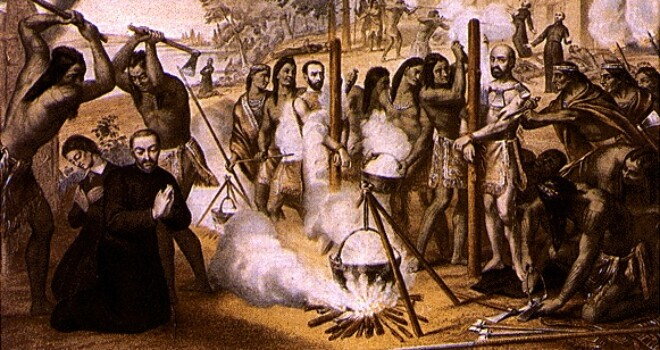
In 1649 Seneca and Mohawk warriors attacked Huron villages, overrunning them. Père Brébeuf and a colleague, Père Gabriel Lalemant, where captured. The Huron villagers and the French who lived and served the missionaries were either summarily killed or captured. The Iroquois peoples of this time, before their conversion to Christianity, believed in torturing their victims to taunt and humiliate them, to watch them suffer, and to avenge their dead. The Black Robes such as Brébeuf and Lalemant especially annoyed the Iroquois because the Jesuits had made known their desire to come among the Iroquois to teach and convert and turn them to French ways of Christian civilization. The warriors made a point with these two Jesuits: they stripped them, pulled out their finger nails, and beat them with cudgels on their loins, arms, legs, belly, head, and face. All the while Père Brébeuf prayed and sang, and told the other Christians suffering torment to be true to Christ who suffered with them. Some of Brébeuf ‘s tormentors knew him. One, whom Brébeuf had tried to convert several years before, said to the priest, according to an eyewitness whose memories were later recorded in the Jesuit Relations, “thou sayest that Baptism and the sufferings of this life lead straight to Paradise; thou wilt go soon, for I am going to baptize thee, and to make thee suffer well, in order to go the sooner to thy Paradise.”

The baptizer, true to his words, began the most unimaginable tortures that are best left unsaid. It took Brébeuf hours to die and Lalemant even longer. Their martyrdom was truly Christ-like, the intense pain, the need for patience, waiting upon God’s will to take them to Him. Brébeuf knew that he was not the first, rather there had been thousands of Catholic martyrs over the centuries, and in New France, there had been martyrs before him, and others would come after. French Jesuit René Goupil, for example, had suffered martyrdom in 1642, seven years earlier, at the hands of the Iroquois. Another French martyr, Isaac Jogues, had escaped with his life after watching Goupil’s martyrdom. “During thirteen days,” he recalled, “that we spent on that journey, I suffered in the body torments almost unendurable, and, in the soul, mortal anguish.” Jogues returned to France in 1646 only to come again among the Huron, was captured again, tortured again, this time to death. He had been sent as a peace ambassador to the Mohawks, who received him and his fellow Jesuit Jean de Lalande with death. Another who had been martyred, just a year before Père Brébeuf, was Jesuit Antoine Daniel, who during an attack on the Huron village of St. Joseph, regardless of his own danger, baptized as many children as he could before they were clubbed to death by the invaders. When all was lost he stood between the attackers and the innocent children and aged and was struck down by the aggressors. There were two other Jesuits who died the same year as Père Brébeuf: Charles Garnier and Noël Chabanel. These eight who died during the decade of the 1640s were canonized by Pope Pius XI in 1930 and are known collectively as the Canadian martyrs.

The word martyr in the New Testament is Greek for witness. The Jesuits, Franciscans, Dominicans and other Catholic missionaries who came to America knew that in going among the American Indians that some tribes like the Iroquois were intransigent toward their teachings, and their violence and cruelty knew no bounds. Père Brébeuf knew this, yet such was his drive, his desire to spread the word of God, to fulfill the Great Commission, that he put his life in God’s hands, knowing that whatever his fate it would conform to Divine Providence: even if he was to be tortured to a horrible bloody death that it was God’s will that the other sufferers watch and learn, and that even the torturers watch and learn, so that in time, eventually, they too would succumb to God’s will, and embrace the Good News.

This essay appeared in a slightly modified form in Catholic Exchange: https://catholicexchange.com/whats-better-left-unsaid-the-testimony-of-jean-de-brebeuf-martyr/

Posted in American History, Biography, Christianity, Great Commission | Tagged , , , , , , , , , | Leave a comment

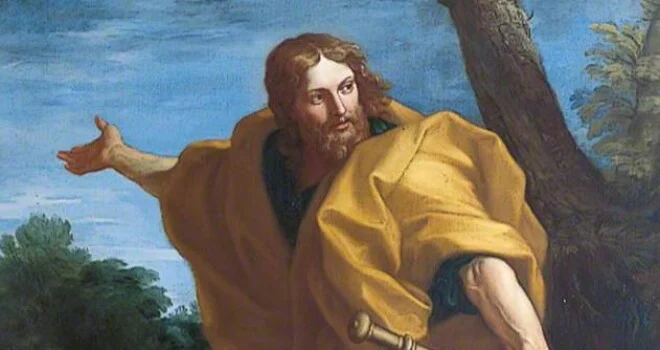
St. James, a Son of Thunder

James the son of Zebedee and brother of John the Apostle was one of the first disciples of Jesus, was a fiery personality completely committed to the Great Commission, and was the first martyr of Jesus’ disciples.  

The Gospels tell the story of an occasion of no clear time or place, perhaps at Capernaum on the Sea of Galilee, when and where Jesus was preaching to listeners from this town and others about the Kingdom of God. It was early in his ministry. Capernaum was a place of fishers, those who went out every day, or night, fishing the great freshwater lake. Among the listeners were two young men, James and John, the sons of a fisher named Zebedee. Jesus preached from a fishing boat owned by Simon Peter, who with his brother Andrew were engaged in the fishing business either alongside or as partners with the Zebedees. After Jesus spoke, he asked Peter to take the boat further out into the lake. Peter had spent some time with Jesus, even had had him at his house, and though the fishers had fished the previous night without success, Peter complied with Jesus’ request to take to the lake again to fish. The fishers lowered the nets and to their astonishment there was such a catch that it threatened the sturdiness of the nets, even threatening the stability of the boat. The Zebedee brothers witnessed the miracle and brought their boat alongside and lowered their nets, which filled with fish. Peter, afraid now, asked the Lord to depart. The Gospels do not record the reaction of the Zebedee brothers.

We can gather from their subsequent relationship with Jesus what might have been their response. One of the brothers, John, was closer to Jesus than his older brother James, and besides John outlived James by a good fifty years; he came to regard Jesus early on as the Christ, but more, the Wisdom of God, the Word, the Logos who was with God in the beginning. We might assume that his brother James had somewhat the same intuitive understanding.

Not only had James witnessed the miracle of the fish, but he was with Peter and John on the mount when Jesus was transfigured. He was with Jesus the many times that Jesus healed the physically and mentally ill. On one occasion at a synagogue a man possessed demanded what Jesus wanted from him, crying out that he knew Jesus was the “holy one of God.” James listened to the parables and sermons, hearing words so forcefully put, so astonishingly truthful, that he knew this person was the Christ.

James, along with his brother John, had learned that Jesus, a craftsman from Nazareth, knew people, each person, knew them entire, their past and future, their suspicions and problems. What is more, the miracle of the fish informed James that this man not only knew each human, but each creature as well: how else would he know where schools of fish were in the lake unless he knew each fish as an individual, as he knew each human as an individual? Thus did James and John discover that Jesus was not only the long-anticipated Messiah but the eternal spoken and written truth, the Logos, long talked about by Greek philosophers. Jesus was (is) God become flesh.

About the particulars of James’ life little is known. He is rarely mentioned in the Gospels, though his presence is implied in the major actions of Jesus’ ministry. His mother, according to Matthew (27: 56), was present at the crucifixion, as was his brother John, hence so too was James. Mark (15,40) says that James’ mother was Salome, wife of Zebedee. John (19, 25) implies that Salome was Mary’s sister, which if true, would mean that Jesus and James were cousins. Salome, if Jesus’ aunt, was sufficiently audacious to request of Jesus that her sons James and John be granted the privilege of sitting next to him in Heaven. Jesus responded that only if they could drink from his cup of suffering. That they were so willing explains Jesus’ nickname for the two brothers, the “Sons of Thunder.” That James was so fervent an apostle explains his early martyrdom.

James was executed in 44, Anno Domini, by Herod’s grandson Herod Antipas, who the Roman emperors Caligula and Claudius allowed to rule a huge amount of territory, including Judaea and Samaria. Antipas was obsequious to the Romans as well as the Jews, hence he was a persecutor of Christians, and for an unknown reason had James beheaded, as recorded in the Book of Acts (12,2).

Anecdotal evidence suggests that at some point between the Crucifixion and his own death James was an Apostle in Spain, and that his remains are at the Cathedral of Santiago de Compostela in northwestern Spain.

This article originally appeared in slightly modified form in Catholic Exchange: https://catholicexchange.com/st-james-son-of-thunder/

Posted in Christianity, FAQs of Christianity | Tagged , , , , , , | Leave a comment

Saint Anthony of Padua, Franciscan Thaumaturgist

St. Anthony (1195-1231, Anno Domini) was a Franciscan thaumaturgist famous for his erudition, oratory, works of charity, and miracles. A native of Portugal, for a time he was a cleric with the monastic order of St. Augustine. In his early twenties, hearing of the martyrdoms of followers of Francis of Assisi, and stirred to imitate their sacrifice for Christ, he joined the Friars Minor of St. Francis. Although Anthony lived a short life, he was noteworthy for his willingness to conform to the will of God; for combining the qualities of a scholar and a pastor, for his thought and charity; and for his many miracles.

In February, 2010, Pope Benedict XVI, in a General Audience, discussed at length the life and significance of Saint Anthony. The Pope, himself a superb scholar, recognized the same ability in Saint Anthony. And like Saint Anthony, Pope Benedict found in his life frequently the call of God to shape his course not to his own choosing, but to Another’s will. Saint Anthony was so stirred by the martyrdom of five Franciscans at the hands of the Saracens that he, too, wished to end his short life with martyrdom. But this was not God’s will. As Pope Benedict said, Anthony, having “set out for Morocco,” was stopped by illness, as “divine Providence [had] disposed otherwise.” Anthony ended up in Italy, where he attended a Franciscan meeting at Assisi. The same sense of humility and obscurity that had convinced him that his life should be a brief testament to Jesus Christ made him retire to a cell to live in isolation and solitude. But “the Lord called him to another mission,” in the words of Pope Benedict. Asked to preach, his listeners were astonished by his rhetorical skill, his prodigious memory, and his sophisticated comprehension of the lessons of Scripture. Soon after, Francis sent Anthony a brief message: “To Brother Anthony, . . . Francis sends his greetings. It is my pleasure that thou teach theology to the brethren, provided, however, that as the Rule prescribes, the spirit of prayer and devotion may not be extinguished. Farewell. (1224).”

In his teaching, Anthony focused on the love and charity of Christ. He said, as quoted by Pope Benedict: “Charity is the soul of faith, it gives it life; without love, faith dies. . . . Christ who is your life is hanging before you, so that you may look at the Cross as in a mirror. There you will be able to know how mortal were your wounds, that no medicine other than the Blood of the Son of God could heal. If you look closely, you will be able to realize how great your human dignity and your value are…. Nowhere other than looking at himself in the mirror of the Cross can man better understand how much he is worth.”

Anthony’s many miracles are fascinating and controversial. We live in a time of reason, when according to the laws of nature we expect and assume that observation will confirm the process of the laws of space and time. But God and His ways are so different, so beyond our comprehension, that it is singularly arrogant to assume we know, and only what we know and observe, or hypothesize and predict, can exist. As a result during the past few centuries humans doubt miracles, anything supernatural. (Seehttps://theamericanplutarch.com/2015/05/18/history-and-miracle/)

St. Anthony could perform astonishing miracles, such as, according to the 14th century book The Little Flowers of St. Francis, sermonizing to a school of fish, who lined up in orderly rows with open mouths to listen to the lessons of St. Anthony. He taught them: “My brothers the fish, much are ye bounden so far as in ye lies, to give thanks to our Creator, who hath given you so noble an element for your abode; . . . God, your kind and bountiful Creator, when He created you, gave you commandment to increase and multiply, and poured on you His blessing.” God blessed fish such that they played an important role in God’s plans for the salvation of Creation; the Son of Man ate fish before and after Crucifixion. (The Little Flowers of St. Francis of Assisi, trans. T. W. Arnold, London: Chatto and Windus, 1908)

St. Anthony’s life teaches us that the path we have chosen will continue as long as we exercise free will according to God’s grace. This sometimes entails a different direction, even a miraculous transformation, than what we have hitherto conceived for ourselves. We must be guided, as was St. Anthony, by love and charity for others, including all life, all creation. Saint Anthony taught: “If you preach Jesus, he will melt hardened hearts; if you invoke him he will soften harsh temptations; if you think of him he will enlighten your mind; if you read of him he will satisfy your intellect.” (Pope Benedict, Feb 10, 2010, General Audience)

This article originally appeared in a slightly modified form in Catholic Exchange: https://catholicexchange.com/unexpected-paths-examining-the-life-of-saint-anthony-of-padua/

Posted in Christianity, FAQs of Christianity | Tagged , , , , , , , | Leave a comment

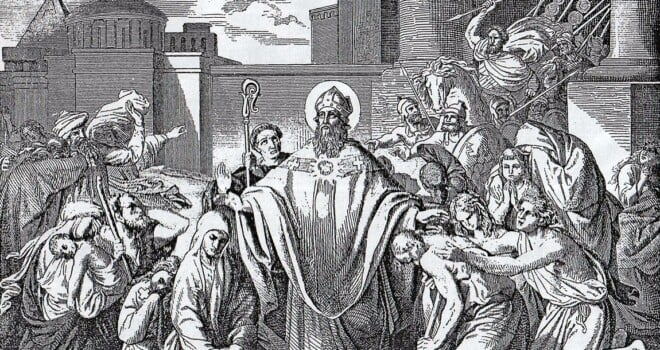
Saint Athanasius: Saint and Doctor of the Church

Athanasius (196-373 AD) lived a long and varied life subject to philosophical, political, and theological controversies, violence, exile, and contentious relations with the most powerful rulers of his time, the Roman Emperors. Athanasius is well known for the Creed named for him formulated by his disciples after his death. Athanasius’s significance lies in his valiant defense of the Trinity at a time when this fundamental basis of Christian theology was under attack.

Athanasius was born in Alexandria, which was a center of violence, persecution, and civil conflict as well as one of the great cities of antiquity, a cosmopolitan center of learning and a growing center of Christian thought. Athanasius was of a well-to-do family; he benefitted from an excellent classical and Christian education. When Athanasius was growing up, the Roman Empire came under the control of an autocrat, Diocletian, succeeded by the first Christian emperor, Constantine, who used Christianity as a way to solidify his power. Even though Constantine’s Christianity was underdeveloped, as head of the state religion he mediated conflicts among Christians over doctrine. At the Council of Nicaea in 325, he heard the arguments of the Arians, that Christ was not co-eternal, not the same substance as God the Father, and the Nicaeans, who believed that the first chapter of John’s Gospel proved that Christ, the Logos, was co-eternal, and of the same substance (homoousios), as the Father and the Holy Spirit. Constantine supported the Nicaeans and repressed the Arians. According to the fifth-century historian Socrates Scholasticus, Athanasius was present at the Council of Nicaea as an aid and secretary to Bishop Alexander of Alexandria. Athanasius forcefully presented the arguments for the Trinity. Constantine supported those who believed in the concept of homoousios and he banished the Arians, but only briefly; thereafter, the emperor agreed to end the exile of Arius and his supporters. By this time Athanasius was Bishop of Alexandria and he refused to accept the Arians, arguing that once they had disowned Christ the Logos they could not be forgiven. This earned him the ire of the Arians, led by Eusebius, Bishop of Nicomedia, as well as the emperor, who forced Athanasius into exile.

When Arius died a horrible death in 336, according to Socrates Scholasticus, Constantine was reaffirmed in his Nicaean views. After Constantine died, the empire was left to his three sons: Constantine II, Constans, and Constantius II, who controlled the East, including Alexandria. Constantine and Constans supported their father’s Nicaean creed. Constantius supported the moderate Arian belief that Christ is like (Homoean) but not the same or equal to God.

In the ensuing years, there was a fierce debate between Constantine II and Constans and the bishops of the West against Constantius II and the bishops of the East. In 338, Constantine II tried to re-invest Athanasius in Alexandria, but Constantius in turn deposed him—but only temporarily. Upon Athanasius’s return, his enemies renewed their attack. In the Council of Antioch of 341, dominated by Arians, Gregory of Cappadocia was appointed to the See at Alexandria. Five thousand soldiers accompanied the new Bishop Gregory to Alexandria, forcing Athanasius to flee. He journeyed to Rome and made his case to Pope Julius, who agreed that Athanasius had been wronged. Nevertheless, Athanasius was forced to spend many years in exile away from Alexandria. According to Sozomen, the fifth century author of Historia Ecclesiasticus, Constans supported Athanasius’s attempts to return to Alexandria, even threatening war, forcing Constantius to agree: Athanasius became Bishop of Alexandria again. Constantine II had already been defeated and killed by Constans; when Constans died in 350, Constantius II, as sole emperor of the Roman Empire, became more oppressive to the Nicaeans and their leader Athanasius.

During these years the Council of Arles in 353 and the Council of Milan in 355 renewed the condemnation against Athanasius, again forcing him into exile. But upon the death of Constantius II in 361, the Apostate Emperor Julian came to power. Julian’s rule was brief, followed by the Christian Jovian, similarly brief. Athanasius was in and out of exile during these years. As the recognized leader of the Nicaeans he bore the brunt of the Arian anger. He revealed during these many years resilience, faith in the midst of danger and scandal, and hope in the triumph of the will of God.

Today, we venerate this Doctor of the Church and most forceful proponent of Christ’s divinity and of the eternal Logos, who provides us with an example to fight for our beliefs in the face of ridicule, hatred, and violence. As the 21st century progresses, Christians will find, as in previous centuries, that we will have to rely on prayer, and the intercession of such saints as Athanasius, to support us in patience, perseverance, and suffering in the face of an increasingly atheistic world.

(This article first appeared in a modified form in the online journal, Catholic Exchange: https://catholicexchange.com/an-early-christian-saint-for-our-time-st-athanasius/

Posted in Christianity, FAQs of Christianity | Tagged , , , , , , , | Leave a comment

The Sorrels Family Orchestra

Ephraim Deals (Deal) Sorrels, Arkansas farmer and woodcutter, was a singer and perhaps a fiddler–at least it is clear he had a musical bent. And Van, his son, took after his father. Whether or not Van was a singer is not known, but he clearly was a musician, and a fiddle-maker as well. 

Left to right John on violin, Daisy standing, Van on guitar, Susie standing between her parents, Tina on mandolin, and Martha on ukulele 

The above picture of Van and Martha and their young family of musicians appears to have been taken around 1905. The family portrait is posed beautifully, and looks as if the instruments were mere props. But they weren’t. Van and Martha, both musical, taught their children to play and christened the Sorrels Family Orchestra. This portrait, then, was perhaps a promotional photograph to encourage would-be planners of feasts, dances, celebrations, and contests to employ the Sorrels family to provide music. Family tradition has it that Van was a fiddle-maker. Did he make all of the instruments played by the family–in addition to the fiddle, the mandolin, guitar, and ukulele? The latter two instruments were relatively new on the mountain folk music scene in early Appalachia, including Arkansas. Some musicologists argue that the guitar wasn’t seen in Oklahoma until the second decade of the twentieth century. If true, then Van was a pioneer in guitar playing so early in northwest Arkansas. The ukulele was introduced to Americans from Hawaii, and became wildly popular among musicians in the early 1900s. An Arkansas music critic a few years after the family portrait was taken wrote mirthfully, “A justly famous music critic announces that the ukulele is not a musical instrument, but an instrument of torture, and that it has no place in modern civilization. But the many new-fangled ways of making people suffer have so crept into our modern civilization that the ukulele has come forward boldly and now has maintained its mournful cadence for several months.” The fiddle had the oldest pedigree among the Arkansas players of the past. Assuming that tradition is accurate, and Van made the family instruments, it reveals not just a man handy with an axe, but a skilled woodworker who could select the finest wood–for musical instruments like the fiddle maple, pine, rosewood, ebony, walnut, and mahogany–using tools such as saws, gouges, chisels, planes, knives, scrapers, callipers, hand screws, and clamps to fashion the instruments. John Broadhouse, who wrote the manual on fiddle-making in 1894, claimed: “A man of fair intelligence, and some aptitude in the use of tools, will be able to construct a violin. Whether it will be a good or a bad violin will depend mainly upon things which will come gradually, and after some failures and many attempts, within the maker’s own control. There is no magic in the art of making a fiddle, but there is a wide scope for the exercise of the mental powers of him who would make a good violin.” One guesses that Deal knew how to make fiddles, perhaps learning from his father, and he taught Van, who perhaps taught his son John. The fiddler of the family, John, who in the family portrait would have been about ten years old, did not have musical training, per se, rather that during winter or rainy days when stuck indoors in the small cabin challenged the hearing of his family screeching on the fiddle until he came to master some of the chords. Doubtless his father and grandfather steered him in the right musical direction. This was the way of fiddlers at the time in rural America anyway, playing by feel, intuitively, without music; hence the fiddler played the same songs but differently every time. Listeners didn’t mind, because the other fiddlers were doing the same thing, and the beauty of the fiddle was the loud reverberations of the strings and exhilaration of the songs. 

The fiddle and other stringed instruments highlighted conventions and contests through the American South in the early 1900s. “A typical fiddlers’ convention usually began in early afternoon and continued into the night. At 1:00 p.m., there would be an open-air concert kickoff with as many as a dozen fiddlers playing at the same time. Thirty minutes later, with the convention now in full swing, the tempo changed producing two hours of breakdown music that echoed into the surrounding hills. Its manner mirrored the simple yet often capricious life of the mountainous community.” “The evening continued with a compilation of tunes from a dozen fiddlers sawing away on “Dixie,” “Arkansas Traveler,” “’Billy in the Low Ground,” “Fox Chase” and “Devil’s Dream.” Next came a fiddler, described as having plenty of resin on his bow, fingering and bowing to “Bonaparte’s Retreat.” Seven fiddlers followed by grinding out the ditty, “Goin’ Long Down to Town.” The show concluded with a combination of performers playing: “Fire on the Mountain,” “Leather Breeches,” “Sugar in the Gourd,” “Please Don’t Shoot the Fiddle,” “Down in Bolson’s Hollow,” “Peter Went A Fishin’” and “Sally Goodin.”

Whether or not the Sorrels Family orchestra played any, some, or all of these tunes is unknown. Doubtless they played the most famous and popular fiddle tune of the day, “Arkansas Traveler,” which was a story about a traveler who came upon a shack where lived a rough impoverished squatter who was playing a tune on his fiddle. The traveler asked for directions, which the squatter was reluctant to give, until the traveler pulled out his fiddle and played the remainder of the song the squatter was playing. The squatter was so happy he gave directions, but advised the traveler to stay put instead, offering his hospitality. One popular fiddle contest in northwest Arkansas was held at Monte Ne, a resort founded by Coin Harvey held for several years in a row. During the contest held in June, 1901, the fiddlers each played “The Arkansas Traveler” and the best fiddler won. 

Ten years later, there was another fiddle contest at Monte Ne again hosted by Coin Harvey, a local celebrity. At this festivity, held August 9, 1911, after speeches and a brass band playing tunes, as the fiddlers prepared for the contest several stringed orchestras played for the crowd. One of those orchestras was “the Sorrels family orchestra of West Fork.” By this time, Van appears to have dropped out of the orchestra, according to surviving photos. John was sixteen, Tina was fourteen, Daisy was ten, and Susie was eight. The photo inscribed with names by Susie appears to have been taken a few years earlier, perhaps about 1908. Susie omitted (or when she wrote the names forgot) the tall brunette girl in the middle. Who was she and how did she fit the band? One possibility is Ethel Abshier, a friend of the family who often played music with the Sorrels.

Indeed, several years later, perhaps about 1915 or 1916, a photo was taken of a much different family orchestra, in this case combining two families, the Sorrels and the Abshiers. The Abshier family lived nearby the Sorrels and became good friends. George and Tonie Abshier, on the left sitting and standing, George played banjo and Tonie played guitar, and their son Lacy, far right played the violin, and their daughter Ethel, sitting in center played guitar, were joined by Tina Sorrels, standing next to Tonie playing guitar, Martha, playing ukulele standing between Tina and her son John, playing violin, and the two younger Sorrels girls, Susie on the right, and Daisy on the left, with her face partially obscure–both girls playing ukuleles.An obscure notice in the Springdale News for April 28, 1916, reads in full: “Geo. Abshier, his daughter Miss Ethel and Mr. Sorrls and his three sisters of Cove Creek came over for the entertainment and furnished music for the play.” What the reporter meant was that George Abshier and daughter Ethel of Cove Creek, Arkansas, joined John Sorrels and sisters Tina, Daisy, and Susie to provide entertainment at a school play, as schools in northwestern Arkansas in late April, 1916, were engaging in various festivities to bring their school year to a close. 

For a complete history of Van Sorrels and his extended family, purchase my biographical portrait published on Amazon: https://www.amazon.com/Van-Sorrels-Woodcutting-Russell-Lawson/dp/B0G524SNSW/ref=sr_1_2?crid=36PPTM7BCTC2Z&dib=eyJ2IjoiMSJ9.cqGw_xgnYBNRNQQZ3VVlDTDuoYsfRKxj_sIIwKXnNqz3Sc9Q0z_tRe-gXhSqrYuSiTeWVpdkbeR0UsauvA-pdRwLV29G0a8HbEi3x-NPsvfHRuI9MFZ7xnvafLMgxAVJDSsu9Aup3YrsJkFIqa3HntEFmdb1m36V2e5Jki2B2VORJ0fxrcOagNlw1y07G0_Z83CLGFv4t6Dyfi3RuXu6coGUAjCvcSesMxcQDkon0yc.r7TvUj2h-Yky7rx02rNzQHuEsw1e1NIPpuyyyQjelbo&dib_tag=se&keywords=Russell+Lawson&qid=1766343535&s=books&sprefix=russell+lawson%2Cstripbooks%2C211&sr=1-2

Posted in American History, Biography | Tagged , , , | Leave a comment

Van Sorrels, the Woodcutting Musician

As the woodcutter sawed and chopped and hewed oak, hickory, maple, and pine, he sang songs to the past, to the land, and to the Lord.

His name was Van. He was a simple man. He could read and write but he had no formal schooling. Yet he was a thinker. He was a big man, stout, strong, blue-eyed, a firm gazer, an honest looker, a man whom others trusted, who kept his word, who believed firmly that the Lord watched him always, and knowing this, Van wished his actions to be pleasing to God.

Van had light hair tended toward reddish-brown, hence he fit the surname Sorrell, which literally means, reddish-brown, or auburn–a Norman-English name. Indeed the Sorrells according to tradition were Normans who came to England with William the Conqueror in 1066. Some authorities claim that the Sorrels were Huguenots from France.  In America the name has been spelled variously, Sorrel, Sorrel, Sorrels, Sorrells, and so on. The immigrants from the British-Isles are often of Scotch-Irish extraction. Many moved south and west in America. Some of the earliest Sorrell immigrants arrived in Virginia in the first half of the seventeenth century. For example there was a Robert Sorrell who came to Virginia and owned 800 acres in James County. He could have been the same Robert Sorrell who died during Bacon’s Rebellion

This man Van of Norman and English extraction of reddish-brown hair had hard muscles, because he worked from dawn to dusk, most days, cutting trees in the forest, cutting off the limbs, dragging the large trunks to his workshop, hewing the wood into various shapes, squares and rectangles that could be used for fencing, barn and cabin framing, railroad ties, and such. During winter he spent much of his time cutting firewood for customers. Sometimes his work was more intricate: preparing wood for the delicate task of fashioning a stringed instrument. Some of this work took thought, some of it did not; he supplemented the routine actions with traditional songs and hymns, many of which he had memorized, others he had composed based off of the original–his own compositions, his own verse–which he said or hummed, thinking that later in the day, after dusk, he would sit next to the fireplace strumming his guitar, or making the mandolin sing. And his wife would join in, their voices merging together, the mandolin, guitar, or fiddle combining together in joyous tunes of praise to the Lord, the land, and the past.

Van’s great-great-great grandfather William Sorrels lived in Virginia, born in 1735, died in 1780 during the War for Independence. He was a veteran of the French-Indian War, discharged early in the war in 1755. He was once again involved in the War for Independence, even though he was in his forties. A record exists showing that he was part of a medical staff caring for wounded soldiers, including his son Richard, who died from his wounds. William appears to have married Ann Holloway, ten years older, in 1749. They both died in 1780. Although there is a record of a Thomas Sorrell dying in 1777 during the war, it was probably not William and Anna’s son Thomas, who died in 1832. Whether or not such historical records ever occurred to Van, I would doubt, as he was a farmer and woodchopper, not the type to care about the details of his forebears in the Revolution. Perhaps he had good reason, as the records are very vague and uncertain, and it is only speculation that William and Anna and Thomas were his ancestors. 

 Imagine one November day that found Van alone in the forest about a mile from his cabin. He was hard at work felling a huge oak tree. It was difficult, dangerous work. His ax rang out into the silence of the forest as he struck and struck again and again. The steel blade of his ax attached to a hard ash handle was his pride, his livelihood, an expensive, elegant tool that he kept sharp every day, in the morning before going off into the woods, grinding and whetting the blade until it shined and was ready for the day’s work. This day, Van struck at the oak, the blade digging deeper and deeper, the wood shavings flailing into the air, the smell of the cut wood inundating the air. He knew that his work was life to him and to his family yet death to the tree. This tree was old, much older than Van, and had been in this forest for several score years. Yet Van was bringing about the tree’s demise. He might have thought about this as he swung his ax. He did not sense that the tree felt anything. But to bring about death to anything, any creature–and the tree was certainly a creature, created by God—was solemn work. The forest surrounded him with life. There were countless trees like this one. The forest filled a purpose for him, so that he and his family might live. Such was the course of life and death in God’s creation.

Van swung the ax, in rhythm with time, with the Creation, and he thought of simple words, like a verse for a song. Such is how this simple man passed his days, working in the forest, cutting wood, thinking, singing, perhaps even creating a Psalter in his head to justify his existence, to make peace with God’s creation.

Van’s ax fashioned the cabin, we imagine, in which his young family resided. It was a solid pine cabin with oak flooring. Van had constructed a hearth on the north side of the cabin to counter the coolest winds of the winter. It was a broad hearth that dominated the room, which was altogether spacious for his family, with one part a parlor for sitting and conversing, another part with beds for sleeping, and the hearth itself for cooking, warming, sitting, reading, relaxing. Van had his chair before the fire. He found it stimulated his thinking. His wife Martha had her rocking chair next to his before the fire. Here she worked with her hands, sewing, mending clothes, cutting the vegetables for the family meals, holding her book to read, or sitting quietly next to her husband in the simplicity of daily life. Unlike him she was small, not weak but still delicate, appearing like a fragile flower, at least in Van’s mind. She was pretty in a basic feminine way. Her hair was long; she kept it up in the fashion of the day. She wore long dresses of her own manufacture. She was fond of simple pastel colors: blues, pinks, yellows. She spun her own thread at the spinning wheel, situated at the northwest corner of the cabin. Here she had a basket filled with yarn and thread. She had a small table with scissors, pins, pin cushions, thimbles, and such tools of the dressmaker’s trade. She made her own dresses, and perhaps even made Van’s trousers and shirts.

Van and Martha lived in the forest and hills of northwest Arkansas, in the small town of Rule in Carroll County. Van worked the land he rented. A small part of this land was plowed and planted for subsistence living: they grew potatoes, corn, okra, tomatoes, lettuce, beans, and squash. There were wild fruit trees and vines throughout, such as persimmon, mulberry, blackberry, blueberry. Van made maple syrup from maple trees in the late winter. He supplemented their diet with fishing. Osage Creek, a mountain stream that flowed into the Illinois River, cut through Van’s rented acreage. The river hosted trout for the cunning angler to supply the dinner table. Van spent part of almost every day fishing. It was relaxing, after a long day swinging the ax. And it was important for his livelihood. The shallow river was fresh and cool, perfect for trout. Van made his own poles and flies and was quite a good fisher.

Fishing was a thoughtful, solemn activity. Van stood at the riverbank, or waded close to shore, fishing quietly. Van listened to the water, to the breeze flowing through the trees, and thought of the ways of the Lord, who communicates so silently.

The dangers of the Arkansas forest were many. But Van knew that God was with him and his family. His father, an Arkansas farmer, had taught Van the greatest lesson he sought to teach. Rely on the Lord. Life is filled with happenstance, it seems. There is danger and death. Rely on the Lord. Van was not a man of great words, rather great thoughts. He spoke when necessary.

Van was not a preacher. Preachers were prolific, of course, among the people of Arkansas, and Van knew quite a few, had listened to even more. The Bible was the great source of knowledge of God, not preachers–though they served their purpose. Van believed in reading the Bible, the source of wisdom.

The farmers and laborers of Carroll County met on Sundays at the Baptist church. It was a small, rectangular building fashioned with wood, built by the people of the town. The pews were of hardwood, and they were uncomfortable to sit in in summer when the clothes stuck to the wood and in winter when the fireplace at the north end hardly warmed the place. The preacher told the people that this was a way to mortify themselves, deny themselves, to prepare for the inevitable meeting with the Lord. “You shall meet the Lord soon,” he said; “some of you sooner than others. Prepare yourselves for His wrath.” Van heard the preacher’s message and wondered about God’s ways. Would God send some to Hell, others to Heaven, as the preacher said? Who goes where, and why? These were difficult matters to consider, and Van’s questions and uncertainty matched others in the congregation.

The time we are describing, 1895, provides few records to help us discover much about Van and Martha’s lives. They were married March 27, 1895, in Mountain Home, Arkansas. Mountain Home was Van’s birthplace, and his parents, Ephraim Deals and Sarah Amelia Sorrels, yet lived there. Martha was born in northern Texas, Titus County, to Joseph Wesley and Jerusha Clementine Tully. Her parents had relocated to the town of Liberty in Carroll County, Arkansas, seventy miles from Mountain Home, where she met Van. Soon after their marriage, Van and Martha set up housekeeping in Rule, Carroll County, near where Joseph and Jerusha lived. And, soon after the marriage, Martha became pregnant with their first child.

The people of Northwest Arkansas were mostly whites, descendants of immigrants who came to the original southern colonies; many had relocated to Arkansas from North Carolina and Tennessee. There were few blacks who lived and farmed in Carroll County; before the Civil War there were few slaves in this region. The people generally had not been slave owners, hence opposed secession, as did their forebears in eastern Tennessee; but when push came to shove and it was a choice between the Confederacy and the invaders, the Union troops, the people of Northwest Arkansas went with the Confederacy. Part of the reason for their choice was the presence of armed bands of Union troops, some official army, some Jayhawkers from Missouri and Arkansas, that brought lawlessness to the region. The independent-mindedness of the people did not pay off, as much of Carroll County was overrun with Union troops, who destroyed and confiscated as they marched through the farmlands. Rule was a small town that was founded after the war; the population was scarce and scattered, and Van and Martha had land, wood, and fish but few neighbors. Joseph and Jerusha lived nearby. The land was mountainous, good for apples, grapes, and peaches as well as family gardens. The land was well-watered. Besides Osage Creek, other good places to fish included King’s River and White River. Oak and cedar provided wood for fences, rustic furniture, and the warmth of family hearths. Traveling in Carroll County was a chore in the late 1800s. Even today the highways are few and far between, windy and filled with quick elevations succeeded by rapid declensions in the road. Walking, riding horseback, or traveling by horse and buggy would have been treacherous in a land of contrary weather and quick storms brewing, rough often nonexistent roads, thick forests, and rapid sometimes uncrossable streams. It tended to make people stay put. It is surprising, however, how often Van and Martha, Ephraim and Sarah, Joseph and Jerusha, and other members of the Sorrels and Tully families, moved–it was poverty and want, more than anything else, that forced the frequent movement, usually west. 

Van and Martha about 1906   

For a complete history of Van Sorrels and his extended family, purchase my biographical portrait published on Amazon: https://www.amazon.com/Van-Sorrels-Woodcutting-Russell-Lawson/dp/B0G524SNSW/ref=sr_1_2?crid=36PPTM7BCTC2Z&dib=eyJ2IjoiMSJ9.cqGw_xgnYBNRNQQZ3VVlDTDuoYsfRKxj_sIIwKXnNqz3Sc9Q0z_tRe-gXhSqrYuSiTeWVpdkbeR0UsauvA-pdRwLV29G0a8HbEi3x-NPsvfHRuI9MFZ7xnvafLMgxAVJDSsu9Aup3YrsJkFIqa3HntEFmdb1m36V2e5Jki2B2VORJ0fxrcOagNlw1y07G0_Z83CLGFv4t6Dyfi3RuXu6coGUAjCvcSesMxcQDkon0yc.r7TvUj2h-Yky7rx02rNzQHuEsw1e1NIPpuyyyQjelbo&dib_tag=se&keywords=Russell+Lawson&qid=1766343535&s=books&sprefix=russell+lawson%2Cstripbooks%2C211&sr=1-2

Posted in American History, Biography | Tagged , , , , , | Leave a comment