Behold, A Virgin Shall Conceive

People throughout the ancient Mediterranean believed that the divine spoke to humans through dreams.

Such was the experience of the young woman, which brought images so vivid, a conversation so easily recalled, that the sights and sounds etched on the mind and memory were never to be forgotten. Whether she was asleep or awake is indeterminable as it was recorded later; the experience was so vivid in her sleep as to be unquestionably real or so dreamlike in her wakefulness as to not be doubted. When the event happened, day or night, winter or summer, month or year, is unknown, unimportant. It was an experience not bound by the normal rules of time. How long it lasted, and whether it was continuous in one or several series of moments, is irrelevant to the experience, to the overwhelming truth that the message contained, both for her and for others. People of her time and of the past had had similar experiences, as she well knew, from hearing stories told or listening to the scriptures being read. She had learned that messengers came and spoke to royalty and commoners alike. So sure were people of her time that such messages were divine, that kings sought out whoever could explain their dreams; some people had that art, soothsayers and prognosticators, experts who could read divine messages in the flights of birds, the arrangements of the stars, the shape of the liver of a sacrificial animal. She had no need for such expertise. Her experience was sufficient to know it was a messenger, one who came from God.

Strangely, in recollecting the experience, she did not describe the messenger save for his name, Gabriel, which means man of God, or strength in God, which was precisely what the girl, Mary, would require to fulfill the requirements of the message. It was an ethereal messenger who spoke to Mary, a messenger without form, merely the spoken word or thoughts, powerful enough to bring about a change in the girl, to cause her body to shutter in the presence of God, to hear more carefully the words spoken, to know for certain what was said to her in her mind.

            She was no one in particular, merely a girl, a virgin, daughter of commoners, illiterate and ignorant as were most such people two thousand years ago. At the same time she was exceptional, unique, one favored by God, selected by Him for an important role, a service for all humankind. Her purpose in life, like all girls and women of her time, was to marry and bear children, if she was so fortunate; few women questioned such a role, it was what their mothers and grandmothers had done, and what their daughters and granddaughters would do. To have a mate and have a child was as natural as to sleep and eat, to live and die. And yet the dreamlike message she experienced, which told her that this was her destiny, which was neither exceptional nor out of the ordinary, was forcefully put, a message of an imminent occurrence, something that could not be delayed. She was a virgin. And yet, she was to have a child. Her dream turned out to bear a divine gift.

            Modern philosophy and science are uncomfortable with the presence of God in any venue, much less the womb. What should be considered the most inviolable place has been violated and penetrated time and again to destroy the most sacred of all things, life. Great thinkers, such as Sigmund Freud, who saw God as the figment of the collective imagination, the product of psychic yearning for completion and love, are aware of no true unity with the divine, in or outside of the womb. Other great thinkers, such as Karl Marx, believing that biological demands precede consciousness, that before awareness is hunger, subject humans to the overwhelming dominance of time and place. Yet, ironically, now and in the past humans have engaged in an unending search for the divine, the discovery of which, it is thought, will yield answers to the many perplexing questions confronting humankind. Great have been the number of philosophers who ask the questions all humans ask and propose answers fit for their time and place. Rather than finding humility in the elusive search for truth, thinkers wallow in the hubris of knowing. All the while humans face the abyss of ignorance.

Dreams invite acceptance of the unreal, something outside of oneself. Individuals in any culture at any time feel an overwhelming need for completion, sense a pull from a transcendent other. What Rudolph Otto called the numinous was the dazzling light that blinded Paul of Tarsus; the child’s voice that responded to Aurelius Augustine’s agonizing question; the austere, universal presence of the One that so captivated Plotinus and his disciples Porphyry and Julian; the oneness that Siddhartha Gautama experienced in the rushing water of the river of life; and the fear and awe that Moses knew when standing on holy ground before Yahweh. All of these religious experiences involve particular people at particular times seeking, sensing, reaching out for, receiving, and accepting, the transcendent.

            The greatest threats to modern society in the third millennium, Anno Domini, are not overpopulation, hunger, disease, terrorism, global warming, and war–although these are pressing problems to be sure. Rather, the modern scientific worldview of purposeful objective thought is destroying the subjective, intuitive awareness of the numinous and transcendent that humans have sensed for countless ages. The individual’s sense of self is a casualty in the secularization of knowledge that has occurred during the past two centuries. Impersonal social and economic forces rather than life are the great agents of change. Reason and science have overwhelmed intuition and art; the subject who intertwines oneself with the object of inquiry is condemned as biased and prejudiced; personal religious beliefs have no place in scholarly endeavors. This secular, objective trend is, perhaps, a mere aberration in time. The period from the structured urban lifestyle that began in Mesopotamia five thousand years ago to today is comparatively brief in the history of humankind. The age of modern science since 1500 is on the human time scale just a fleeting moment. The transcendent and the transient, the subjective and the objective, intuition and reason, have been united from the beginning of humankind.

            Mary’s betrothed similarly received a dreamlike visitor, a messenger bearing a gift, who asked of him to accept what he did not understand, to abide by a will larger than himself. Joseph, a simple man who worked with his hands, not a great thinker or exceptional leader, rather a person content to listen and abide, dreamed of God’s messenger telling him to accept a destiny that would have otherwise been abhorrent to him. Betrothal to a virgin implied she would be untouched until marriage, that her womb was reserved for his seed. Joseph dreamed, however, that Mary was pregnant and that her womb was inviolable and sacred and that he must accept the child as his own. He awoke to a new reality that he acted upon with confidence in the truth. He transformed his entire life according to a message he received in a singular, inexact moment of time.

            Joseph was a Hebrew, a Semite, a descendant of people who had migrated from ancient Iraq, Mesopotamia, west to the land of Canaan, what in time became Galilee, Samaria, and Judaea. The Book of Genesis describes the transformation of these Semites into Hebrews by focusing upon the story of a man, Abram, and his wife, Sarai, nomadic herders who followed a divine call to journey to a distant land. Like other Semites, Abraham and Sarah and their people continued to feel the terror of the unknown, but their fear was mitigated by the realization of a God who cared for them, who was Himself Fate, who controlled all things, and who could circumvent the laws of nature should He so desire. This identification of self with God grew more sophisticated with the passing centuries. We find in Exodus Moses discovering a God of law and deliverance called simply, “I Am Who I Am.” Who precisely this God is and what are His powers and interest in humans is made specifically clear in the writings of the Psalmist David, king of the united kingdom of Israel and Judah from 1000 to 961, Ante Christos. David, at the same time a warrior, murderer, adulterer, and conqueror, was also a poet and singer of extraordinary talent and sensitivity, whose Psalms express the epitome of piety and anguish, love and torment.

            David’s poems are ironic expressions of faith in an all-powerful God even as evil torments and controls the poet. David discovered the dreamlike existence of continually being seduced by some force, some spirit, something strangely in yet outside himself. It was there to counter whatever felt good, those pleasant feelings of life, when things appear right, more than adequate, and nothing is better than a peaceful smile and soft sensations of contentment. It was a fleeting sensation, this intrusion into constancy and order, this violation of satisfaction and happy thoughts. It pierced well-being. It distracted normalcy. It penetrated into a deep well of abandonment, fear, distrust, envy, selfishness, anger, and lust. It found the weakness of his being, the entrance in time of corruption, the fleeting path to what is not real, the moment when fantasy, indolence, hunger, dissatisfaction, and the corporeal reign. It was not right yet it felt good. It was wrong yet just for a moment it was allowed. Evil triumphed. But only in the passing moments. God triumphed over the timeless, the transcendent feelings and experiences that overwhelmed the singular instance of evil.

            God, Yahweh, transcends the moment by speaking in a timeless fashion. Sometimes his words are profound, as to Moses. Usually they are indirect, as to Elijah, when he heard God whispering to him. Sometimes the voice of God is found in the wind. The Hebrews discovered that God often speaks subtly, as through dreams. Elihu, in the ook of Job, proclaimed that God’s word comes to humans “in a vision of the night,” and He tells them of His plans, and dissuades them from their’s.

Many Hebrew prophets were experts in dream interpretation. Joseph the son of Jacob became the powerful adviser to pharaoh after providing an insightful interpretation of the Egyptian ruler’s dream. After failing to find his own dream prophesiers able to explain his perplexing dreams, the Babylonian king Nebuchadnezzar employed Daniel, who provided the correct interpretation. The Hebrew prophets heard the voice of God in singular and transcendent moments, either when awake or asleep, and responded like Isaiah, who declared, “the Spirit of the Lord God is upon me.”

            Isaiah, learning of God’s plans, even predicted that at some point in time, “Behold, a virgin shall conceive, and bear a son, and shall call his name Immanuel.” God is with us.
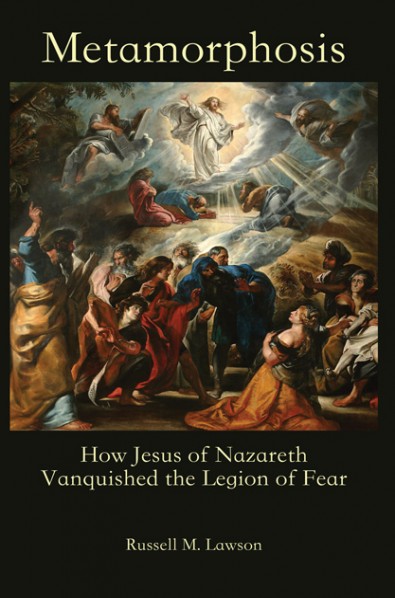
(The above passage is taken from Metamorphosis: How Jesus of Nazareth Vanquished the Legion of Fear, available at Amazon: https://www.amazon.com/Metamorphosis-Jesus-Nazareth-Vanquished-Legion-ebook/dp/B07N9B75YF/ref=tmm_kin_swatch_0?_encoding=UTF8&qid=&sr=)

Posted in books, Christianity | Tagged , , , , | Leave a comment

The Story of the Wise Men

The world was in need of a savior; then a star appeared, an astral phenomenon seen in the east.

            Those who witnessed the rising star on the endless desert horizon were seeking signs of the will of heaven, the becoming—that which is not, yet will be. Each night these sorcerers of the desert, star worshipers known as Chaldeans or magi (μάγος, magŏs), sought in the movement of the stars and planets along the zodiac the signs of the future, information they could employ in their sorcery and charms, their advice to kings, their own achievement of power and wealth. The astral event, unexpected, astonishing, and concerning, impelled the sorcerers to journey in search of its meaning.

Their search led them to the one through whom all of the past as well as the whole of the present and the future are fulfilled.

            The sorcerers lived in lands to the east out of reach of the power of Rome and the eastern extremes of the Roman Empire—Anatolia, distant lands of Mesopotamia and Babylon and beyond to the Iranian plateau where the star-worshiper Zoroaster had once come preaching a belief that the multitude of divinities long held in awe by priests and peoples were but two primal forces of good and evil in constant combat for control over the natural and supernatural. The sorcerers devoted themselves to the good rather than the evil, and used their knowledge of the stars to predict events that served the former in opposition to the latter.

            The sorcerers of Anatolia followed the star that guided them across the deserts, journeying in the wake of other nomadic travelers who centuries before had set out from Mesopotamia toward the land of Canaan. Unlike the first Hebrews led by Abraham, the sorcerers did not drive sheep and goats before them; but they were sufficiently wealthy to bring rich gifts of their lands: minerals and spices and ointments. They were uncertain of their destination, uncertain for whom the gifts were; they traveled with theirs eyes and ears open to any possibility to which the astral phenomenon might bring them. Passersby might wonder, “what folly is this, that sorcerers follow a strange star bringing rich gifts to where and to whom they know not?” The sorcerers had faith in their reading of the heavens, faith that the astral messenger was not bent on folly; something sensed and intuited informed them of the rectitude and certainty of their mission.

            The sorcerers believed that the supernatural could interpose change and movement on the unchanging truths of the natural. The great certainty of the patterns of the heavens had meaning and influence over human events. The number of stars in the sky, the wandering planets, the patterns of the zodiac, held latent power, as did substances of the earth, air, fire, and water. The sorcerers, knowing that the divine and its many manifestations revealed truths to the willing observer, thinker, and listener, hurried them on in the conviction that without doubt the astral phenomena had supernatural origins, and must not be ignored.

            The appearance of a star, a new light in the heavens, might signal any of a number of events. Time immemorial had taught prognosticators that stars were manifestations of the divine, even symbols of particular supernatural powers—to impregnate the barrenness of soil and womb with new life and growth, to stir among men the angst to desire power and conquer foes, to will to rise among others as king. This latter possibility, that an astral phenomenon was a supernatural sign of the birth of a king, quickened their step as they journeyed west.

            It is not told how long was their journey and precisely from where they came; what were their names and nationalities; how many they were and whether or not they held political power among their respective peoples. The story of the sorcerers’s journey to Palestine is anonymous about such details, but clear about their beliefs and purpose and about what they found when they arrived. 

            Ancient authorities on the practice of magic, who lived during the many centuries that the Roman Empire provided a unified structure for learning, believed that the magi, the sorcerers of Anatolia who were experts in astrology, divination, and magic, were opportunists. These Asian sorcerers claimed to be able to anticipate the interposition of the supernatural on the natural, to predict, anticipate, the arrival of divine hints of the future and read them when they arrived. Ancient scientists and philosophers were often incredulous about such claims, though they did not doubt the abilities of the sorcerers to use magic, to predict the future, and to gauge the will of heaven from the stars. Hence when the sorcerers from Anatolia crossed the Jordan River, entering into Palestine, following an astral phenomenon, their counterparts at the court of Herod, king of Judaea, sought to discover the magi’s mission. Herod was like most ancient kings insecure in his power, wondering how long fate had decreed his rule, hungry to find out from any source, information about the future. He had court astrologers, to be sure—the strongest, wealthiest kings attracted the most skilled soothsayers, either Chaldean or trained by Chaldeans. Their positions at court, indeed their very lives, depended upon their skill at prognostication. The sorcerers arriving from the east were rivals, but could hardly be ignored.

            Upon arriving at Jerusalem, the sorcerers went to the court of the king, whose name was Herod. Whether the king that they met with was Herod or his son and successor Herod Archelaus is unclear from the source, the Gospel of Matthew. The king and his advisers, upon learning of the coming of the magi from the east, following the sign of heaven, inquired of the sorcerers what they had seen and what it could mean. The sorcerers revealed enough of their mission to encourage speculation as to what the star could mean, but they were hesitant to put themselves into the hands of the king or his court astrologers. While the sorcerers stayed in Jerusalem an uncertain amount of time, they continued to see the astral phenomenon, and wondered when its true significance would be revealed.

            The sorcerers either had learned beforehand or learned upon their arrival in Jerusalem that Jews were most particularly anxious about one future event, the coming of the anointed one, the Messiah. The Hebrews had for over a thousand years looked for the appearance of the anointed one, who would champion their cause, free them from suffering and political oppression, and lead them to a new age wherein the chosen people of Yahweh would find redemption and peace—and power and glory as well.

            The yearning for a savior is common among individuals and peoples throughout time. Some Hebrew writers, such as Isaiah, portrayed the Messiah as a “Prince of Peace,” a humble and loving healer. The author of the Psalms believed the Messiah was Lord, son of God. Other Hebrew writers expected the Messiah to come in a blaze of glory. According to the author of the Old Testament book of Daniel, who wrote two to three hundred years before the reign of Herod, the Messiah would provide a temporal and secular manifestation of what all people seek, what people of the ancient world in particular sought: wealth, power, glory, revenge, martial success. More recently, perhaps only seventy years earlier, the writer Enoch had conceived of the Messiah as God’s agent to avenge His enemies. Hence did the Jews hunger for the appearance of the anointed one.

            Even if freed for short periods from the whims of rulers and soldiers, the people of Palestine, like most ancient peoples, were constantly pressured by famine, malnourishment, plague, individual illnesses, disability, insecurity, pain, and eventual death. Lives were short and brutish. Few people were educated, and most lived in fear of the unknown. Ignorance was the great ruler of all people, fed by the deception that life could be lived without pain, hunger, violence, and fear. People responded to their conditions by retreating inward to what was left of self, a dark, dismal region of absence of love and the ubiquity of pain and terror. The only release was death.

            Out of the darkness a light shown. Hopeful individuals saw it, reached out to touch it, embrace it. Sin and despair often tried to cover the light, to smother its rays, to hide it though it could not be hidden. Somewhere the light still penetrated the darkness. The magi from Anatolia focused on the light amid the darkness of Herod’s Judaea. As they viewed the suffering and poverty of the people and the lavish wealth and momentary power of the king and court; as they walked among religious leaders, Pharisees and Sadducees and Essenes, who puffed themselves up thinking that they knew the will and ways of God; as they listened to astrologers and sorcerers who sought to tell the king what he wanted to hear—the magi still could see the light, the astral messenger that nightly appeared, giving them hope. So they waited. They knew that in time, soon, the astral messenger would reveal what they had journeyed so far to see. They waited in expectation of the supernatural.

(This is an excerpt from Metamorphosis: How Jesus of Nazareth Vanquished the Legion of Sin, Wipf and Stock, 2018, which can be purchased from the publisher at https://wipfandstock.com/9781532694714/metamorphosis/ or through Amazon.com at https://www.amazon.com/gp/product/B07N9B75YF/ref=dbs_a_def_rwt_bibl_vppi_i7)

Posted in books, Christianity | Tagged , , , , | Leave a comment

Reflections on Psalm 1

Happy is the person who does not walk in the way of sinners. . . .

Happiness comes from acting according to God’s will. This simple truth is so obvious and necessary, it should so drive all human actions and thoughts, that the alternative should appear nonsensical. And yet the alternative is what drives humans forward in time, confronting the everyday with their own actions, their own will, contrary to God’s will, God’s law.

Other living creatures are not like this. Other creatures live according to God’s will and law. Their choices are restricted to nature’s mandates. They eat, sleep, hunt, live, and die, according to what God has willed. They don’t contrive self-devised opposites, of living in an unnatural way, staving off death as long as possible, eating more than what nature mandates, seeking to break from nature by creating as artificial an existence as possible.

Humans are cursed with the ability to choose. They are cursed with apparent free will. They have convinced themselves that they can order their lives, control their destinies, make choices without (or ignoring the) consequences, tempt fate in so many ways, and live almost as gods. When it all comes crashing down, they are shocked, surprised, horrified, feel ill-used, curse God, fate, or the heavens, all the while taking no responsibility for what they themselves contrived.

Meditate on God’s Law day and night. . . .

God’s law, God’s word, comes in so many forms, it is impossible, as Paul said in his Epistle to the Romans, to be unaware, or pretend unawareness, of God’s Creation, God’s actions throughout time in human and natural experience. Nature is filled with the writing of God. Human history is a narrative of God’s will. Each life, human as well as others, are contrived by, designed by, God, and it takes very little thought, from humans who are otherwise so reflective and ruminating, to see the hand of God in each day of our existence.

God’s law is natural law, it is the law of the heart and soul, and we scarcely need to be told what is obvious in our deepest intuitions. As Richard Hooker, the Anglican theologian, wrote: “nature teaches men to judge good from evil, as well in laws as in other things” by “the force of their own discretion.” It follows then that “whatsoever we do, if our own secret judgment consent not unto it as fit and good to be done, the doing of it to us is sin, although the thing itself be allowable.”

Hooker said further respecting the laws of God and humans, that God is a law unto Himself, in that He is both the Author of Law and the Doer of Law, both equally in perfection. Human natural and civil laws are learned from nature, learned from God, not original to humans, who perceive disorder and chaos because we are ignorant of God’s true purposes and His eternal laws: all things work according to His will, which is good and perfect.

It follows that all things yearn for what is more perfect, all things therefore yearn for Goodness, and by this yearning, all things are good. All things therefore yearn for God.

God knows the way of the righteous, who thrive next to clear waters, as well as the way of the impious, who will perish like a tree in the desert lacking moisture.

As Hooker wrote, “the general and perpetual voice of men is as the sentence of God himself. For that which all men have at all times learned, Nature herself must needs have taught; and God being the author of Nature, her voice is but his instrument. By her from Him we receive whatsoever in such sort we learn.”

By listening to the voice of reason and the authority of teaching over time we know the Good and are able to withstand the temptations inherent in the passing moments of fads and whims.

If you like this reflection on the Psalm, see my book, God is Love: Reflections on the Psalms, available here: God is Love: Reflections on the Psalms – Kindle edition by Lawson, Russell M. . Religion & Spirituality Kindle eBooks @ Amazon.com.

Posted in books, Christianity, Reflections on the Psalms | Tagged , , , | Leave a comment

God is Love

God is mysterious. God is unknowable. God’s ways are unfathomable. Yet like the wind, the air we breathe, God’s presence is unmistakable. Reasoning, trying to figure out God and His ways, is a dead end. Feeling, intuition, sensing His presence, accepting Him as the guide: these are the ways to know God, that is, feel God. Love is not rational, not logical, cannot be induced and deduced, but is felt, is present, is obvious as it washes over us and cleanses us, gives us an overwhelming peace. Love is not bound by time or place. Love simply is. 

The voice is heard, air is breathed, thirst is quenched, the wilderness is watered with life, amid the Love of God. 

Love is about feeling, the affective, it is not absolute. God loves us in the moment, because humans live in the moment. We can each and every minute feel God’s love. God is absolute and his knowledge is absolute. But His love is contingent upon time—it is a reaching out to humans living in time. Love is also about desire. Desire to be with someone, extend out to the other, merge with the other, share with the other. God’s love is not just an intellectual love. Love is a feeling. God’s love must be a feeling. Hence God desires us to love him, be with him, be one with him. To be one with a person is to have the same mindset, the same feelings. If God loves us always he is hoping that we will too. But if we don’t respond to God’s love with commensurate love, it is in that sense that we are not conforming to God’s will. Free will is simply one’s decision each moment to love God or reject God, love God or something else, someone else, like oneself. God outside of time knows all things. God acts in time with love, via the Holy Spirit, leaving the response to His desire up to us. The freedom of the will is done in the confines of God’s grace, that is, His love.

Love is not rational but intuitive, feeling, mysterious, transcendent, unconditional, a union, a warmth, an emotional attraction.  God rules Creation by Love. God’s will is me, in me. One may access it intuitively and by prayer. Love is the active verb, hence to access God’s love is by loving him, loving all creatures, the whole creation. The is clearly what Jesus did, hence to act in love is to imitate Jesus. So to find love is to find God. To share love is to share God, to form an empathetic communion that is God.

For more on God’s Love, see my newest Kindle Book, God is Love: Reflections on the Psalms, which is an ecumenical, spiritual, meditative, historical reflection on the 150 Psalms of David. The book is meant to inspire reflection on the historical and existential purpose of the Psalms, an active search for and communication with God, a meditative dialogue with God’s words that links the meditative person with so many like seekers and thinkers over the centuries.

Posted in Christianity | Tagged | Leave a comment

Ebenezer Hazard, Jeremy Belknap, and the American Revolution

My book, “Ebenezer Hazard, Jeremy Belknap, and the American Revolution,” has been republished by Routledge. Ebenezer Hazard was a surveyor of post roads and scientist during the War for Independence. Jeremy Belknap was a clergyman, scientist, and historian. Their epistles during the war are wonderful examples of graceful writing, sharing scientific, historical, political, and social issues relating to the American Revolution. You can purchase the book through Routledge at https://www.routledge.com/Ebenezer-Hazard-Jeremy-Belknap-and-the-American-Revolution/Lawson/p/book/9780367643416

Or at Amazon:

Posted in American History, books | Tagged , , , | Leave a comment

Harriet Jenkins Wiggin of Massachusetts

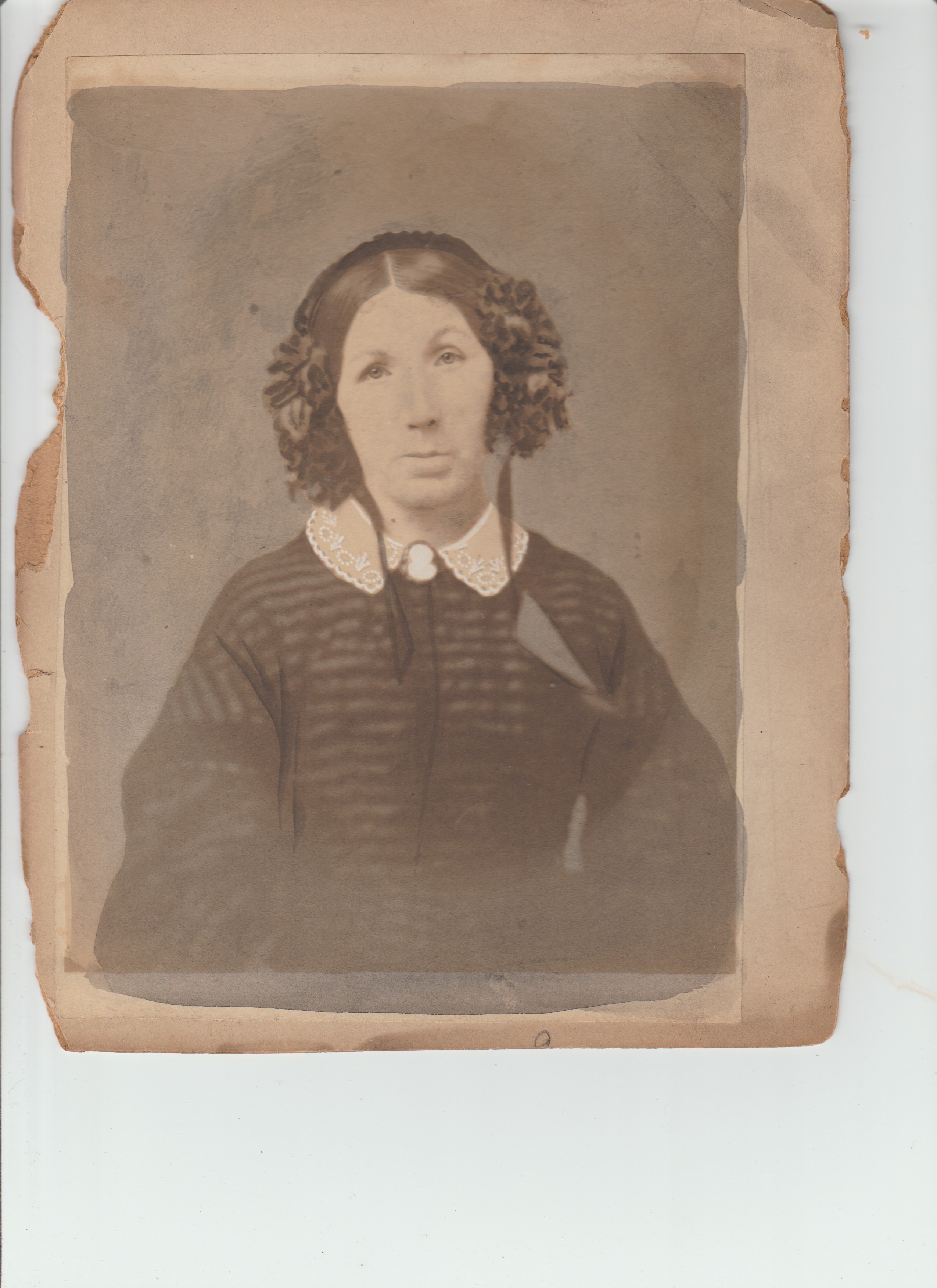
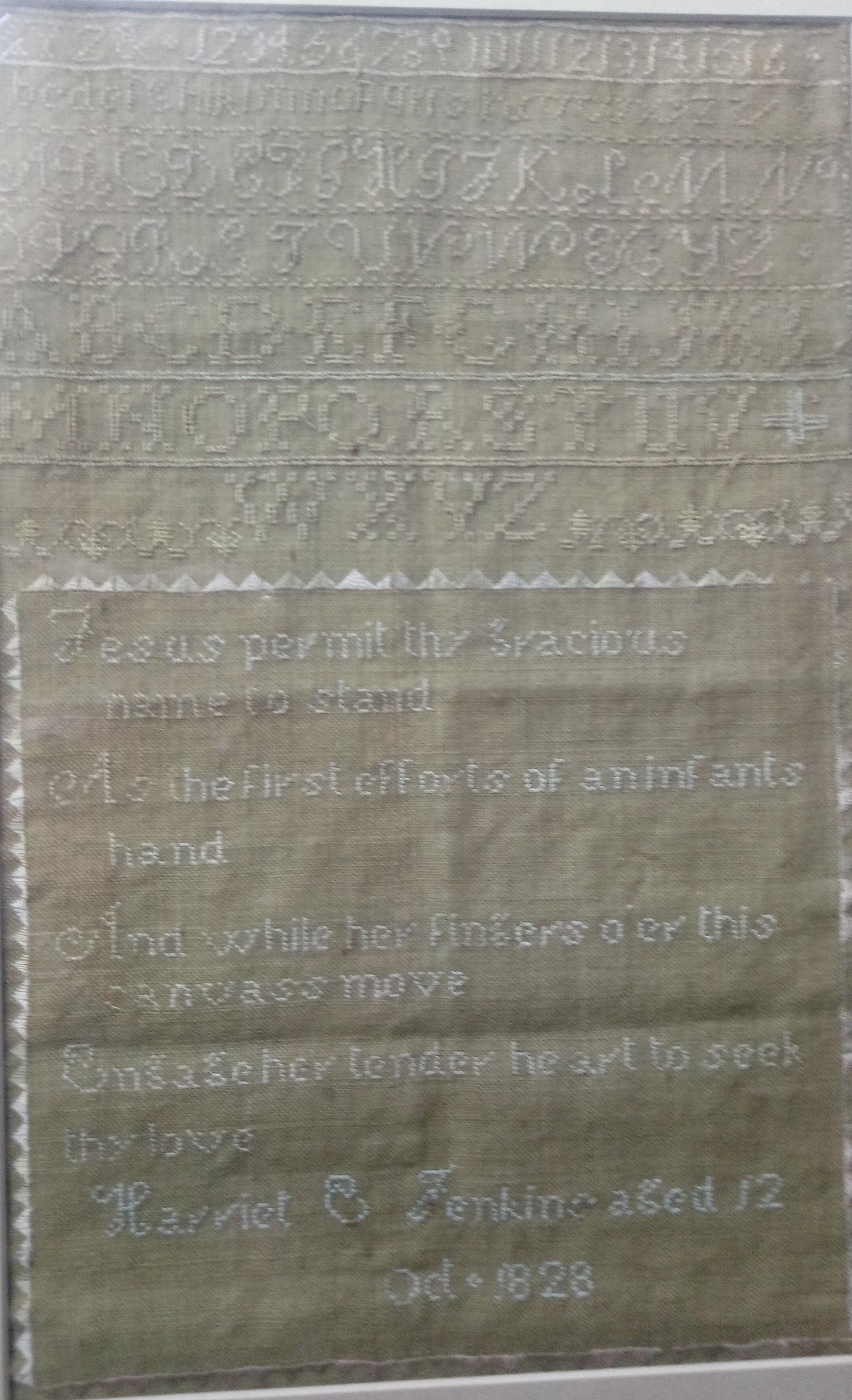
Harriet E. Jenkins was born in Vermont sometime in 1815, possibly to John and Mary Jenkins. She was a little girl of 12 in 1828 when she worked on a sampler using needle and thread. She sewed white thread on a beige linen background. She included, as samplers typically did at the time, the alphabet in various forms and fonts. Then she included a poem:

Jesus permit thy gracious name to stand,

As the first efforts of an infants hand,

And while her fingers o’er this canvass move,

Engage her tender heart to seek thy love.

sampler

Harriet’s family moved to Massachusetts at some point, so that she married Joseph Wiggin April 14, 1836, in Stoneham, MA.

In the 1850 census Joseph and Harriet lived in South Reading, MA; he was a shoemaker, and they had two daughters. He was 37, she was 35, which is in keeping with the sampler indicating that she was 12 in 1828. One daughter, Harriet, was aged 11; another daughter, Mary Frances, was 7 years old, born in 1843.

Little is known about the life of Harriet and her husband. Much is known about her daughter, Mary Frances, who lived a long life, dying in 1931.

Posted in American History | Tagged , , , , , | Leave a comment

Metamorphosis

Franz Kafka’s Metamorphosis is a strange story about a man who awakes one day to find himself transformed, or metamorphosed, into a bug-like creature with many small skinny legs, antennae, and a hard shell. His appetites change and he can no longer communicate intelligibly to his family, who are astonished and horrified. He still thinks like he did when a human, still has the same emotions and intellectual desires. He is disgusting to himself and to others—as though humans might not be disgusting to other creatures. At the time Kafka wrote the book, during World War I, humans were increasingly disgusting, disgusted with themselves, with the rape of the environment and the destruction imposed on other, civilized and “less civilized” human peoples.

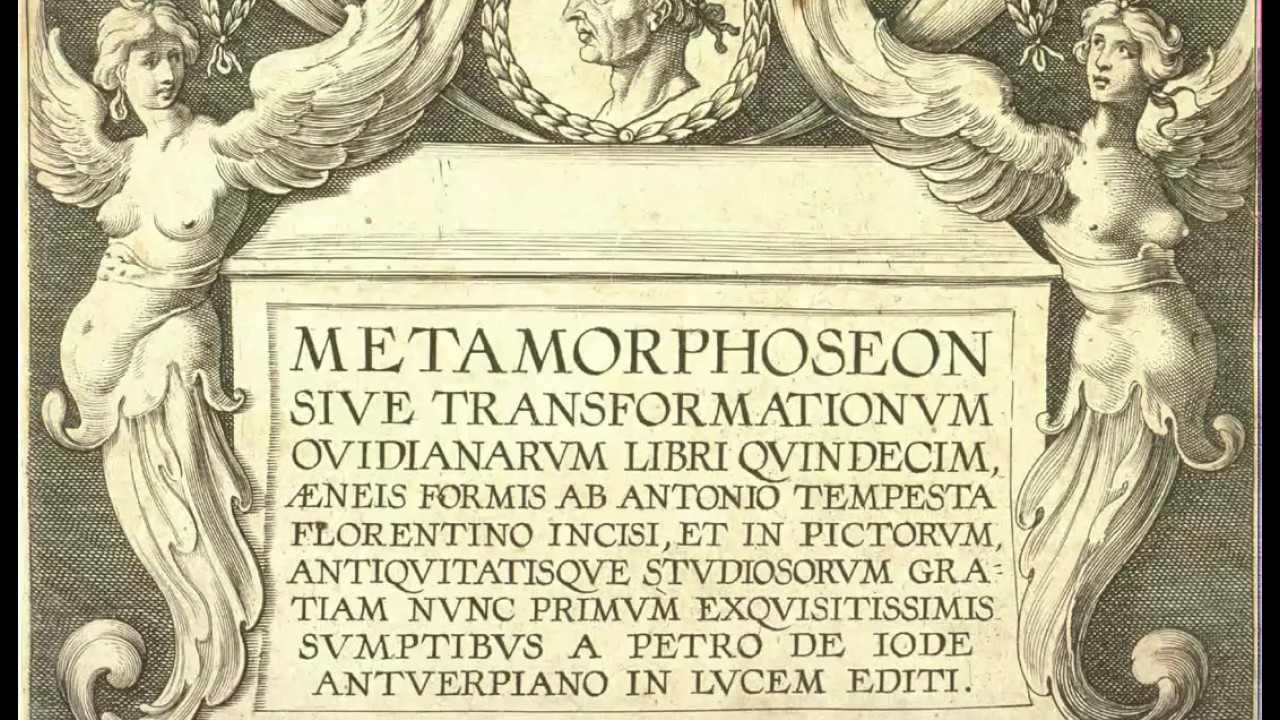
Another book of the same title, by the Roman poet Ovid, provides a completely different view of metamorphosis. His poem says that the divine might transform into material things and living creatures. Ovid represents ancient thought on the interaction of the divine with corporeal existence. He says that the Metamorphosis occurs in the beginning of time, when forms are changed into new bodies, such that the Artificer of all things forms humans from a divine seed.

ovid metamorphosis

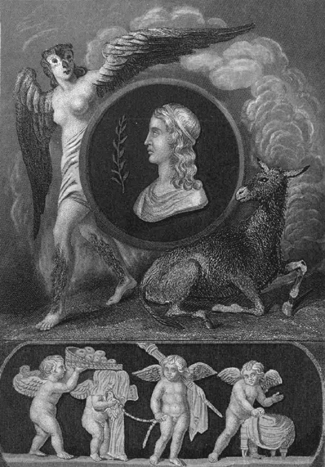
Likewise, the ancient writer Apuleius wrote an account of Metamorphosis; the book was also known as the Golden Ass, and tells of a man transformed by magic into a four-legged ass. But this is not the story of the transformation of a human into an animal and back to a human. Rather, Apuleius tells of a man who goes through such suffering and fear, as a man and as an ass, that he is finally through prayer metamorphosized into a life of peace and contentment. This is by means of the intervention of the transcendent, symbolized by Isis, the Egyptian fertility goddess, into the man’s life. Isis represents the fundamental deity, of which there are many manifestations. Isis is the light and truth, very similar to Christ, the Logos, of ancient Greek and Christian philosophy. The worship of Isis was a chief mystery religion; such mystery religions were similar to Christianity; conversion was a metamorphosis of a person to realize and accept the transcendent.

ApuleiusFrontispiece

Another ancient source that describes such a metamorphosis is the New Testament, specifically the synoptic gospels, in describing Jesus’s transfiguration (literally, metamorphosis) on a mountain in front of his choice disciples. Like Ovid, like Apuleius, the gospel writers claim that there is a connection between the transcendent and the transient in the person of Jesus of Nazareth, who experiences a connection with the one God during this time of metamorphosis.

The New Testament describes many such experiences of metamorphosis, such as that experienced by the Christian persecutor Saul on the road to Damascus, during which he experienced the transcendent, and became physically blind but spiritually aware. Paul, in the Letter to the Romans, chapter 12, described such an experience as being “transformed by the renewing of your minds.” This form of metamorphosis was akin to the world of Hellenistic philosophy in which Paul lived and wrote, in which thinkers and practitioners of the mystery religions searched for a mystical communion of the transient human with the transcendent deity.

220px-La_conversion_de_Saint_Paul_Giordano_Nancy_3018

A fourth-century intellectual and spiritual follower of Paul, Aurelius Augustine, described in the Confessions his own metamorphosis on reading a passage from Paul’s epistles during a moment of emotional crisis, in which he heard the divine voice of a child. This one moment metamorphosed Augustine spiritually and physically for a lifetime

There are many examples in human history of a metamorphosis that occurs when a human experiences the divine. Often these experiences occur during moments of trauma, during mental or physical anguish, when healing is needed, and a metamorphosis occurs in mind and body, and time is briefly interrupted by the coming of the divine into transient human affairs.

In today’s day and age of skepticism and incredulity, it is hard to find serious examples of such metamorphosis. But I would argue that they occur all of the time, and are not limited just to humans, but to all life forms. Such metamorphoses have to be sought after, thought about, reflected upon, before they are realized for what they are, moments when the supernatural intervenes, and the presence of God is felt, and fear is transfigured into love.

Posted in books, Christianity, European history | Tagged , , , | Leave a comment

George Washington Amos III, Arkansas Farmer, 1845-1916

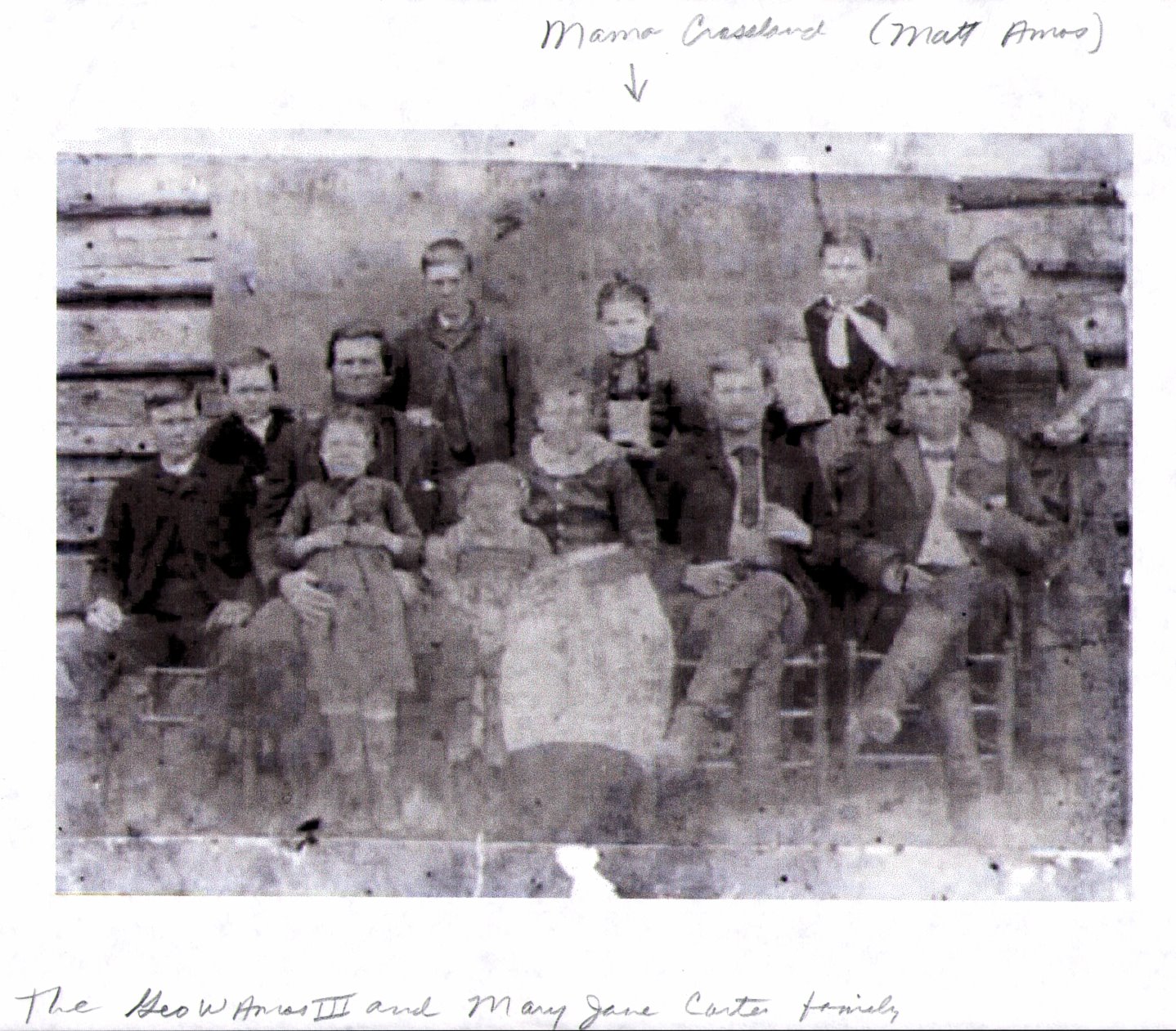
George Washington Amos was son of George Washington Amos II, who was son of George Washington Amos I. GW Amos III was born in Talbot County, Georgia, on February 28, 1845. His family moved to Alabama when he was young, and after his marriage and service in the Civil War, he moved his family to Arkansas.

In the 1850 census, GW Amos III was six years old with seven siblings. His father, GW Amos II was 37, married to Catherine Hammock (married August 24, 1831). GW Amos II had been born in Hancock Georgia, south of today’s Oconee National Forest, near Atlanta. He would die on April 1, 1889 in Grimes, Alabama. The grandfather, GW Amos I, was born in Lunenburg, Virginia, in 1785. He married Anna Bentley on Oct 8, 1807. They moved to Georgia, where GW Amos I died on April 3, 1845.

During the 1850s, GW II and Catherine Amos and family moved to Pike County, Alabama, where they farmed. After the war began in 1861, and when GW Amos III reached his 18th birthday, he enlisted as a private in Company B, 57th Infantry Regiment organized at Troy, Alabama. GW fought in numerous battles in Tennessee and Georgia, fighting against the invading armies of the North. Many of his comrades died, but he survived. A monument erected by the Atlanta Historical Society in 1944 commemorated the “American Valor” of the “participants in the Battle of Peachtree Creek, July 20, 1864,” in which GW III fought.

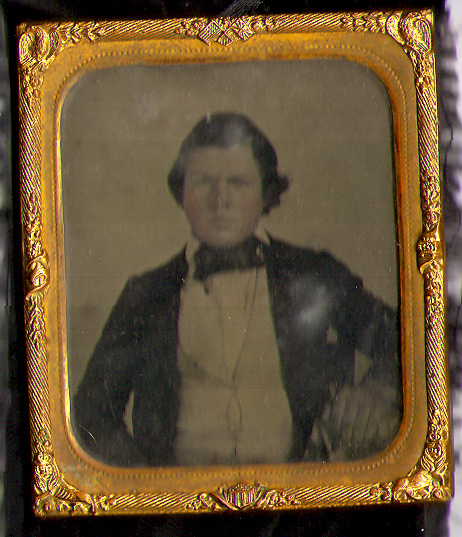
GW Amos at age 18

After the war, GW married Mary Jane Carter, born Sept. 29, 1842; she was 24 and he was 21. Mary was a native Alabaman, daughter of Seaborn and Hannah Carter; Seaborn Carter was a fairly wealthy Alabama farmer. According to the propriety of the time, GW (along with his brother Henry W.) had to post a bond of $200 guaranteeing that there were no impediments to the marriage: “Know all men by these presents, that we .. .. are held and firmly bound unto the State of Alabama in the penal sum of two hundred dollars; for payment of which, well and truly to be made, we bind ourselves and each and every of our Heirs, Executors, and Administrators, jointly, and severally, firmly by these presents. ….The condition of the above obligation is such that if there be no lawful cause why George W. Amos and Jane Carter should not be joined together in the Holy union of Matrimony, then this obligation to be void; otherwise, to remain in full force and virtue.”

Their first born was William Wilburn, 1867-1931, followed by Seaborn Washington, 1868-1908, John Henry, 1871-1935, James Belvy 1873-1964, Mary Catherine, 1875-1952, Martha Matilda “Mattie”, 1877-1968, Alexander Zacariah, 1879-1974, Ada Lee, 1882-1973, and Nettie, 1887-1942. Remarkably for the time, all of their children survived childhood to die in adulthood.

In the 1870 census GW III and Mary Jane lived in Pike Co., Alabama, and had two young children (William Wilburn and Seaborn, 3 and 1); GW was listed as a farmer. His wife was illiterate, unlike him. He lived next to his father GW Amos II, probably farming the family land, as he was listed as having no real or personal estate. GW II was 58, wife Catharine was 53; two daughters lived with them, Rebecah and Isabella, 18 and 16.

In the 1880 census eldest son William Wilburn, aged 12, was listed as farm laborer to his father. The family had relocated to Arkansas, living in Big Creek, Sebastian, Arkansas (southeast of Fort Smith).

george washington amos family portrait

Mary died in 1895; GW married Martha Ann Harper, aged 47, in 1899. They had two children, one out of wedlock, Emma, born in 1897, another, Nada, born in 1901 (died, 1973). Martha died in 1902, and GW remarried Sarah E. Alford; they had no children. She was 49 when they were married.

In the 1910 census, GW and Sarah had three grandchildren living with them and one child, Emma, from his previous marriage. They were homeowners, farming in Bloomer, Sebastian Co. Arkansas, near Big Creek.

GW Amos III and family

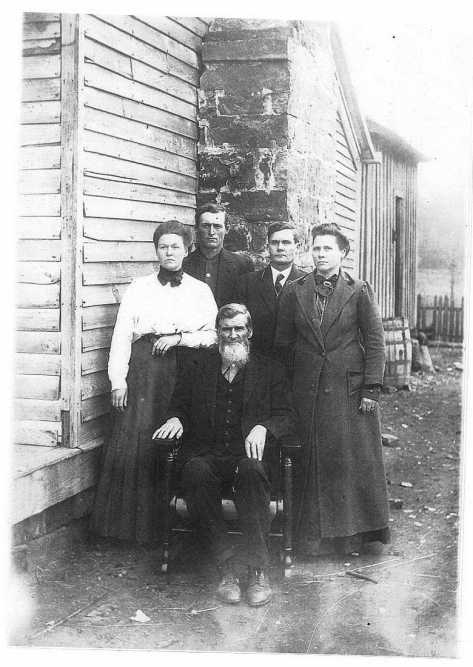
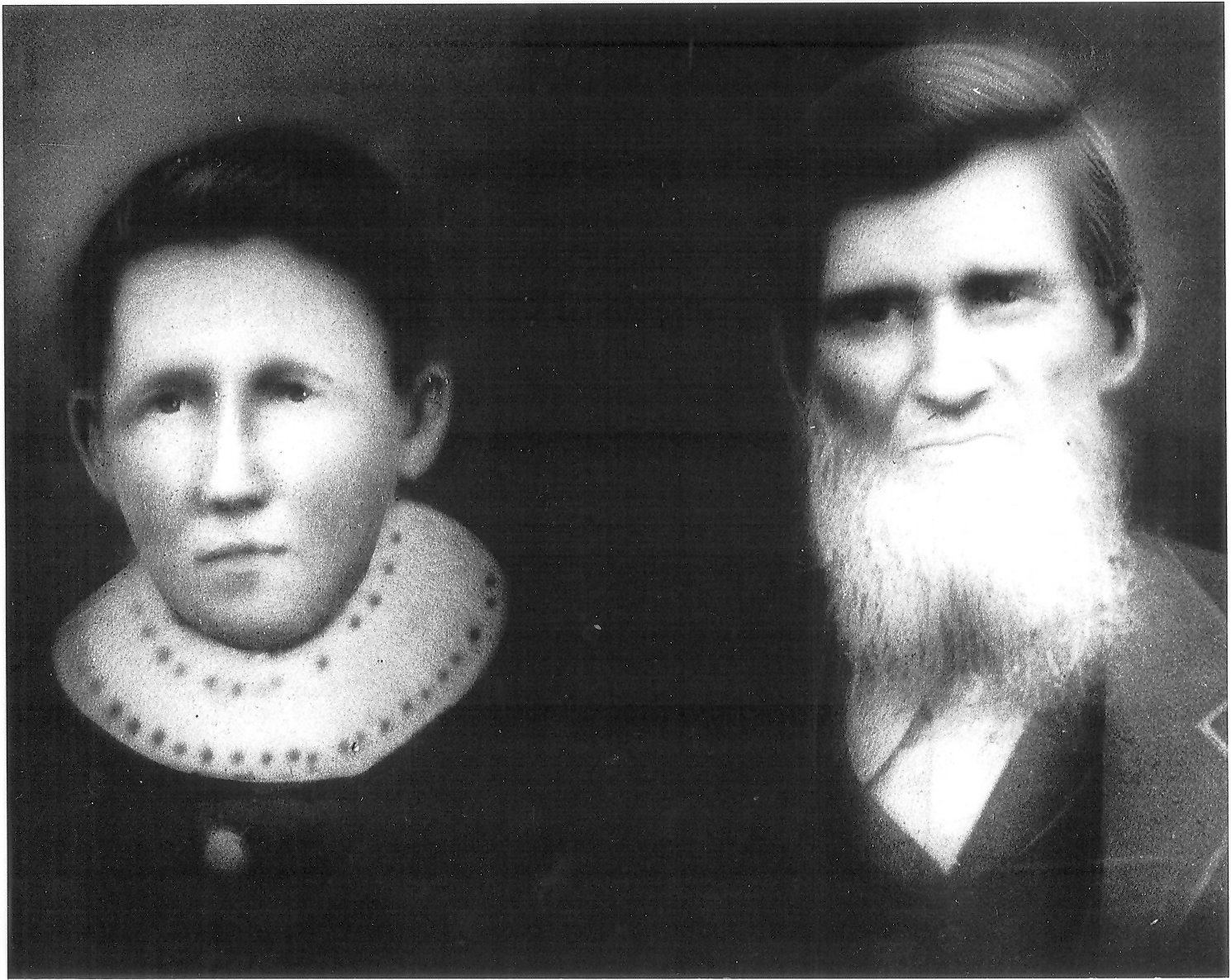
GW Amos III was a strong-looking man, according to several surviving photos. The photo taken when he was 18 before he enlisted reveals a pudgy, healthy young man with a full face and narrow, penetrating eyes. A later family photograph taken shortly before Mary Jane’s death shows a middle-aged man, stern, with a square face, no longer pudgy, thick hair and beard (without moustache). A photo taken around 1910 with four of his children shows a stern-faced man, lean, with heavy eyebrows, penetrating eyes, and a thick white beard sans moustache. A portrait perhaps drawn from a photo with his third wife Sarah Rambo Amos shows a white-bearded, brown-haired, stern man with sunken cheeks.

george washington amos and mary jane carter

In 1902 GW applied for an Arkansas pension as a Confederate veteran. His widow Sarah applied again after his death in 1916. GW is buried at Greenwood, Arkansas. Sarah outlived him by six years.

Posted in American History, Biography | Tagged , , , , | Leave a comment

Hugh Crawford, Scottish Paper Stainer and Emigrant to America, 1789-1857

Hugh Crawford was born in Glasgow on January 31, 1789; he died in Pawtucket, Rhode Island on July 1, 1857 when he was 68. He was the second-born son of John Crawford and Agnes Wright of Glasgow. He had many siblings, though most died in childhood. His mother died in childbirth in 1809 when Hugh was twenty. His father died at age of 86 in 1853.

Hugh married Janet Rowan at Canongate, Edinburgh, Midlothian Scotland on April 4, 1809. Janet was twenty-one and Hugh was twenty. Their firstborn son was John in 1811, followed by Hugh, Jr., in 1814, George Hugh in 1816, Janet in 1818, and Agnes in 1819. Wife Janet died in 1839, and Hugh remarried Margaret Lenox on August 19, 1840 in Glasgow. She was 35 and he was 51. They had two children, daughter Margaret Rennie, born Oct. 9, 1841, and son William, born in 1845.

The 1851 Scotland Census lists Hugh as a paper stainer who lived at 55 High St. in St. Paul parish in Glasgow. He was erroneously listed as 67 years old (actually 62). His wife Margaret was 43, daughter Margaret Rennie was 9, and son William was 6. A paper stainer was an old and honorable profession in the British Isles, typically involving the staining of wall hangings such as wallpaper, sometimes engravings. Hugh’s son Hugh Jr. had been trained in this craft as well, as seen in a letter written from son to father in September, 1852.

margaret rennie crawford

(Margaret Rennie Crawford, 1841-1921)

Hugh Jr. had sailed for America in 1843, arriving at New York on August 13. He migrated to Providence, Rhode Island, and established himself in business as a paper box manufacturer. His wife Catharine Blair Crawford followed eight years later, arriving at New York on the vessel Statira Morse on Sept 15, 1851, from Glasgow. Accompanying her was their daughter, Janet, age 16.

Hugh Jr. became a citizen Sept. 1852, which perhaps inspired him, joined by Catherine, in writing a letter of invitation to America to his father, on Sept. 27. The letter reads:

“Pawtucket, Sept 27th 1852

“Dear Father

“We take this opportunity of writing you a few lines informing you of our welfare and hoping they will find you and Family enjoying good health and this leaves us with the blessing of God. You must excuse us for not writing sooner. We now write you sitting in our own House; it is now six weeks since we came in to it; it is 32 feet long 23 wide with an L 12 by 10 feet which gives us a house of a Parlor and Kitchen 2 Bed room a clothes room and Pantry and a good cellar the size of the building and the upper flat is a work shop the whole size of the building with a counting room below. It cost us about thirteen hundred Dollars which is about ₤ 268. It is in a location about a gun shot from the Rail Road Depot for Boston and Worcester rail road and we have a small garden. Sister Agness and her Husband is in Philadelphia. We had a letter from them a week ago which left them in good health. Agness is expected to be confined soon the youngest girl died about the end of July. We receive the Newspapers regularly and we are much obliged . . . for them as there is no paper here . . . worth the sending as we get the American news as same from the Glasgow paper as soon as we get it here some times but we in close a small bill of exchange in place of a paper. We carry on the business as yet but don’t know how long as Bliss and Potter has got me back to be there color mixer at ten dollars a week which is ₤ 2 and a little over.

“Dear Father We have just taken it into consideration that if you wished to come out it would be a very good place for you to carry on the business for me till such time that you could get along your self and it would be for the benefit of your Family as it is easier to get along here than at home but the principle of total abstinence must be attended to and it is the first thing that causes a person to be looked down upon and then it is a hard case to get along if you thought of it you might come along this fall as I cannot get along very well with some responsible person to take charge I have a German at present but he can’t take charge of the half and so We will be under the necessity of getting another or selling out you could come along your self and see how you . . . along and send for your Family in the Spring. The fall is a very good time to come if you think of coming write by return of post. We will send a bill for your passage but we would have promised more but we have a good deal to pay just now with the building of the house anyhow write by return of post to let us know what to do give our respects to Mr and Mrs Murry if you see them and tell them that we received a letter from on last Saturday and we will write them soon. Give our respects to Brother John and family and Grand Father and Aunt and that we would like to Hear from them. We join in sending out respects to Brothers John and Andrew Bla[i]r and Families and all inquiring Friends.

“We have no more to say at present

“But remain your Affectioned Son and Daughter

“Hugh and Catherene Crawford

“NB We would have given you more time if we had thought of it sooner but as it is it is a good time to Cross the Sea and you will have a comfortable home to come to. I will send full directions how to come on receipt of your Answer if you come by Boston you will be here the same day and by New York the next day.

“Answered 2 Nov 1852 HC

In the letter Hugh made mention of his sister Agnes, who had immigrated to Philadelphia. She married David Wilson, also from Scotland.

Hugh Sr. was sufficiently impressed by the prospect of America to emigrate with his family, arriving at Pawtucket on April 9, 1853.

margaret lenox crawford

(Margaret Lenox Crawford, 1805-1875)

Hugh died in 1857; his widow Margaret outlived him by 18 years, dying May 3, 1875. They are buried next to Hugh Crawford Jr and Catherine Blair Crawford at Mineral Spring Cemetery in Pawtucket. Their descendants included Hattie Perkins, who married Samuel Brown; they had a daughter Florence, who married Earle Phillips; their son Milton Phillips married Shirley Newcomb: they had three children: Craig, Linda, and Joy.

For more on the Crawford and Perkins families, see The Memories of Katie Perkins, available at Amazon: https://www.amazon.com/Memories-Katie-Perkins-Related-Families/dp/B0CH2QVCYY/ref=sr_1_19?crid=398YMK046NRTF&keywords=Russell+M+Lawson&qid=1703172044&s=books&sprefix=russell+m+lawson%2Cstripbooks%2C124&sr=1-19

Posted in American History, Biography, European history | Tagged , , , | Leave a comment

Arthur Hamilton Phillips, Farmer and Factory Foreman of New Brunswick and Rhode Island, 1869-1939

Arthur Hamilton Phillips was born in New Brunswick in 1869, the son of Thomas Phillips, an immigrant from Ireland, and Charlotte Kingston, a native of New Brunswick. It is unclear precisely where in New Brunswick Arthur was born. His sister Eliza Jane, who was thirteen years older than him, was born at Coles Island on the Canaan River, a tributary of the St. John River. Arthur’s mother was born near the Canaan River as well. The Rhode Island State and Federal Naturalization Records for 1899, however, indicates that Arthur was born at the city of St. John, at the mouth of the St. John River. This was perhaps a mistake.

In the 1871 Canadian census, Thomas and Charlotte Phillips lived in Queens Co., Johnston Parish, New Brunswick, where the Canaan River is located. Thomas, a farmer from Ireland, was 52. He was Episcopalian while his wife Charlotte, aged 42, was Free Will Baptist. Their children were Eliza Jane, Melbourne, Anna Bella, Alfred, Thomas, William, Emma, and Arthur.

The family lost the father sometime in the next few years, so that in the 1881 Canadian census Charlotte was a widow, and the head of the family was Alfred, aged 18, a farmer, although the oldest child was Eliza Jane at 23. The family was listed as Baptist save Charlotte, Free Will Baptist.

When Arthur was 19 years old he arrived at East Providence, Rhode Island. His sister Anna Bella and brother Alfred had emigrated to Massachusetts and Rhode Island respectively in 1885, so we might assume that they convinced Arthur to follow suit three years later. Arthur joined his brother Alfred at East Providence in 1888. A few of Arthur’s siblings remained in New Brunswick for their lives, but his mother Charlotte joined Alfred and Arthur in Rhode Island, precisely when is not clear. She died in 1909 and was buried in the North Burial Ground in Providence.

After five years in the States, Arthur married Elizabeth Walker Camac on June 29, 1893. She was born in East Providence in 1873; her parents were Irish immigrants.

In the 1900 census, Arthur was 31 and Elizabeth was 27. They had had four children: Harold, born in 1894, Nettie, born in 1895, Earle, born in 1896, Lloyd, born in 1898. They would have other children as well: Olive, born in 1902, Mildred, born in 1904, Alston, born in 1905, and Arthur Jr., born in 1916. In 1900 Arthur was a laborer in a chemical works factory. He and Elizabeth owned their own home.

In the 1910 census, they had seven children. Arthur was now a foreman at the chemical works. Daughter Nettie worked at a mill. Son Harold worked as a laborer. These two did not have proper schooling, but the other children did. They lived on Campbell St.

In the 1920 census, their residence was listed as 25 Campbell St., E. Providence. Arthur now worked as a “fireman” at a cold roll steel mill. Son Earle was a grocery manager. Harold was a foreman in a warehouse. Lloyd was a grocery truck driver. Oliver and Mildred were threaders in a lace mill.

In the 1930 census, the family lived at 25 Manton St. They owned a radio. Arthur was listed as “literate,” though unschooled. Arthur by 1930 was no longer working. He lived at home with Elizabeth. Lloyd still lived at home, working as a truck driver for a steel company. Alston lived at home and worked as an order boy at a grocery warehouse. Arthur Jr. lived at home, attending school.

Elizabeth died on November 14, 1935. Arthur lived with Alston and Lloyd at the Manton Ave. home until he died in 1939.

Posted in American History, Biography | Tagged , , , , | Leave a comment