George Washington Amos III, Arkansas Farmer, 1845-1916

George Washington Amos was son of George Washington Amos II, who was son of George Washington Amos I. GW Amos III was born in Talbot County, Georgia, on February 28, 1845. His family moved to Alabama when he was young, and after his marriage and service in the Civil War, he moved his family to Arkansas.

In the 1850 census, GW Amos III was six years old with seven siblings. His father, GW Amos II was 37, married to Catherine Hammock (married August 24, 1831). GW Amos II had been born in Hancock Georgia, south of today’s Oconee National Forest, near Atlanta. He would die on April 1, 1889 in Grimes, Alabama. The grandfather, GW Amos I, was born in Lunenburg, Virginia, in 1785. He married Anna Bentley on Oct 8, 1807. They moved to Georgia, where GW Amos I died on April 3, 1845.

During the 1850s, GW II and Catherine Amos and family moved to Pike County, Alabama, where they farmed. After the war began in 1861, and when GW Amos III reached his 18th birthday, he enlisted as a private in Company B, 57th Infantry Regiment organized at Troy, Alabama. GW fought in numerous battles in Tennessee and Georgia, fighting against the invading armies of the North. Many of his comrades died, but he survived. A monument erected by the Atlanta Historical Society in 1944 commemorated the “American Valor” of the “participants in the Battle of Peachtree Creek, July 20, 1864,” in which GW III fought.

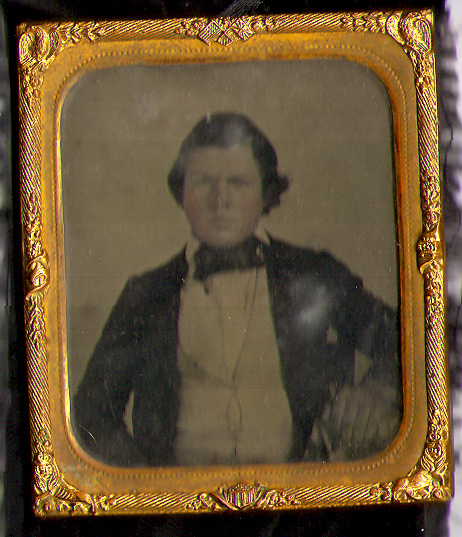
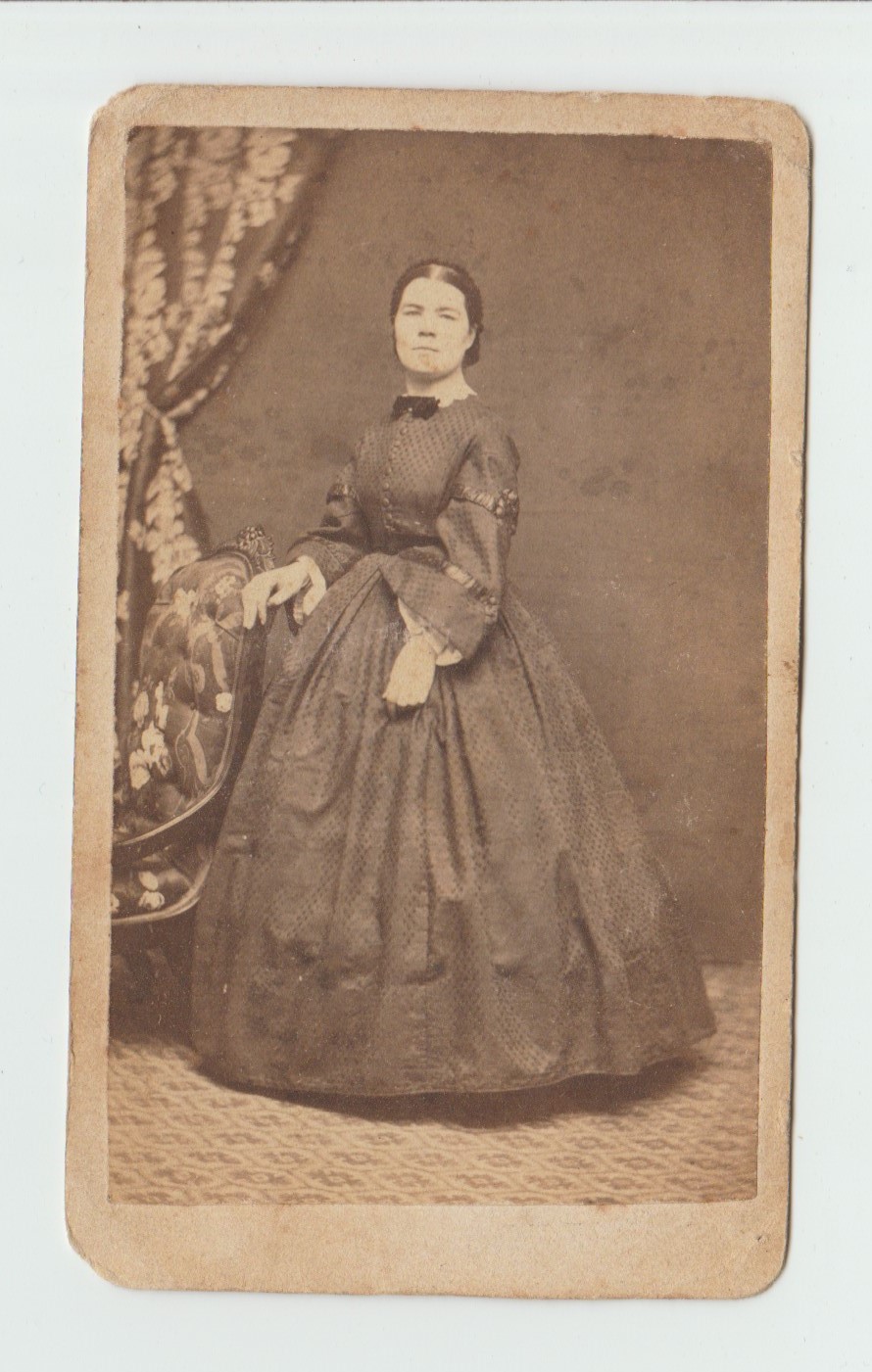
GW Amos at age 18

After the war, GW married Mary Jane Carter, born Sept. 29, 1842; she was 24 and he was 21. Mary was a native Alabaman, daughter of Seaborn and Hannah Carter; Seaborn Carter was a fairly wealthy Alabama farmer. According to the propriety of the time, GW (along with his brother Henry W.) had to post a bond of $200 guaranteeing that there were no impediments to the marriage: “Know all men by these presents, that we .. .. are held and firmly bound unto the State of Alabama in the penal sum of two hundred dollars; for payment of which, well and truly to be made, we bind ourselves and each and every of our Heirs, Executors, and Administrators, jointly, and severally, firmly by these presents. ….The condition of the above obligation is such that if there be no lawful cause why George W. Amos and Jane Carter should not be joined together in the Holy union of Matrimony, then this obligation to be void; otherwise, to remain in full force and virtue.”

Their first born was William Wilburn, 1867-1931, followed by Seaborn Washington, 1868-1908, John Henry, 1871-1935, James Belvy 1873-1964, Mary Catherine, 1875-1952, Martha Matilda “Mattie”, 1877-1968, Alexander Zacariah, 1879-1974, Ada Lee, 1882-1973, and Nettie, 1887-1942. Remarkably for the time, all of their children survived childhood to die in adulthood.

In the 1870 census GW III and Mary Jane lived in Pike Co., Alabama, and had two young children (William Wilburn and Seaborn, 3 and 1); GW was listed as a farmer. His wife was illiterate, unlike him. He lived next to his father GW Amos II, probably farming the family land, as he was listed as having no real or personal estate. GW II was 58, wife Catharine was 53; two daughters lived with them, Rebecah and Isabella, 18 and 16.

In the 1880 census eldest son William Wilburn, aged 12, was listed as farm laborer to his father. The family had relocated to Arkansas, living in Big Creek, Sebastian, Arkansas (southeast of Fort Smith).

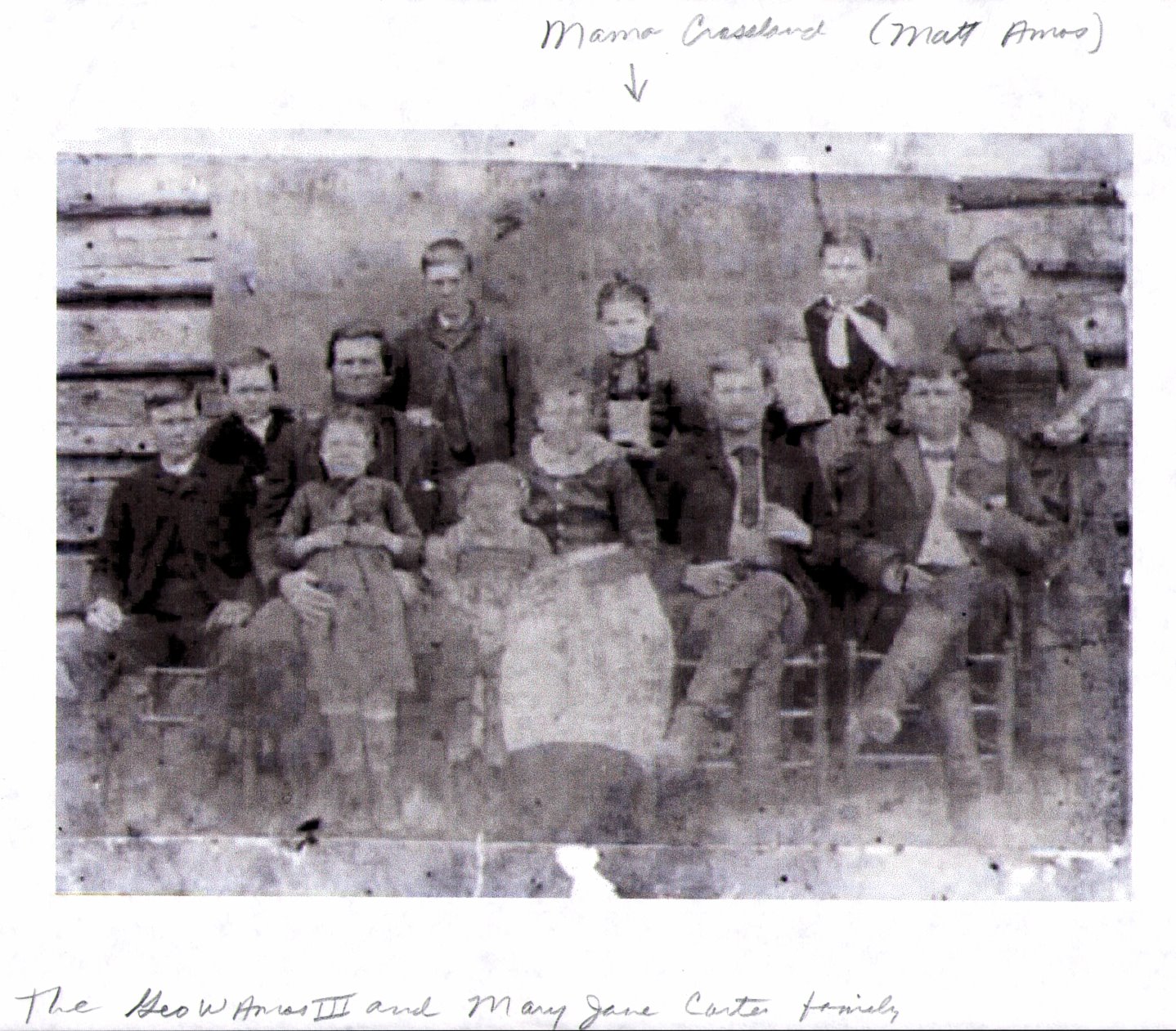
george washington amos family portrait

Mary died in 1895; GW married Martha Ann Harper, aged 47, in 1899. They had two children, one out of wedlock, Emma, born in 1897, another, Nada, born in 1901 (died, 1973). Martha died in 1902, and GW remarried Sarah E. Alford; they had no children. She was 49 when they were married.

In the 1910 census, GW and Sarah had three grandchildren living with them and one child, Emma, from his previous marriage. They were homeowners, farming in Bloomer, Sebastian Co. Arkansas, near Big Creek.

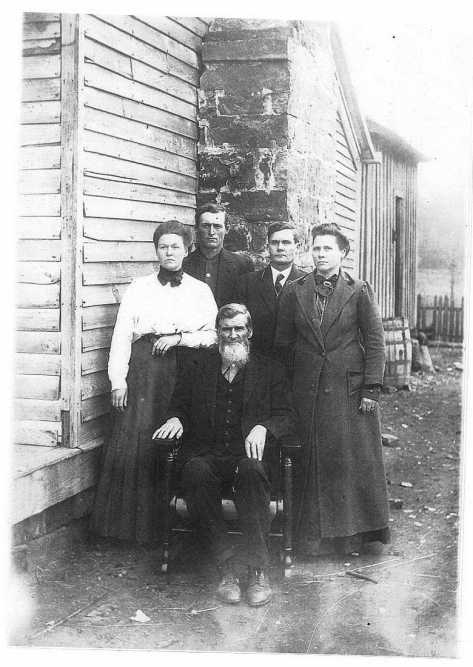
GW Amos III and family

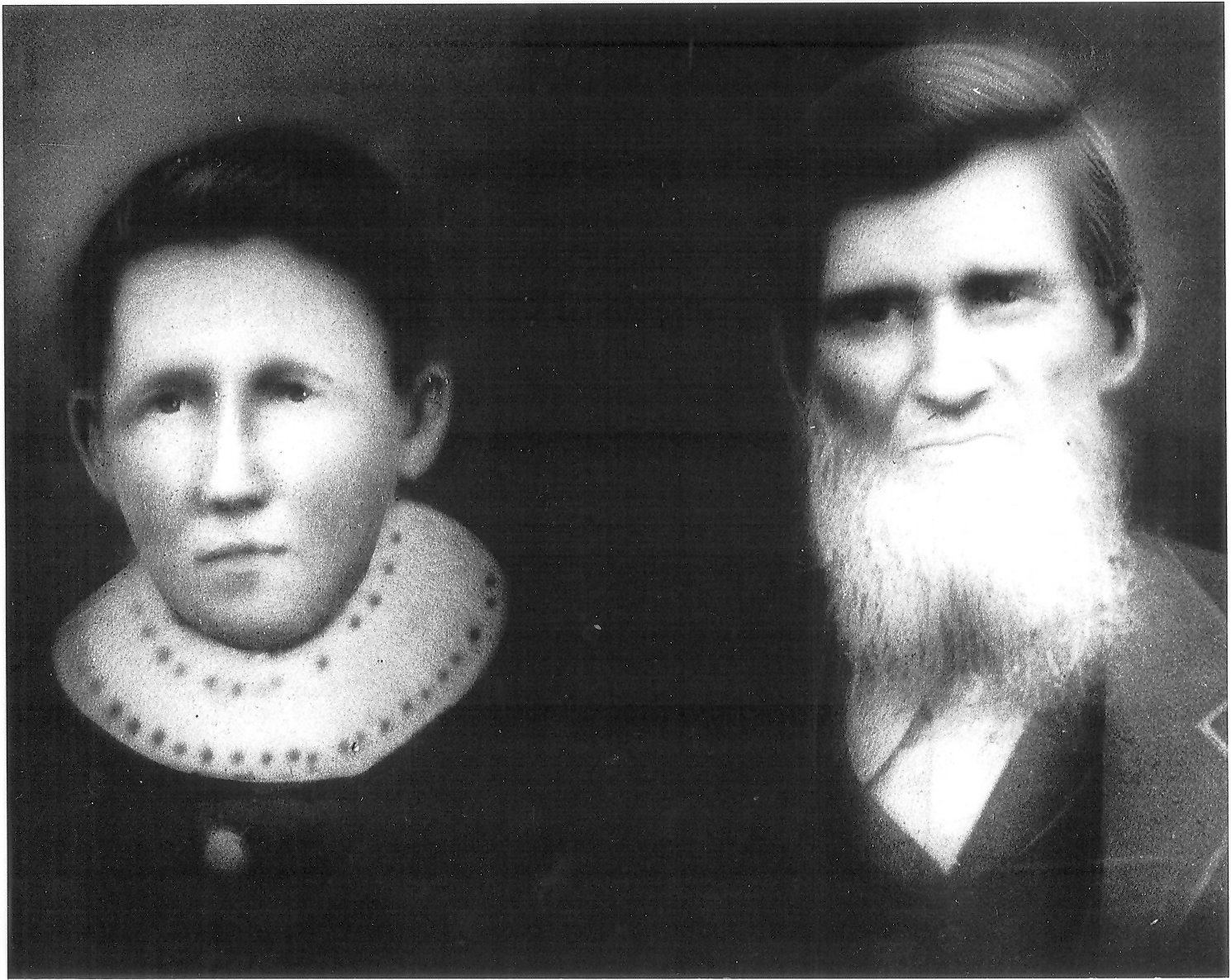
GW Amos III was a strong-looking man, according to several surviving photos. The photo taken when he was 18 before he enlisted reveals a pudgy, healthy young man with a full face and narrow, penetrating eyes. A later family photograph taken shortly before Mary Jane’s death shows a middle-aged man, stern, with a square face, no longer pudgy, thick hair and beard (without moustache). A photo taken around 1910 with four of his children shows a stern-faced man, lean, with heavy eyebrows, penetrating eyes, and a thick white beard sans moustache. A portrait perhaps drawn from a photo with his third wife Sarah Rambo Amos shows a white-bearded, brown-haired, stern man with sunken cheeks.

george washington amos and mary jane carter

In 1902 GW applied for an Arkansas pension as a Confederate veteran. His widow Sarah applied again after his death in 1916. GW is buried at Greenwood, Arkansas. Sarah outlived him by six years.

Posted in American History, Biography | Tagged , , , , | Leave a comment

Hugh Crawford, Scottish Paper Stainer and Emigrant to America, 1789-1857

Hugh Crawford was born in Glasgow on January 31, 1789; he died in Pawtucket, Rhode Island on July 1, 1857 when he was 68. He was the second-born son of John Crawford and Agnes Wright of Glasgow. He had many siblings, though most died in childhood. His mother died in childbirth in 1809 when Hugh was twenty. His father died at age of 86 in 1853.

Hugh married Janet Rowan at Canongate, Edinburgh, Midlothian Scotland on April 4, 1809. Janet was twenty-one and Hugh was twenty. Their firstborn son was John in 1811, followed by Hugh, Jr., in 1814, George Hugh in 1816, Janet in 1818, and Agnes in 1819. Wife Janet died in 1839, and Hugh remarried Margaret Lenox on August 19, 1840 in Glasgow. She was 35 and he was 51. They had two children, daughter Margaret Rennie, born Oct. 9, 1841, and son William, born in 1845.

The 1851 Scotland Census lists Hugh as a paper stainer who lived at 55 High St. in St. Paul parish in Glasgow. He was erroneously listed as 67 years old (actually 62). His wife Margaret was 43, daughter Margaret Rennie was 9, and son William was 6. A paper stainer was an old and honorable profession in the British Isles, typically involving the staining of wall hangings such as wallpaper, sometimes engravings. Hugh’s son Hugh Jr. had been trained in this craft as well, as seen in a letter written from son to father in September, 1852.

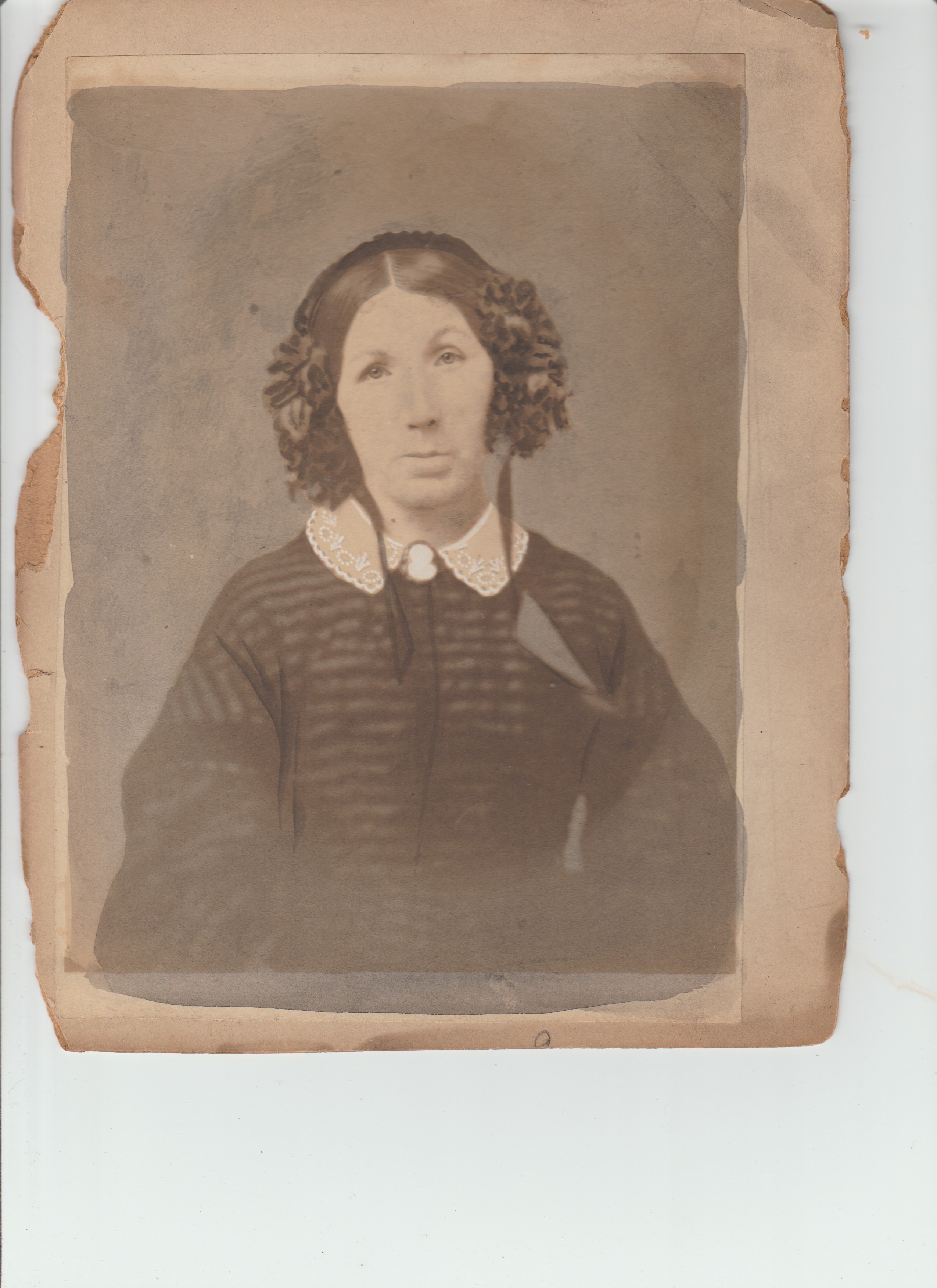
margaret rennie crawford

(Margaret Rennie Crawford, 1841-1921)

Hugh Jr. had sailed for America in 1843, arriving at New York on August 13. He migrated to Providence, Rhode Island, and established himself in business as a paper box manufacturer. His wife Catharine Blair Crawford followed eight years later, arriving at New York on the vessel Statira Morse on Sept 15, 1851, from Glasgow. Accompanying her was their daughter, Janet, age 16.

Hugh Jr. became a citizen Sept. 1852, which perhaps inspired him, joined by Catherine, in writing a letter of invitation to America to his father, on Sept. 27. The letter reads:

“Pawtucket, Sept 27th 1852

“Dear Father

“We take this opportunity of writing you a few lines informing you of our welfare and hoping they will find you and Family enjoying good health and this leaves us with the blessing of God. You must excuse us for not writing sooner. We now write you sitting in our own House; it is now six weeks since we came in to it; it is 32 feet long 23 wide with an L 12 by 10 feet which gives us a house of a Parlor and Kitchen 2 Bed room a clothes room and Pantry and a good cellar the size of the building and the upper flat is a work shop the whole size of the building with a counting room below. It cost us about thirteen hundred Dollars which is about ₤ 268. It is in a location about a gun shot from the Rail Road Depot for Boston and Worcester rail road and we have a small garden. Sister Agness and her Husband is in Philadelphia. We had a letter from them a week ago which left them in good health. Agness is expected to be confined soon the youngest girl died about the end of July. We receive the Newspapers regularly and we are much obliged . . . for them as there is no paper here . . . worth the sending as we get the American news as same from the Glasgow paper as soon as we get it here some times but we in close a small bill of exchange in place of a paper. We carry on the business as yet but don’t know how long as Bliss and Potter has got me back to be there color mixer at ten dollars a week which is ₤ 2 and a little over.

“Dear Father We have just taken it into consideration that if you wished to come out it would be a very good place for you to carry on the business for me till such time that you could get along your self and it would be for the benefit of your Family as it is easier to get along here than at home but the principle of total abstinence must be attended to and it is the first thing that causes a person to be looked down upon and then it is a hard case to get along if you thought of it you might come along this fall as I cannot get along very well with some responsible person to take charge I have a German at present but he can’t take charge of the half and so We will be under the necessity of getting another or selling out you could come along your self and see how you . . . along and send for your Family in the Spring. The fall is a very good time to come if you think of coming write by return of post. We will send a bill for your passage but we would have promised more but we have a good deal to pay just now with the building of the house anyhow write by return of post to let us know what to do give our respects to Mr and Mrs Murry if you see them and tell them that we received a letter from on last Saturday and we will write them soon. Give our respects to Brother John and family and Grand Father and Aunt and that we would like to Hear from them. We join in sending out respects to Brothers John and Andrew Bla[i]r and Families and all inquiring Friends.

“We have no more to say at present

“But remain your Affectioned Son and Daughter

“Hugh and Catherene Crawford

“NB We would have given you more time if we had thought of it sooner but as it is it is a good time to Cross the Sea and you will have a comfortable home to come to. I will send full directions how to come on receipt of your Answer if you come by Boston you will be here the same day and by New York the next day.

“Answered 2 Nov 1852 HC

In the letter Hugh made mention of his sister Agnes, who had immigrated to Philadelphia. She married David Wilson, also from Scotland.

Hugh Sr. was sufficiently impressed by the prospect of America to emigrate with his family, arriving at Pawtucket on April 9, 1853.

margaret lenox crawford

(Margaret Lenox Crawford, 1805-1875)

Hugh died in 1857; his widow Margaret outlived him by 18 years, dying May 3, 1875. They are buried next to Hugh Crawford Jr and Catherine Blair Crawford at Mineral Spring Cemetery in Pawtucket. Their descendants included Hattie Perkins, who married Samuel Brown; they had a daughter Florence, who married Earle Phillips; their son Milton Phillips married Shirley Newcomb: they had three children: Craig, Linda, and Joy.

For more on the Crawford and Perkins families, see The Memories of Katie Perkins, available at Amazon: https://www.amazon.com/Memories-Katie-Perkins-Related-Families/dp/B0CH2QVCYY/ref=sr_1_19?crid=398YMK046NRTF&keywords=Russell+M+Lawson&qid=1703172044&s=books&sprefix=russell+m+lawson%2Cstripbooks%2C124&sr=1-19

Posted in American History, Biography, European history | Tagged , , , | Leave a comment

Arthur Hamilton Phillips, Farmer and Factory Foreman of New Brunswick and Rhode Island, 1869-1939

Arthur Hamilton Phillips was born in New Brunswick in 1869, the son of Thomas Phillips, an immigrant from Ireland, and Charlotte Kingston, a native of New Brunswick. It is unclear precisely where in New Brunswick Arthur was born. His sister Eliza Jane, who was thirteen years older than him, was born at Coles Island on the Canaan River, a tributary of the St. John River. Arthur’s mother was born near the Canaan River as well. The Rhode Island State and Federal Naturalization Records for 1899, however, indicates that Arthur was born at the city of St. John, at the mouth of the St. John River. This was perhaps a mistake.

In the 1871 Canadian census, Thomas and Charlotte Phillips lived in Queens Co., Johnston Parish, New Brunswick, where the Canaan River is located. Thomas, a farmer from Ireland, was 52. He was Episcopalian while his wife Charlotte, aged 42, was Free Will Baptist. Their children were Eliza Jane, Melbourne, Anna Bella, Alfred, Thomas, William, Emma, and Arthur.

The family lost the father sometime in the next few years, so that in the 1881 Canadian census Charlotte was a widow, and the head of the family was Alfred, aged 18, a farmer, although the oldest child was Eliza Jane at 23. The family was listed as Baptist save Charlotte, Free Will Baptist.

When Arthur was 19 years old he arrived at East Providence, Rhode Island. His sister Anna Bella and brother Alfred had emigrated to Massachusetts and Rhode Island respectively in 1885, so we might assume that they convinced Arthur to follow suit three years later. Arthur joined his brother Alfred at East Providence in 1888. A few of Arthur’s siblings remained in New Brunswick for their lives, but his mother Charlotte joined Alfred and Arthur in Rhode Island, precisely when is not clear. She died in 1909 and was buried in the North Burial Ground in Providence.

After five years in the States, Arthur married Elizabeth Walker Camac on June 29, 1893. She was born in East Providence in 1873; her parents were Irish immigrants.

In the 1900 census, Arthur was 31 and Elizabeth was 27. They had had four children: Harold, born in 1894, Nettie, born in 1895, Earle, born in 1896, Lloyd, born in 1898. They would have other children as well: Olive, born in 1902, Mildred, born in 1904, Alston, born in 1905, and Arthur Jr., born in 1916. In 1900 Arthur was a laborer in a chemical works factory. He and Elizabeth owned their own home.

In the 1910 census, they had seven children. Arthur was now a foreman at the chemical works. Daughter Nettie worked at a mill. Son Harold worked as a laborer. These two did not have proper schooling, but the other children did. They lived on Campbell St.

In the 1920 census, their residence was listed as 25 Campbell St., E. Providence. Arthur now worked as a “fireman” at a cold roll steel mill. Son Earle was a grocery manager. Harold was a foreman in a warehouse. Lloyd was a grocery truck driver. Oliver and Mildred were threaders in a lace mill.

In the 1930 census, the family lived at 25 Manton St. They owned a radio. Arthur was listed as “literate,” though unschooled. Arthur by 1930 was no longer working. He lived at home with Elizabeth. Lloyd still lived at home, working as a truck driver for a steel company. Alston lived at home and worked as an order boy at a grocery warehouse. Arthur Jr. lived at home, attending school.

Elizabeth died on November 14, 1935. Arthur lived with Alston and Lloyd at the Manton Ave. home until he died in 1939.

Posted in American History, Biography | Tagged , , , , | Leave a comment

Montaigne’s Lesson about Life

“We are great fools,” Montaigne declared, in Of Experience. “I have done nothing today,” the fool says. “What! Have you not lived?” The living of life is a sufficient task. “Have you known how to . . . manage your life?” If so, then you have done great work. “Have you known how to compose your manners”?, how to treat others, especially those closest to you? “You have done a great deal more than he who has composed books. Have you known how to take repose? You have done more than he who has taken cities and empires.”

To be happy one has to accept oneself. To accept oneself one has to accept the present and the past, not struggle, trying to overcome, to surpass, to change or make up for limitations or mistakes, to somehow alter the past or the present by living the anticipated future differently. One simply has to accept the past and present, which in so doing will guarantee the acceptance of the future.

“The great and glorious masterpiece of man is to know how to live to purpose,” to live properly and appropriately, both for yourself and others.

Posted in books, European history, Michel de Montaigne | Tagged , , , | Leave a comment

William Wilburn Amos, Arkansas and Oklahoma Farmer

William Wilburn Amos was born on April 18, 1867, in Pike Co., Alabama, in the southern part of the state, to George Washington Amos III and Mary Jane Carter Amos. William was their first-born son. He was brought up as a farmer, and was so designated in the 1880 census. At age twelve he had not yet learned to read and write. He had six siblings. Some time in the 1870s the Amos family moved to Big Creek, Sebastian, Arkansas, on the Arkansas River. Nearby was the Calhoun family, whose youngest daughter, Arsula, met William at some point; they were married on Christmas Day, 1890, in Greenwood, Sebastian Co., Arkansas, south of Fort Smith in western Arkansas. She was seventeen and he was twenty-three. Their first-born child was a girl, Bessie, born on December 24, 1891.

In the 1900 census, Will was listed as a farmer who could read and write; perhaps Arsula helped him to learn. They rented. Their children were Bessie, 8, Harland, 6, Charley, 4. They lived in Center, Sebastian Co., Arkansas, southeast of Fort Smith.  Ten years later the family had moved a few miles east to Boone Township (Booneville), where Will still farmed. By this time, Will and Arsula (or Sula) owned their own farm. Their children were Bessie, age 18, Harland, age 16, Charley, age 14, Reba, age 8, and Wayne, age 3.

During the next decade, one would assume that hard times came upon the family. They had left Arkansas and had moved to Oklahoma, settling in the town of Stigler, in eastern Oklahoma. They lived on N. Ninth St, and Will still farmed, working on his “own account,” either as a renter or farm laborer—it is not clear. His son Charley, still living at home, worked as a salesman at a drugstore. Bessie and Harland had left home, but Reba (Elizabeth Reba) and William Wayne were living at home. Will was 52 and Sula was 46.

During the next ten years, all of their children left home. Will and Sula lived at 341 S. 3rd St. in 1930. Will was no longer a farmer, rather a caretaker of the town cemetery. He was 60, she was 55.

Will died soon after, on died Feb. 17, 1931; he is buried in the cemetery in which he had once worked. His widow outlived him by 17 years, dying on June 10, 1948. They are buried next to each other.

william wilburn amos and ursula calhoun

Posted in American History, Biography | Tagged , , , , , | Leave a comment

William Leverett Lawson, Tulsa Mechanic and Fisherman, 1900-1968

William Leverett Lawson was born Nov 5, 1900, in Wesley, Madison Co., Arkansas. His parents were John Calvin and Josephine Robbins Lawson. When he was born, his parents had just returned to Arkansas from living in the Cherokee Nation, Indian Territory (Township 22). William was born into a family with four other siblings: James H., born Sept 1888, Denver J, born Jan 1891, Clint, born Sept 1894, and Allie, sept 1896. John C. was a farmer; he and his wife and older children were literate. They rented their farm.

William did not serve in World War I, being exempted from the draft, per the 1917 Congressional Legislation that “exempted persons in certain classes or industries, including workmen in armories and those in agriculture whose work was ‘necessary to the maintenance of the Military Establishment’.” Will while he lived in Arkansas was a farmer.

William and Martha Susan Sorrels were married Dec. 15, 1920. He was 20, she was 17. At this time he was called “Will”.

The young couple became parents on Nov. 2, 1922, with the birth of Chloe Elnora. Soon after Will, Martha (or, Susie), and Chloe moved to the city of Tulsa. Six years later, living in Tulsa, their son Oliver Roy was born on July 27, 1928.

In the 1930 census, Will was listed as a mechanic working at an electrical shop. She and Susie owned a radio, rented a house at 1520 N. Victor (which no longer exists), and Will worked as a mechanic at an electrical shop. Soon after, the family moved to 1545 N. Birmingham Pl., where Oliver began kindergarten at Springdale Elementary, 2510 Pine St. They lived there for several years. Oliver recalls that that owned quite a few chickens, a cow, and Will often brought home a half a hog to cut into bacon and ham. He and his brother-in-law Guy Sorrels would engage in squirrel hunting, often bringing home the limit of ten. Susie fried them. They refrained from eating rabbit at this time because of a rabbit disease.

Around 1936/37 the family relocated to West Tulsa, living a house they owned at 16 S. Santa Fe. This bungalow style home was long and narrow, atop a rising hill. The front steps went up a brief steep incline. There was a large porch and a porch swing. There was an alley next to the house that Will used to drive his auto into the unattached garage at the back of the lot. The house had a deep basement.

In the 1940 census, Will was listed as an auto mechanic, working 48 hours per week, at Adams Motor Co, 5th and Detroit in Tulsa. During this time the family began to attend the Church of Christ; previously they had rarely gone to church, save to sometimes visit the Springdale Baptist Church. Will later worked as a mechanic at a Ford dealership, and was so listed in the 1950 census. At this time, Chloe had married and left home, Oliver had graduated from High School, and served in the US Army in Korea, and was currently looking for work.

Will retired in 1966 from Fred Jones Ford, 12th and Boston, in Tulsa. He drove a black 1950 Ford, then later invested in a white Mercury Comet.

Meanwhile, at some point after moving to Tulsa Will and Susie invested in real estate. Their son Oliver remembers, “I do know that my mother and father bought a 4-acre piece of land with run-down house on it in Sperry sometime when I was fairly young. I think they bought it at a tax auction. I had forgotten that my grandparents,” John Calvin and Josephine Lawson, “lived there at any time, but I think that I do now recollect them being there for a while, and I don’t remember their dying there. I do know that at some point in time, they rented the house and land to someone who eventually bought it from them.”

Will was a hunter an avid fisherman, and made his own fishing flies out of molded lead and small bright feathers. Will and Susie loved to fish at local lakes, such as Hominy Lake, Lake Spavinaw, and Keystone Lake. They caught bass, perch, and bluegill. They would take their two grandsons Chris and Rusty, on weekend fishing trips.

Will, or as Susie grew to call him, “Bill,” was a quiet, reserved man. But he was a good man.

He died of cancer November 13, 1968, at age 68. did not serve in World War I, being exempted from the draft, per the 1917 Congressional Legislation that “exempted persons in certain classes or industries, including workmen in armories and those in agriculture whose work was ‘necessary to the maintenance of the Military Establishment’.”

William and Martha Susan Sorrels were married Dec. 15, 1920. He was 20, she was 17. At this time he was called “Will”.

The young couple became parents on Nov. 2, 1922, with the birth of Chloe Elnora. Soon after Will, Martha (or, Susie), and Chloe moved to the city of Tulsa. Six years later, living in Tulsa, their son Oliver Roy was born on July 27, 1928.

In the 1930 census, Will and Susie owned a radio, rented a house at 1520 N. Victor, and Will worked as a mechanic at an electrical shop. Soon after, the family moved to 1545 N. Birmingham Pl., where Oliver began kindergarten at Springdale Elementary, 2510 Pine St. They lived there for several years, then around 1936/37 relocated to West Tulsa, living in a house they owned at 16 S. Santa Fe. This bungalow style home was long and narrow, atop a rising hill. The front steps went up a brief steep incline. There was a large porch and a porch swing. There was an alley next to the house that Will took to park his cars in the unattached garage at the back of the lot. The house had a deep basement.

In the 1940 census, Will was listed as an auto mechanic, working 48 hours per week, at Adams Motor Co, 5th and Detroit in Tulsa. He later worked as a mechanic at a Ford dealership, and retired in 1966 from Fred Jones Ford, 12th and Boston, in Tulsa. He drove a black 1950 Ford, then later invested in a ’63 white Mercury Comet.

Meanwhile, at some point after moving to Tulsa Will and Susie invested in real estate. Their son Oliver remembers, “I do know that my mother and father bought a 4-acre piece of land with run-down house on it in Sperry sometime when I was fairly young. I think they bought it at a tax auction. I had forgotten that my grandparents,” John Calvin and Josephine Lawson, “lived there at any time, but I think that I do now recollect them being there for a while, and I don’t remember their dying there. I do know that at some point in time, they rented the house and land to someone who eventually bought it from them.”

Will was a hunter, sometimes bagging squirrels that Susie prepared for dinner. He was an avid fisherman, and made his own fishing flies out of molded lead and small bright feathers. Will and Susie loved to fish at local lakes, such as Hominy Lake, Lake Spavinaw, and Keystone Lake. They caught bass, perch, and bluegill. They would take their two grandsons Chris and Rusty on weekend fishing trips.

Will, or as Susie grew to call him, “Bill,” was a quiet, reserved man. But he was a good man.

He died of cancer November 13, 1968, at age 68.

william leverett lawson 1967

For a complete history of William’s ancestors, the Lawsons of the American South, see my book published by Amazon: https://www.amazon.com/dp/B0G9RDT3PF/ref=sr_1_1?crid=36PPTM7BCTC2Z&dib=eyJ2IjoiMSJ9.cqGw_xgnYBNRNQQZ3VVlDTDuoYsfRKxj_sIIwKXnNqz3Sc9Q0z_tRe-gXhSqrYuSiTeWVpdkbeR0UsauvA-pdRwLV29G0a8HbEi3x-NPsvfHRuI9MFZ7xnvafLMgxAVJDSsu9Aup3YrsJkFIqa3HntEFmdb1m36V2e5Jki2B2VORJ0fxrcOagNlw1y07G0_Z83CLGFv4t6Dyfi3RuXu6coGUAjCvcSesMxcQDkon0yc.r7TvUj2h-Yky7rx02rNzQHuEsw1e1NIPpuyyyQjelbo&dib_tag=se&keywords=Russell+Lawson&qid=1766343535&s=books&sprefix=russell+lawson%2Cstripbooks%2C211&sr=1-1

Posted in American History, Biography | Tagged , , , , , | Leave a comment

Martha Rhodes Calhoun, Farm Mother and Wife

Martha Rhodes Calhoun was born July 24, 1831 and died in 1873.

Martha Rhodes Calhoun was the mother of Arsula Calhoun Amos and grandmother of Bessie Lura Amos. She was born in Williamson, Tennessee; she married William C. Calhoun on October 17, 1850 in Marshall, Tennessee. He was 24 and she was 19 years old. William and Martha had eight children, the youngest of whom was Arsula (sometimes spelled Ursula) Calhoun Amos, who married William Wilburn Amos.

Martha and William moved to Illinois after their second child was born in the mid 1850s; the lived in the southern corner of the state in-between the Mississippi and Ohio rivers.

In the 1870 federal census, William was 44 and Martha was 38. Both were listed as illiterate, likewise all of their children, of which Elizabeth was the oldest, at 18, born in Tennessee. The oldest boy was Thomas, age 17, also born in Tennessee, already a farmer. The rest of their children were born in Illinois: Amanda was 14, James was 9, Susan was 7, Samuel was 4, and Robert was 2. Martha’s mother, the widowed Elizabeth Rhodes, age 69, also lived with the family; she was listed as an illiterate farmer. William farmed, and Martha kept house. The value of their real estate was $800, and the value of their personal estate was $600. In 1870, the Calhoun family lived in Township 11, Range 21, Johnson Co., Illinois; the post office is at Goreville (southern corner of Illinois north of Ohio River and east of the Mississippi River).

William and Martha had two more children, Alphus, in 1871, and Arsula, in 1873. Martha apparently died in childbirth or soon after. She was 42 years old.

William soon removed his family to Arkansas and remarried.

Posted in American History, Biography | Tagged , , , , | Leave a comment

William Calhoun, Illinois and Arkansas Farmer and Carpenter (1826-1900)

William Calhoun was born in May, 1826, in Williamson, Tennessee, to Jacob (Jack) Julian Calhoun (1802-1856) and Rebecca McCall (1797-1869).

William and Martha Rhodes, who was also from Tennessee, were married Oct 17, 1850 in Tennessee; he was 24, she was 19.

In 1852 their daughter Elizabeth was born, followed by William Thomas in 1853. After his birth the family moved to southern Illinois, Johnson County, in the corner of the state between the Mississippi and Ohio rivers. There their daughter Amanda F. was born in 1856, James A. in 1862, Susan in 1863, Samuel H. in 1866, Robert M. in 1868, son Alphus in 1871, and daughter Arsula Jane in 1873. Martha apparently died in childbirth or soon after the birth of Arsula.

In the 1860 federal census, William listed himself as a carpenter. He registered for the draft in 1863. In the 1870 census William listed himself as a farmer. He and Martha were both listed as illiterate. The value of their real estate was $800, personal estate $600.

After Martha’s death, William took his family of eight children to western Arkansas, Bates Township, south of Fort Smith, just east of the Oklahoma border, where he farmed and worked as a carpenter. By this time William, as well as all of the children, were listed as literate. His oldest daughter Elizabeth kept house for William.

Ten years after Martha’s death, in 1883, William married Eunice Rebecca Davis in Sebastian Co.

In the 1900 census, William and Rebecca lived with son Samuel in Eagle Township, Sebastian Arkansas, in the Ouachita forest. Samuel was head of the family, born in 1866; he was 33 years old, married to Effie, who was 29. William was listed as a farmer.

William’s youngest daughter Arsula married William Wilburn Amos Christmas, 1890. His granddaughter Bessie Lura Amos married Claude Largent in 1911.

William died soon after, in 1900. His widow Rebecca died in Stigler in 1920.

Posted in American History, Biography | Tagged , , , | Leave a comment

Ebenezer Hazard, Jeremy Belknap, and the American Revolution

Routledge, a division of Taylor and Francis, will be reissuing this fall my 2011 book, Ebenezer Hazard, Jeremy Belknap, and the American Revolution.

The letters of Jeremy Belknap and Ebenezer Hazard encompassed twenty years, from 1779 to 1798, during a time when the United States was warring against England, establishing new governments, building a national identity, exploring the hinterland, and refining an American identity in prose and verse. Belknap, a historian, scientist, and Congregational minister, and Hazard, a historian, scientist, and Surveyor of Post Roads, were busily involved in all that was going on, the pitfalls as well as the promise. Their correspondence traced the course of the war and its aftermath from several different perspectives, as Belknap lived in Northern New England while Hazard traveled throughout the thirteen states, making his postal headquarters (and home) variously at Philadelphia, Boston, and New York. Belknap was during the time of their correspondence thoughtful and lonely, despairing of his situation in life, using pen and ink as a substitute for flesh and blood, releasing onto paper the pent-up feelings of long winter months, generating in his solitude theories to explain the whims of nature, the works of government, the varieties of religious experience, the course of history, and the ways of humankind. Belknap, who felt planted “like a cabbage,” unable to move, envied Hazard, who as Surveyor of Post Roads from 1776 to 1782 was always travelling, seeing new places and enjoying (or enduring) a variety of different experiences, thoughtful and lonely in a different way from Belknap, always on the pad when but wishing for the quiet moment next to the fireplace to examine some new find to go into his traveling “museum” of historical and natural curiosities. Hazard felt “hurried through life on horseback” compared to Belknap’s stifled existence. Ebenezer Hazard and Jeremy Belknap referred to their friendship as that of fellow travelers into the human and natural past. Their mutual existence centered upon the written word. They recorded the details of life for reflection and for the benefit of posterity. As so many of their contemporaries did during the years of the American Enlightenment, Hazard and Belknap used paper and pen to keep track of experiences, journeys, thoughts, and actions. The letters of Ebenezer Hazard and Jeremy Belknap tell of an age when science and religion had not yet divorced due to irreconcilable differences, when the most profound philosophy nestled comfortably next to a childlike fascination with the remarkable. The two men filled their letters with inquisitive attempts to know, to understand, and to express. The two friends explored in their epistles the nature of love, death, and piety; the best way for humans to govern themselves; matters of religious and scientific truth and the best means to arrive at it; the methods and writing of history; human credulity; and the wonders of nature. The Hazard-Belknap epistles, if they were not objective and disinterested, concrete in their knowledge and secure in their wisdom, were at least sincere and fascinating attempts to know. This is their charm.

book image

Posted in American History, Biography, books | Tagged , , , , | Leave a comment

Philadelphia in 1787: The Making of the Constitution of the United States

Philadelphia, the capital of Pennsylvania, was in 1787 a city of a little over 40,000 people. The city had been founded a century earlier by Quakers and it still had a strong Quaker presence. Philadelphia was the cultural and intellectual center of the new United States of America. The College of Philadelphia, now the University of Pennsylvania, was one of the top colleges in America in 1787. The most important scientific society, the American Philosophical Society, met in Philadelphia. And America’s greatest thinker, Benjamin Franklin, lived in Philadelphia. In 1787 Ben Franklin was an old man, at 81 years. But he remained active intellectually and politically. Franklin was the President of Pennsylvania. He had only a few years before returned from spending over a decade in Europe where he served as a United States envoy to France. When the American War for Independence broke out in 1775, the Continental Congress, directing the American war effort, sent Franklin to Paris to try to convince the French to support the United States in their rebellion against England. Franklin had been very popular in France. He was a favorite at the French court and in French intellectual and cultural circles. He often donned a coonskin cap and made himself out to be an American backwoodsman. At the same time the French knew Franklin to be a world famous scientist, the man who had discovered that lightning from clouds was made of, in Franklin’s words, “the electric fluid.” Partly because of his popularity Franklin was able to convince the French to support America’s cause against the English.

Ben Franklin living on Market street in Philadelphia in 1787 opened his home to scientists and intellectuals who visited Philadelphia. In the spring of that year Franklin was expecting some visitors who were coming to Philadelphia for a particular reason. Philadelphia had been agreed upon by the thirteen United States to be the rendezvous for delegates or representatives of the states who were especially chosen to meet to discuss the problems of government. The United States in 1787 was governed by the Articles of Confederation, a government created during the war. Philadelphia had been the place where the Continental Congress met at the beginning of the War. At Independence Hall, down the street from Franklin’s house, delegates from the thirteen states had met and signed the Declaration of Independence on July 4, 1776. After independence had been declared, it was thought necessary to have a central government to direct the war against England. The Articles of Confederation created that government, one that had a one-house congress and a weak executive. The Congress had appointed George Washington of Virginia to be the Commander in Chief.

Years later in 1787, the war having reached a successful conclusion, the United States was still governed by the Articles of Confederation. But there were problems. The United States economy was burdened by high inflation. There was no common currency–indeed each state could print and issue their own currency. There was no unified trade policy. At the conclusion of the war in 1783 the American army and navy disbanded; the only military forces in the United States in 1787 were state militias, and they were inadequately supplied and ill-prepared for conflict. Even with the conclusion of the war, and American Independence, the United States was threatened by other countries. Great Britain ached for revenge and kept troops on America’s northern borders, even maintaining a presence in in old forts on American soil, such as at Detroit. The Spanish, interested in seeing the United States lose control of its western territories–the lands of Kentucky and Tennessee, for example–closed the port of New Orleans to American shipping. The Congress, however, without an army and navy and without the funds to create a viable military force, could do nothing.

Those who had led America during the war looked upon the weakness of the United States with dismay. George Washington, having retired as commander of American forces and living at Mount Vernon on the Potomac River, wrote anguished letters to his friends, men such as Alexander Hamilton, complaining of the ineffectiveness of the Articles of Confederation. Washington was afraid that the United States would be taken over by foreign countries, or that the thirteen states would split apart into aggressive dominions. He believed the only solution was a stronger central government.

To this end George Washington traveled to Philadelphia in May 1787 as a delegate from Virginia to meet with other delegates to discuss the future of the United States and what could be done to reform the Articles of Confederation. Washington visited the home of Ben Franklin. He learned of others who had arrived at Philadelphia. Already there was the young James Madison of Virginia, a brilliant political thinker. Also arrived was Alexander Hamilton of New York, ambitious, vain, and also brilliant. John Langdon, a wealthy merchant who lived at Portsmouth on the Piscataqua River, arrived from New Hampshire. In all, about fifty men met at Philadelphia the spring and summer of 1787 to discuss the Articles of Confederation. They styled themselves a Convention. Their commission from the thirteen states was vague: to discuss ways to amend the Articles of Confederation to make it a stronger government to cure some of America’s ills. The delegates met at Independence Hall, where many of them had stood eleven years earlier to sign the Declaration of Independence. Indeed the men who formed the Philadelphia Convention were experienced statesmen, diplomats, soldiers, lawgivers, merchants, and farmers. They were generally young–many of them were in the Thirties. Quite a few of them owned slaves. They were all educated. And they were the cultural and political elite of their respective states. Wealthy and powerful, they were conservative as well. They had welcomed the changes of the American Revolution that brought about independence from England. But they feared too much change. Hence most of the delegates at Philadelphia the summer of 1787 sought to create a stronger, more centralized government that could bring order to a society that seemed to be becoming more disorderly. They met at Independence Hall, where the Declaration of Independence had been signed in 1776.

Sunplus

Independence Hall, Philadelphia
These fifty some men had faults to be sure. They were not saints. However they did share one gift that set them apart from others, both of their time and even now. These men possessed a certain political wisdom, an ability to understand what precisely is the relationship between government and society, how best to grant the most liberty and freedom while at the same time maintaining order and security. Their greatest gift was an awareness of the needs of their own time and what might be the needs of posterity. Their creation, the United States Constitution, is a government that has lasted for over 200 years precisely because it is a government of order and security that is flexible enough to allow for change and the new and unexpected needs of each generation.

As Alexander Pope wrote in Essays on Man:

“For forms of government, let fools contest,

That which is best administered is best.”

Posted in American History, Government | Tagged , , | Leave a comment