Montaigne’s Lesson about Life

“We are great fools,” Montaigne declared, in Of Experience. “I have done nothing today,” the fool says. “What! Have you not lived?” The living of life is a sufficient task. “Have you known how to . . . manage your life?” If so, then you have done great work. “Have you known how to compose your manners”?, how to treat others, especially those closest to you? “You have done a great deal more than he who has composed books. Have you known how to take repose? You have done more than he who has taken cities and empires.”

To be happy one has to accept oneself. To accept oneself one has to accept the present and the past, not struggle, trying to overcome, to surpass, to change or make up for limitations or mistakes, to somehow alter the past or the present by living the anticipated future differently. One simply has to accept the past and present, which in so doing will guarantee the acceptance of the future.

“The great and glorious masterpiece of man is to know how to live to purpose,” to live properly and appropriately, both for yourself and others.

Posted in books, European history, Michel de Montaigne | Tagged , , , | Leave a comment

William Wilburn Amos, Arkansas and Oklahoma Farmer

William Wilburn Amos was born on April 18, 1867, in Pike Co., Alabama, in the southern part of the state, to George Washington Amos III and Mary Jane Carter Amos. William was their first-born son. He was brought up as a farmer, and was so designated in the 1880 census. At age twelve he had not yet learned to read and write. He had six siblings. Some time in the 1870s the Amos family moved to Big Creek, Sebastian, Arkansas, on the Arkansas River. Nearby was the Calhoun family, whose youngest daughter, Arsula, met William at some point; they were married on Christmas Day, 1890, in Greenwood, Sebastian Co., Arkansas, south of Fort Smith in western Arkansas. She was seventeen and he was twenty-three. Their first-born child was a girl, Bessie, born on December 24, 1891.

In the 1900 census, Will was listed as a farmer who could read and write; perhaps Arsula helped him to learn. They rented. Their children were Bessie, 8, Harland, 6, Charley, 4. They lived in Center, Sebastian Co., Arkansas, southeast of Fort Smith.  Ten years later the family had moved a few miles east to Boone Township (Booneville), where Will still farmed. By this time, Will and Arsula (or Sula) owned their own farm. Their children were Bessie, age 18, Harland, age 16, Charley, age 14, Reba, age 8, and Wayne, age 3.

During the next decade, one would assume that hard times came upon the family. They had left Arkansas and had moved to Oklahoma, settling in the town of Stigler, in eastern Oklahoma. They lived on N. Ninth St, and Will still farmed, working on his “own account,” either as a renter or farm laborer—it is not clear. His son Charley, still living at home, worked as a salesman at a drugstore. Bessie and Harland had left home, but Reba (Elizabeth Reba) and William Wayne were living at home. Will was 52 and Sula was 46.

During the next ten years, all of their children left home. Will and Sula lived at 341 S. 3rd St. in 1930. Will was no longer a farmer, rather a caretaker of the town cemetery. He was 60, she was 55.

Will died soon after, on died Feb. 17, 1931; he is buried in the cemetery in which he had once worked. His widow outlived him by 17 years, dying on June 10, 1948. They are buried next to each other.

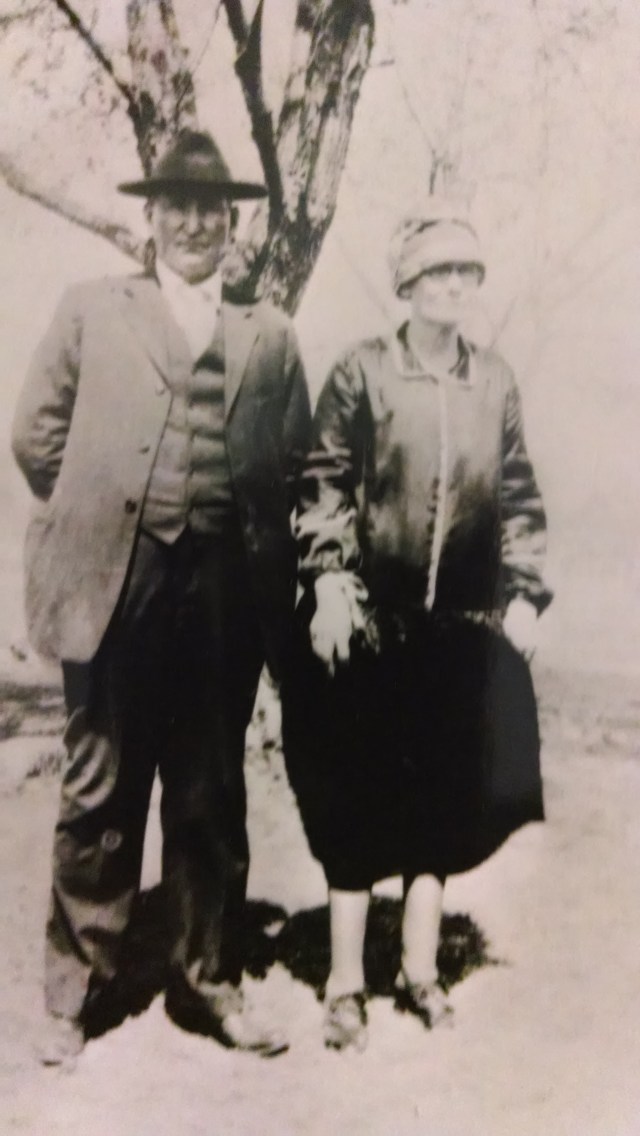
william wilburn amos and ursula calhoun

Posted in American History, Biography | Tagged , , , , , | Leave a comment

William Leverett Lawson, Tulsa Mechanic and Fisherman, 1900-1968

William Leverett Lawson was born Nov 5, 1900, in Wesley, Madison Co., Arkansas. His parents were John Calvin and Josephine Robbins Lawson. When he was born, his parents had just returned to Arkansas from living in the Cherokee Nation, Indian Territory (Township 22). William was born into a family with four other siblings: James H., born Sept 1888, Denver J, born Jan 1891, Clint, born Sept 1894, and Allie, sept 1896. John C. was a farmer; he and his wife and older children were literate. They rented their farm.

William did not serve in World War I, being exempted from the draft, per the 1917 Congressional Legislation that “exempted persons in certain classes or industries, including workmen in armories and those in agriculture whose work was ‘necessary to the maintenance of the Military Establishment’.” Will while he lived in Arkansas was a farmer.

William and Martha Susan Sorrels were married Dec. 15, 1920. He was 20, she was 17. At this time he was called “Will”.

The young couple became parents on Nov. 2, 1922, with the birth of Chloe Elnora. Soon after Will, Martha (or, Susie), and Chloe moved to the city of Tulsa. Six years later, living in Tulsa, their son Oliver Roy was born on July 27, 1928.

In the 1930 census, Will was listed as a mechanic working at an electrical shop. She and Susie owned a radio, rented a house at 1520 N. Victor (which no longer exists), and Will worked as a mechanic at an electrical shop. Soon after, the family moved to 1545 N. Birmingham Pl., where Oliver began kindergarten at Springdale Elementary, 2510 Pine St. They lived there for several years. Oliver recalls that that owned quite a few chickens, a cow, and Will often brought home a half a hog to cut into bacon and ham. He and his brother-in-law Guy Sorrels would engage in squirrel hunting, often bringing home the limit of ten. Susie fried them. They refrained from eating rabbit at this time because of a rabbit disease.

Around 1936/37 the family relocated to West Tulsa, living a house they owned at 16 S. Santa Fe. This bungalow style home was long and narrow, atop a rising hill. The front steps went up a brief steep incline. There was a large porch and a porch swing. There was an alley next to the house that Will used to drive his auto into the unattached garage at the back of the lot. The house had a deep basement.

In the 1940 census, Will was listed as an auto mechanic, working 48 hours per week, at Adams Motor Co, 5th and Detroit in Tulsa. During this time the family began to attend the Church of Christ; previously they had rarely gone to church, save to sometimes visit the Springdale Baptist Church. Will later worked as a mechanic at a Ford dealership, and was so listed in the 1950 census. At this time, Chloe had married and left home, Oliver had graduated from High School, and served in the US Army in Korea, and was currently looking for work.

Will retired in 1966 from Fred Jones Ford, 12th and Boston, in Tulsa. He drove a black 1950 Ford, then later invested in a white Mercury Comet.

Meanwhile, at some point after moving to Tulsa Will and Susie invested in real estate. Their son Oliver remembers, “I do know that my mother and father bought a 4-acre piece of land with run-down house on it in Sperry sometime when I was fairly young. I think they bought it at a tax auction. I had forgotten that my grandparents,” John Calvin and Josephine Lawson, “lived there at any time, but I think that I do now recollect them being there for a while, and I don’t remember their dying there. I do know that at some point in time, they rented the house and land to someone who eventually bought it from them.”

Will was a hunter an avid fisherman, and made his own fishing flies out of molded lead and small bright feathers. Will and Susie loved to fish at local lakes, such as Hominy Lake, Lake Spavinaw, and Keystone Lake. They caught bass, perch, and bluegill. They would take their two grandsons Chris and Rusty, on weekend fishing trips.

Will, or as Susie grew to call him, “Bill,” was a quiet, reserved man. But he was a good man.

He died of cancer November 13, 1968, at age 68. did not serve in World War I, being exempted from the draft, per the 1917 Congressional Legislation that “exempted persons in certain classes or industries, including workmen in armories and those in agriculture whose work was ‘necessary to the maintenance of the Military Establishment’.”

William and Martha Susan Sorrels were married Dec. 15, 1920. He was 20, she was 17. At this time he was called “Will”.

The young couple became parents on Nov. 2, 1922, with the birth of Chloe Elnora. Soon after Will, Martha (or, Susie), and Chloe moved to the city of Tulsa. Six years later, living in Tulsa, their son Oliver Roy was born on July 27, 1928.

In the 1930 census, Will and Susie owned a radio, rented a house at 1520 N. Victor, and Will worked as a mechanic at an electrical shop. Soon after, the family moved to 1545 N. Birmingham Pl., where Oliver began kindergarten at Springdale Elementary, 2510 Pine St. They lived there for several years, then around 1936/37 relocated to West Tulsa, living in a house they owned at 16 S. Santa Fe. This bungalow style home was long and narrow, atop a rising hill. The front steps went up a brief steep incline. There was a large porch and a porch swing. There was an alley next to the house that Will took to park his cars in the unattached garage at the back of the lot. The house had a deep basement.

In the 1940 census, Will was listed as an auto mechanic, working 48 hours per week, at Adams Motor Co, 5th and Detroit in Tulsa. He later worked as a mechanic at a Ford dealership, and retired in 1966 from Fred Jones Ford, 12th and Boston, in Tulsa. He drove a black 1950 Ford, then later invested in a ’63 white Mercury Comet.

Meanwhile, at some point after moving to Tulsa Will and Susie invested in real estate. Their son Oliver remembers, “I do know that my mother and father bought a 4-acre piece of land with run-down house on it in Sperry sometime when I was fairly young. I think they bought it at a tax auction. I had forgotten that my grandparents,” John Calvin and Josephine Lawson, “lived there at any time, but I think that I do now recollect them being there for a while, and I don’t remember their dying there. I do know that at some point in time, they rented the house and land to someone who eventually bought it from them.”

Will was a hunter, sometimes bagging squirrels that Susie prepared for dinner. He was an avid fisherman, and made his own fishing flies out of molded lead and small bright feathers. Will and Susie loved to fish at local lakes, such as Hominy Lake, Lake Spavinaw, and Keystone Lake. They caught bass, perch, and bluegill. They would take their two grandsons Chris and Rusty on weekend fishing trips.

Will, or as Susie grew to call him, “Bill,” was a quiet, reserved man. But he was a good man.

He died of cancer November 13, 1968, at age 68.

william leverett lawson 1967

For a complete history of William’s ancestors, the Lawsons of the American South, see my book published by Amazon: https://www.amazon.com/dp/B0G9RDT3PF/ref=sr_1_1?crid=36PPTM7BCTC2Z&dib=eyJ2IjoiMSJ9.cqGw_xgnYBNRNQQZ3VVlDTDuoYsfRKxj_sIIwKXnNqz3Sc9Q0z_tRe-gXhSqrYuSiTeWVpdkbeR0UsauvA-pdRwLV29G0a8HbEi3x-NPsvfHRuI9MFZ7xnvafLMgxAVJDSsu9Aup3YrsJkFIqa3HntEFmdb1m36V2e5Jki2B2VORJ0fxrcOagNlw1y07G0_Z83CLGFv4t6Dyfi3RuXu6coGUAjCvcSesMxcQDkon0yc.r7TvUj2h-Yky7rx02rNzQHuEsw1e1NIPpuyyyQjelbo&dib_tag=se&keywords=Russell+Lawson&qid=1766343535&s=books&sprefix=russell+lawson%2Cstripbooks%2C211&sr=1-1
Posted in American History, Biography | Tagged , , , , , | Leave a comment

Martha Rhodes Calhoun, Farm Mother and Wife

Martha Rhodes Calhoun was born July 24, 1831 and died in 1873.

Martha Rhodes Calhoun was the mother of Arsula Calhoun Amos and grandmother of Bessie Lura Amos. She was born in Williamson, Tennessee; she married William C. Calhoun on October 17, 1850 in Marshall, Tennessee. He was 24 and she was 19 years old. William and Martha had eight children, the youngest of whom was Arsula (sometimes spelled Ursula) Calhoun Amos, who married William Wilburn Amos.

Martha and William moved to Illinois after their second child was born in the mid 1850s; the lived in the southern corner of the state in-between the Mississippi and Ohio rivers.

In the 1870 federal census, William was 44 and Martha was 38. Both were listed as illiterate, likewise all of their children, of which Elizabeth was the oldest, at 18, born in Tennessee. The oldest boy was Thomas, age 17, also born in Tennessee, already a farmer. The rest of their children were born in Illinois: Amanda was 14, James was 9, Susan was 7, Samuel was 4, and Robert was 2. Martha’s mother, the widowed Elizabeth Rhodes, age 69, also lived with the family; she was listed as an illiterate farmer. William farmed, and Martha kept house. The value of their real estate was $800, and the value of their personal estate was $600. In 1870, the Calhoun family lived in Township 11, Range 21, Johnson Co., Illinois; the post office is at Goreville (southern corner of Illinois north of Ohio River and east of the Mississippi River).

William and Martha had two more children, Alphus, in 1871, and Arsula, in 1873. Martha apparently died in childbirth or soon after. She was 42 years old.

William soon removed his family to Arkansas and remarried.

Posted in American History, Biography | Tagged , , , , | Leave a comment

William Calhoun, Illinois and Arkansas Farmer and Carpenter (1826-1900)

William Calhoun was born in May, 1826, in Williamson, Tennessee, to Jacob (Jack) Julian Calhoun (1802-1856) and Rebecca McCall (1797-1869).

William and Martha Rhodes, who was also from Tennessee, were married Oct 17, 1850 in Tennessee; he was 24, she was 19.

In 1852 their daughter Elizabeth was born, followed by William Thomas in 1853. After his birth the family moved to southern Illinois, Johnson County, in the corner of the state between the Mississippi and Ohio rivers. There their daughter Amanda F. was born in 1856, James A. in 1862, Susan in 1863, Samuel H. in 1866, Robert M. in 1868, son Alphus in 1871, and daughter Arsula Jane in 1873. Martha apparently died in childbirth or soon after the birth of Arsula.

In the 1860 federal census, William listed himself as a carpenter. He registered for the draft in 1863. In the 1870 census William listed himself as a farmer. He and Martha were both listed as illiterate. The value of their real estate was $800, personal estate $600.

After Martha’s death, William took his family of eight children to western Arkansas, Bates Township, south of Fort Smith, just east of the Oklahoma border, where he farmed and worked as a carpenter. By this time William, as well as all of the children, were listed as literate. His oldest daughter Elizabeth kept house for William.

Ten years after Martha’s death, in 1883, William married Eunice Rebecca Davis in Sebastian Co.

In the 1900 census, William and Rebecca lived with son Samuel in Eagle Township, Sebastian Arkansas, in the Ouachita forest. Samuel was head of the family, born in 1866; he was 33 years old, married to Effie, who was 29. William was listed as a farmer.

William’s youngest daughter Arsula married William Wilburn Amos Christmas, 1890. His granddaughter Bessie Lura Amos married Claude Largent in 1911.

William died soon after, in 1900. His widow Rebecca died in Stigler in 1920.

Posted in American History, Biography | Tagged , , , | Leave a comment

Ebenezer Hazard, Jeremy Belknap, and the American Revolution

Routledge, a division of Taylor and Francis, will be reissuing this fall my 2011 book, Ebenezer Hazard, Jeremy Belknap, and the American Revolution.

The letters of Jeremy Belknap and Ebenezer Hazard encompassed twenty years, from 1779 to 1798, during a time when the United States was warring against England, establishing new governments, building a national identity, exploring the hinterland, and refining an American identity in prose and verse. Belknap, a historian, scientist, and Congregational minister, and Hazard, a historian, scientist, and Surveyor of Post Roads, were busily involved in all that was going on, the pitfalls as well as the promise. Their correspondence traced the course of the war and its aftermath from several different perspectives, as Belknap lived in Northern New England while Hazard traveled throughout the thirteen states, making his postal headquarters (and home) variously at Philadelphia, Boston, and New York. Belknap was during the time of their correspondence thoughtful and lonely, despairing of his situation in life, using pen and ink as a substitute for flesh and blood, releasing onto paper the pent-up feelings of long winter months, generating in his solitude theories to explain the whims of nature, the works of government, the varieties of religious experience, the course of history, and the ways of humankind. Belknap, who felt planted “like a cabbage,” unable to move, envied Hazard, who as Surveyor of Post Roads from 1776 to 1782 was always travelling, seeing new places and enjoying (or enduring) a variety of different experiences, thoughtful and lonely in a different way from Belknap, always on the pad when but wishing for the quiet moment next to the fireplace to examine some new find to go into his traveling “museum” of historical and natural curiosities. Hazard felt “hurried through life on horseback” compared to Belknap’s stifled existence. Ebenezer Hazard and Jeremy Belknap referred to their friendship as that of fellow travelers into the human and natural past. Their mutual existence centered upon the written word. They recorded the details of life for reflection and for the benefit of posterity. As so many of their contemporaries did during the years of the American Enlightenment, Hazard and Belknap used paper and pen to keep track of experiences, journeys, thoughts, and actions. The letters of Ebenezer Hazard and Jeremy Belknap tell of an age when science and religion had not yet divorced due to irreconcilable differences, when the most profound philosophy nestled comfortably next to a childlike fascination with the remarkable. The two men filled their letters with inquisitive attempts to know, to understand, and to express. The two friends explored in their epistles the nature of love, death, and piety; the best way for humans to govern themselves; matters of religious and scientific truth and the best means to arrive at it; the methods and writing of history; human credulity; and the wonders of nature. The Hazard-Belknap epistles, if they were not objective and disinterested, concrete in their knowledge and secure in their wisdom, were at least sincere and fascinating attempts to know. This is their charm.

book image

Posted in American History, Biography, books | Tagged , , , , | Leave a comment

Philadelphia in 1787: The Making of the Constitution of the United States

Philadelphia, the capital of Pennsylvania, was in 1787 a city of a little over 40,000 people. The city had been founded a century earlier by Quakers and it still had a strong Quaker presence. Philadelphia was the cultural and intellectual center of the new United States of America. The College of Philadelphia, now the University of Pennsylvania, was one of the top colleges in America in 1787. The most important scientific society, the American Philosophical Society, met in Philadelphia. And America’s greatest thinker, Benjamin Franklin, lived in Philadelphia. In 1787 Ben Franklin was an old man, at 81 years. But he remained active intellectually and politically. Franklin was the President of Pennsylvania. He had only a few years before returned from spending over a decade in Europe where he served as a United States envoy to France. When the American War for Independence broke out in 1775, the Continental Congress, directing the American war effort, sent Franklin to Paris to try to convince the French to support the United States in their rebellion against England. Franklin had been very popular in France. He was a favorite at the French court and in French intellectual and cultural circles. He often donned a coonskin cap and made himself out to be an American backwoodsman. At the same time the French knew Franklin to be a world famous scientist, the man who had discovered that lightning from clouds was made of, in Franklin’s words, “the electric fluid.” Partly because of his popularity Franklin was able to convince the French to support America’s cause against the English.

Ben Franklin living on Market street in Philadelphia in 1787 opened his home to scientists and intellectuals who visited Philadelphia. In the spring of that year Franklin was expecting some visitors who were coming to Philadelphia for a particular reason. Philadelphia had been agreed upon by the thirteen United States to be the rendezvous for delegates or representatives of the states who were especially chosen to meet to discuss the problems of government. The United States in 1787 was governed by the Articles of Confederation, a government created during the war. Philadelphia had been the place where the Continental Congress met at the beginning of the War. At Independence Hall, down the street from Franklin’s house, delegates from the thirteen states had met and signed the Declaration of Independence on July 4, 1776. After independence had been declared, it was thought necessary to have a central government to direct the war against England. The Articles of Confederation created that government, one that had a one-house congress and a weak executive. The Congress had appointed George Washington of Virginia to be the Commander in Chief.

Years later in 1787, the war having reached a successful conclusion, the United States was still governed by the Articles of Confederation. But there were problems. The United States economy was burdened by high inflation. There was no common currency–indeed each state could print and issue their own currency. There was no unified trade policy. At the conclusion of the war in 1783 the American army and navy disbanded; the only military forces in the United States in 1787 were state militias, and they were inadequately supplied and ill-prepared for conflict. Even with the conclusion of the war, and American Independence, the United States was threatened by other countries. Great Britain ached for revenge and kept troops on America’s northern borders, even maintaining a presence in in old forts on American soil, such as at Detroit. The Spanish, interested in seeing the United States lose control of its western territories–the lands of Kentucky and Tennessee, for example–closed the port of New Orleans to American shipping. The Congress, however, without an army and navy and without the funds to create a viable military force, could do nothing.

Those who had led America during the war looked upon the weakness of the United States with dismay. George Washington, having retired as commander of American forces and living at Mount Vernon on the Potomac River, wrote anguished letters to his friends, men such as Alexander Hamilton, complaining of the ineffectiveness of the Articles of Confederation. Washington was afraid that the United States would be taken over by foreign countries, or that the thirteen states would split apart into aggressive dominions. He believed the only solution was a stronger central government.

To this end George Washington traveled to Philadelphia in May 1787 as a delegate from Virginia to meet with other delegates to discuss the future of the United States and what could be done to reform the Articles of Confederation. Washington visited the home of Ben Franklin. He learned of others who had arrived at Philadelphia. Already there was the young James Madison of Virginia, a brilliant political thinker. Also arrived was Alexander Hamilton of New York, ambitious, vain, and also brilliant. John Langdon, a wealthy merchant who lived at Portsmouth on the Piscataqua River, arrived from New Hampshire. In all, about fifty men met at Philadelphia the spring and summer of 1787 to discuss the Articles of Confederation. They styled themselves a Convention. Their commission from the thirteen states was vague: to discuss ways to amend the Articles of Confederation to make it a stronger government to cure some of America’s ills. The delegates met at Independence Hall, where many of them had stood eleven years earlier to sign the Declaration of Independence. Indeed the men who formed the Philadelphia Convention were experienced statesmen, diplomats, soldiers, lawgivers, merchants, and farmers. They were generally young–many of them were in the Thirties. Quite a few of them owned slaves. They were all educated. And they were the cultural and political elite of their respective states. Wealthy and powerful, they were conservative as well. They had welcomed the changes of the American Revolution that brought about independence from England. But they feared too much change. Hence most of the delegates at Philadelphia the summer of 1787 sought to create a stronger, more centralized government that could bring order to a society that seemed to be becoming more disorderly. They met at Independence Hall, where the Declaration of Independence had been signed in 1776.

Sunplus

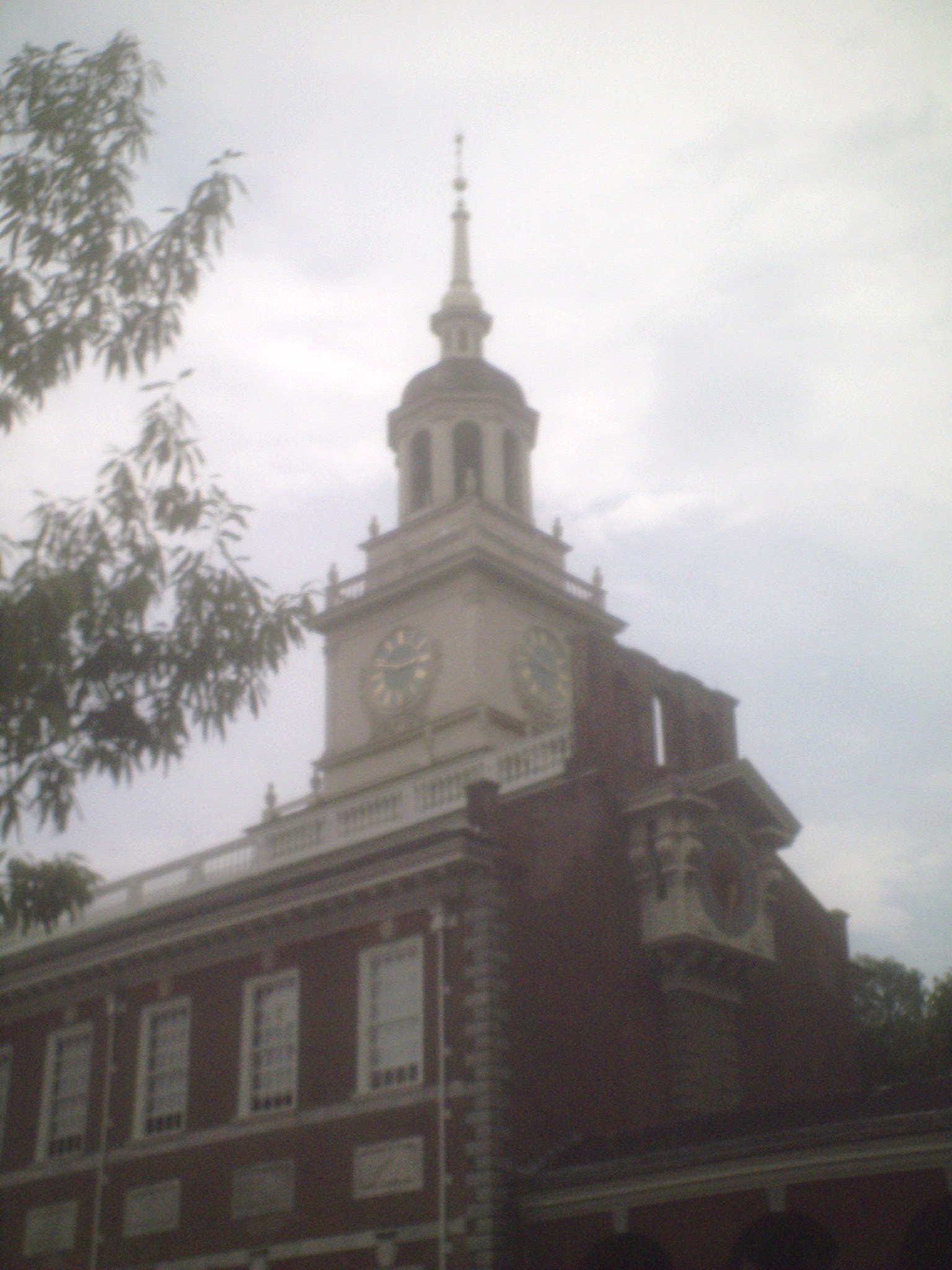
Independence Hall, Philadelphia
These fifty some men had faults to be sure. They were not saints. However they did share one gift that set them apart from others, both of their time and even now. These men possessed a certain political wisdom, an ability to understand what precisely is the relationship between government and society, how best to grant the most liberty and freedom while at the same time maintaining order and security. Their greatest gift was an awareness of the needs of their own time and what might be the needs of posterity. Their creation, the United States Constitution, is a government that has lasted for over 200 years precisely because it is a government of order and security that is flexible enough to allow for change and the new and unexpected needs of each generation.

As Alexander Pope wrote in Essays on Man:

“For forms of government, let fools contest,

That which is best administered is best.”

Posted in American History, Government | Tagged , , | Leave a comment

Ephraim Deal Sorrels, Arkansas and Oklahoma Woodsman and Farmer

Ephraim Deal Sorrels, an Arkansas and Oklahoma woodsman and farmer, was born Jan. 5, 1847 in Ashville, Buncombe Co., North Carolina, and died April 4, 1928, in Sparks, Lincoln Co., Oklahoma, aged 81. His father was Thomas M. Sorrels and mother Mary Drucella Lonon Sorrels, both born in 1827 in North Carolina. Ephraim’s father was a Confederate soldier during the Civil War who died in 1863 when Ephraim was sixteen years old.

The family had moved from North Carolina to Arkansas during the 1850s so that in 1860 they lived in Whiteville, in northern Arkansas, near the White River, and also near the town of Mountain Home.

Ephraim married Sarah Amelia Lane on March 22, 1867 when he was 20 years old. The bride was born in Black Swamps, Woodriff, Arkansas, on Aug. 4, 1852—she was 14 ½ years old when married (although the marriage certificate says 16.) She lived in Lawrence Arkansas, where they were married March 14, 1867. Her parents were James A. Lane and Malinda Coe, both born in 1830.

According to the 1870 census, Ephraim and Sarah lived in Independence, Arkansas, the township that included Whiteville, along with another man, perhaps a border or hand, named Charles Bostick, age 29.

According to the 1880 census, they lived in Mountain Home (which is the same as Big Flat; both were near Whiteville, so whether or not they had relocated is not clear). He was 33, she was 30 (which is slightly inaccurate; she was 5-6 years younger). Van, their oldest, was 5; Mary was age 2.  Ephraim farmed; Sarah kept house. All were born in Arkansas save Ephraim, born in North Carolina.

e. d. sorrells

In the 1900 census, Ephraim and Sarah had relocated to western Arkansas, living at Lees Creek, Washington Ark. This census indicates that there was a 4 ½ year difference in age between husband and wife. They have had 8 children, 7 were still living. Those at home were Thomas H., born Sep. 1882, Cora E, daughter, born Oct 1887, son Jessie E. born Sept. 1899. Thomas, like his father, was listed as a farmer on the census. They rented a house.

Ten years later, in the 1910 census, Ephraim and Sarah had relocated to North Seminole Township, Oklahoma. In a recollection told by a descendant, Mabell Sorrels Tucker, she said:

“In 1902, Ephraim Deal worked as a rail splitter for the Ft. Smith and Western Railroad. He cut railroad ties from Ft. Smith, Ark. to Central Oklahoma. The railroad was to build a “round house” at Sparks, but due to local opposition to the project, the “round house” was built at Shawnee instead. Ephraim left the railroad at Sparks, Ok. He heard of a “dugout” on a school lease about 1/2 mile East of Sparks that was available. They lived in the “dugout” until Ephraim built a two room log house where they lived for a number of years.”  Sparks was in North Seminole Township, Lincoln County.

Ephraim and Sarah had relocated to Oklahoma before statehood, as their youngest son, Jesse Albert (born Sept. 27, 1899), died in Sparks on Jan 11, 1907, when he was 7. He was buried in the White Dove Cemetery in Sparks.

In the 1910 census, Ephraim listed both of his parents having been born in North Carolina. Sarah simply said, vaguely, “United States” as the birthplace of her parents.  Ephraim’s occupations were farming and and fencing. He listed himself as self-employed. Both were literate. They owned their farm. The census indicates that Sarah was the mother of 8 children, four now living. Ephraim and Sarah’s ages are listed as 63 and 56, which was more accurate.

By the time of the 1920 census she listed her parents’ birthplace as unknown; he listed his father as Georgia and mother as North Carolina. He was 73, she was 69. He told the census worker he was self-employed, “working on [his] own account.” They continued to live in North Seminole Township.

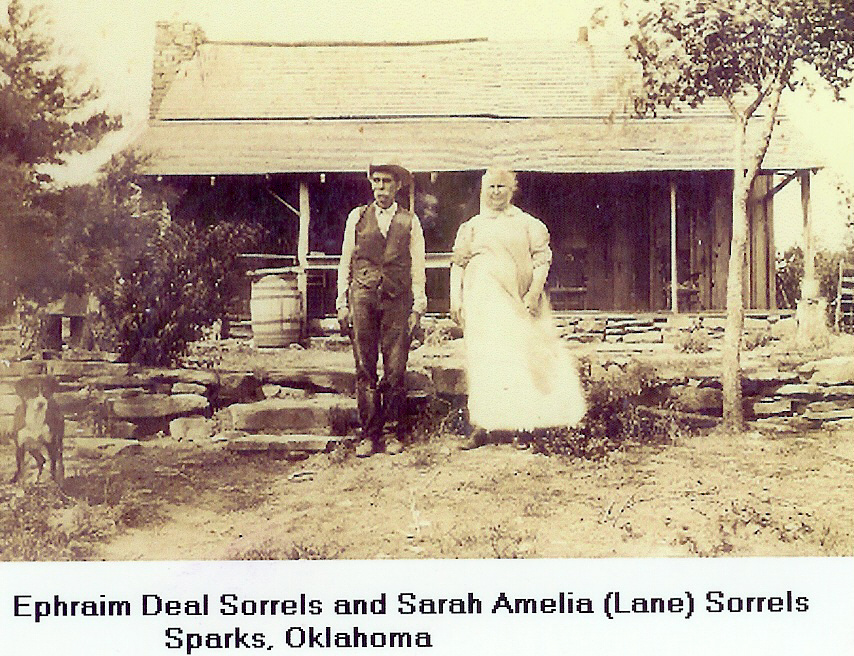
ephraim and sarah sorrells

Ephraim Sorrels died on April 4, 1928, at age 81. The cause of death on the death certificate was “asthma and dropsy”.  Sarah died two months later, June 19, 1928.

For a complete history of Deal Sorrels and his extended family, purchase my biographical portrait published on Amazon: https://www.amazon.com/Van-Sorrels-Woodcutting-Russell-Lawson/dp/B0G524SNSW/ref=sr_1_2?crid=36PPTM7BCTC2Z&dib=eyJ2IjoiMSJ9.cqGw_xgnYBNRNQQZ3VVlDTDuoYsfRKxj_sIIwKXnNqz3Sc9Q0z_tRe-gXhSqrYuSiTeWVpdkbeR0UsauvA-pdRwLV29G0a8HbEi3x-NPsvfHRuI9MFZ7xnvafLMgxAVJDSsu9Aup3YrsJkFIqa3HntEFmdb1m36V2e5Jki2B2VORJ0fxrcOagNlw1y07G0_Z83CLGFv4t6Dyfi3RuXu6coGUAjCvcSesMxcQDkon0yc.r7TvUj2h-Yky7rx02rNzQHuEsw1e1NIPpuyyyQjelbo&dib_tag=se&keywords=Russell+Lawson&qid=1766343535&s=books&sprefix=russell+lawson%2Cstripbooks%2C211&sr=1-2

Posted in American History, Biography | Tagged , , , , , | Leave a comment

What are humans, that You are mindful of them?

Reflections on the 8th Psalm:


How admirable is His Name . . .

God’s magnificence is greater than that which can be conceived. His glory is unsurpassable by even those with the most fertile imaginations. The multiplicity created by His hands boggles the mind, and our ability to speak. Only His word can express the infinite works wrought by His speaking and thinking. He grants to all creation the ability to praise His name. Even infants, as well as other parts of His creation, praise His name. The rocks cry out, the stars shine forth, animals perk their ears listening to the unfathomable message of Being. All creation is a testament to His love.

What are humans, that You are mindful of them? . . .

What is anything, that You are mindful of them? Why does God create the objects of His love? Does He create for His own sake? Does He create for others, for their sake? Does He create me for my sake? Why is He mindful of me, that He gives me life? Why does He attend to my every need?

With glory and honor you crowned him . . .

Human are next to the angels, almost godlike, says the Psalmist—at least compared to the humbleness of the rest of Creation. Hence, as Genesis states, all of Creation is under the dominion of humankind. On this fifth day of Creation, God made humans “in His own image, in the image of God created he him; male and female created he them.” God also made “every living creature that moves” in the air, water, and land, and He declared it “good. All creatures are commanded to “be fruitful, and multiply.” God commands humans to have “dominion” over the Earth, to “replenish” and “subdue” it. All animals, cattle and sheep, birds and fish—all are subject to human rule.

How admirable is Your name in all the Earth.

This apparent blessing of power comes with an overwhelming burden. Humans must be worthy of such a charge, of such power. The author of Genesis, speaking for God the Creator, makes a moral, qualitative declaration and judgment that the Creation is good. Humans, as part of the Creation, are therefore good. The Creation is animate and inanimate, is alive as well as dead, but now, in its existential present, it is good. Goodness is something that occurs through time, just as humans occur, and exercise dominion, throughout time. The goodness of creation implies the goodness of life, that life is good, and is not something to destroy, that humans are not, by having dominion, given the right to kill, dismember, torture, pollute, waste, and destroy in all manner in which humans, particularly in the past century, have done.

God’s name, God’s will, God’s glory as Creator, must be respected, lauded, by the Creation.

Posted in Christianity, Reflections on the Psalms | Tagged , , , | Leave a comment

Lucenda Beach Largent, Illinois Farm Woman of the 19th Century

Lucenda Beach Largent lived from July 12, 1808 to Nov. 26, 1875.

Lucenda A. Beach married Archibald Largent (Thomas Largent’s father, George Washington Largent’s grandfather, Claude Christopher Largent’s great-grandfather) in North Carolina in April, 1825, when she was 17. Before Archibalds’s death in 1838, she bore five children: Thomas W., Idella Eveline, Mahala Caroline, Archibald, and John. Lucenda was born in North Carolina, and died in 1875 in Illinois, living in Bond County. The Bond County federal census for 1830 lists Archibald and Lucenda with one child, the firstborn Thomas. As Thomas was born in Tennessee in 1828, we can assume that Lucenda and Archibald had lived in Tennessee until recently, moving to Bond County, Illinois. Nothing is known of her parents.

In the 1850 federal census for Fayette County, Illinois, Lucenda (spelled Lucinda) was a 41-year-old widow owning real estate valued at $600. She had living in her family the following: Eveline Merryman, age 20, Caroline, age 17, Archibald, age 15, John, age 13, and James, age 1. Archibald is listed as a farmer. Caroline, Archibald and John attend school. Several interesting items about this census: First, Eveline is called Merryman, and there were two families living next to the Largents with the last name Merryman. Eveline was a widow, her first husband was Cayson Harris Merriman, who was born between 1825 and 1828 and died in his twenties in 1850. James, their son, was 1 year old, and living with Lucenda. Thomas, first born son of Archibald and Lucenda, and his wife Narcissa and child Nancy lived nearby on their own farm worth $150.

In the 1860 federal census, Lucenda lived in Vandalia, Fayette County Illinois, with Eveline and her new husband, James Thomas Davis. Eveline and Thomas were married Dec 18, 1852. Eveline was to die soon after, in 1861. Lucenda’s son Thomas would lived until 1887. Lucenda’s other daughter, Mahala Caroline, married William Stokes on Dec 12, 1855.

Lucenda was a significant landowner. The year that her husband died, 1838, the land office of Fayette. Illinois, issued her “the South half of Lott number two of the South west quarter of Section eighteen in Township Six North of the base line of Range one West of the third principal Meridian, in the District of Lands Subject to sale at Vandalia, Illinois, containing forty acres.”

Posted in American History, Biography | Tagged , , , , | Leave a comment